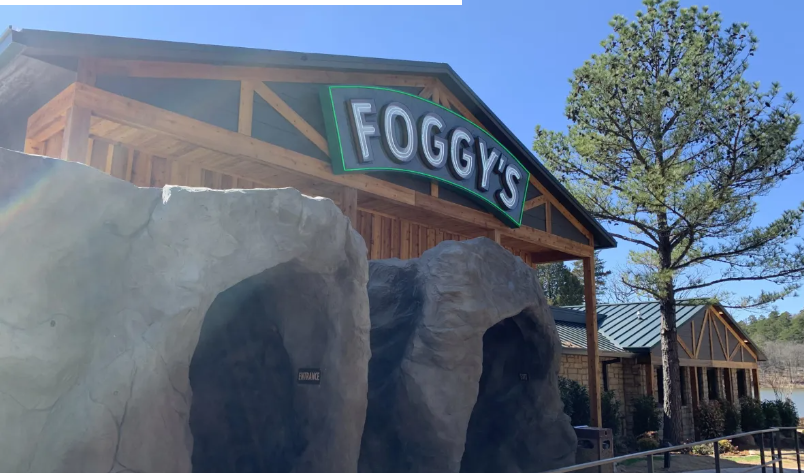

The entrance to the restaurant at Robbers Cave State Park near Wilburton was built to look like the mouth of a cave. Fake stone, mood lighting, a rugged Western aesthetic meant to evoke the outlaws — Jesse James, Belle Starr, the Daltons — who once actually hid in the sandstone bluffs just up the hill. It was a nice touch. A theme-park version of Eastern Oklahoma's genuine wildness, dressed up for tourists.
What state prosecutors would later allege happened inside that operation, however, was something the old outlaws might have recognized: a scheme to rob Oklahoma's taxpayers blind, with the full cooperation — witting or not — of the very state officials who were supposed to be minding the money.
The Swadley's Foggy Bottom Kitchen scandal has been grinding through Oklahoma's courts for four years now. Three men have been indicted on felony fraud charges. The state and the restaurant group are suing each other for millions of dollars. A trial that was scheduled for November 2025 was pushed back by a judge — over the state's "strenuous objection" — and as of this writing, has yet to be rescheduled.
But for the people of Latimer County, Sequoyah County, and the other communities whose state parks were at the center of this mess, the scandal was never an abstraction. It was the lunch counter that went dark. It was the seasonal restaurant jobs that vanished. It was the summer of 2022 when families drove hours to Robbers Cave and found the dining room shuttered. And it is the unresolved question — four years on — of whether the state officials who built the conditions for this scandal will ever be held accountable for a single thing.
The Deal Nobody Else Wanted
To understand how this happened, you have to go back to early 2020, just before the pandemic arrived to complicate everything.
Oklahoma's state park restaurants were, by most accounts, a mess. Decades of deferred maintenance had left the facilities behind. Governor Kevin Stitt's administration was eager to modernize them, and in January 2020 the Oklahoma Tourism and Recreation Department opened a bidding process to bring in a private contractor to renovate and run restaurants at five state park locations.
By the February 10 deadline, exactly one company had applied: Swadley's Bar-B-Q, an Oklahoma City-based barbecue chain with seven locations around the metro area. That lone bid, and what the Tourism Department did with it, would become the first domino in a cascade of problems.
By March 2020, a contract was signed. It would eventually grow to cover six park restaurants — Robbers Cave, Sequoyah, Beavers Bend, Lake Murray, Quartz Mountain, and Roman Nose — operating under the branding "Swadley's Foggy Bottom Kitchen." Between April 2020 and February 2022, the state paid the company roughly $17 million to renovate and manage those sites.
The contract's terms were extraordinary. The state agreed to pay Swadley's management fees, cover the company's operational losses up to $1 million per year, and limit royalty payments to the state until the restaurants reached a certain level of profitability. Internal emails obtained by The Frontier, the Tulsa-based nonprofit news outlet whose reporting broke this story open, showed that then-deputy tourism director Gino DeMarco worked to ensure Swadley's would pay essentially no rent at the state parks and that the state would subsidize significant portions of the company's employee costs.
Critically, the contract was put together in a way that bypassed Oklahoma's Competitive Bidding Act of 1974 — the law designed specifically to prevent this kind of sweetheart arrangement. The Tourism Department's leadership identified what it believed to be three statutory exemptions and proceeded without routing the deal through the Office of Management and Enterprise Services, which serves as central purchasing for the state.
Steven Harpe, who was then the director of OMES, testified before a legislative committee in June 2022 that his office knew nothing about the original contract until it was amended a year later. "They felt they had the ability and authority to act on their own, and therefore they were not using Central Purchasing like most other agencies would," he said.
Nobody in state government has ever been charged with a crime for that decision.
The Smokers That Weren't Worth What They Said They Were
In early 2021, Oklahoma's Legislative Office of Fiscal Transparency began raising flags. By early 2022, those flags had become something harder to ignore.
The Frontier published findings that Swadley's had been billing the Tourism Department for equipment and renovation costs at dramatically inflated prices — sometimes with a 30 percent markup on invoices. In one of the most illustrative examples, Swadley's billed the state $51,346 each for two used barbecue smokers. The same model, bought new directly from the manufacturer, cost $22,700.
State investigators would later allege this was not sloppiness or bad math. According to the criminal indictment handed down in February 2024, Swadley's Foggy Bottom Kitchen maintained two entirely separate sets of books. One set contained the actual invoices the company received and paid. The other — the set submitted to the Tourism Department — contained fraudulent charges billed to the state. The indictment further alleged that Swadley's directed a restaurant equipment supplier to create phony invoices with inflated amounts, then "rebate" the difference back to the company, which would submit the inflated bill to the state for reimbursement.
The Tourism Department billed for a vintage 1956 camper — $12,433 — to be displayed as décor at Sequoyah State Park. There were unapproved fees layered on top of renovation costs. There were charges for equipment never delivered.
In fall 2021, the Tourism Department initiated an internal investigation after reports of financial irregularities surfaced. Financial payments for construction costs were halted in September; management fees were suspended in December. By April 2022, the contract was canceled, the restaurants were closed, and Governor Stitt accepted the resignation of Tourism Director Jerry Winchester.
For the park communities — particularly in rural Eastern Oklahoma — the closure was immediate and tangible. Robbers Cave draws hundreds of thousands of visitors annually. Sequoyah State Park, on Fort Gibson Lake in Cherokee and Wagoner Counties, is one of the busiest in the state. When the restaurant doors closed heading into the summer tourism season, local workers lost jobs and visitors lost services. A new operator, The Lookout Kitchen, eventually took over operations at Robbers Cave — but the gap lasted the better part of a summer.
The Indictments — and the Men Who Weren't Charged
In February 2024, after more than a year of grand jury proceedings, Oklahoma Attorney General Gentner Drummond announced that three men had been indicted on felony charges.
Ronald Brent Swadley, the company's founder, was charged with one count of conspiracy to defraud the state and five counts of presenting false or fraudulent claims against the state. So were Curtis Ray Breuklander, a former executive vice president, and Timothy Raymond Hooper, the company's chief operating officer. The conspiracy charge carries a penalty of up to 10 years in prison.
"The indictments issued today contain serious charges and will be prosecuted by my office on behalf of the people of Oklahoma," Drummond said at the time.
Swadley denied all of it. His attorney, Mack Martin, said his client "absolutely" maintains his innocence and that the company stepped up when no one else in the state would. The Swadley family released a statement calling it "a David vs. Goliath battle" and questioning whether state officials had manipulated the process for political reasons. Swadley's attorneys have also accused Drummond — who is running for governor — of using the prosecution to bolster his own political profile, citing statements the AG made publicly predicting Swadley would go to prison for "about eight years."
A judge eventually pushed back the November 2025 trial date over the state's strenuous objection, and a new date has not been set as of this publication. The case remains unresolved.
But there is a larger question that the criminal charges against these three men do not address, and that virtually no one in Oklahoma's political class has answered: What about the people on the state's side of this deal?
The Unanswered Questions
Jerry Winchester, the Tourism Department director who oversaw the contract, resigned in April 2022. He testified before the grand jury, but that testimony is sealed. He has faced no criminal charges.
Gino DeMarco, the deputy director whose emails suggest he was instrumental in shaping the contract's extraordinary terms — including efforts to ensure Swadley's would pay no rent and that the state would cover employee costs — also testified before the grand jury. He, too, has not been charged with anything.
The question of how the competitive bidding law was bypassed has never received a definitive public answer from the attorney general's office, from the governor's office, or from anyone else with authority to compel one.
As one sharp analysis of the indictments noted, "Swadley, Pool and Breuklander are accused of conspiring to bilk the state out of money, but the only way Swadley was able to spend freely was because of the contract Tourism gave him." The billing fraud — the double books, the inflated smoker invoices — was possible only because the contract itself was structured to give Swadley's enormous latitude with state funds, with minimal oversight, outside the normal competitive bidding process.
Both Winchester and DeMarco were appointees of Governor Stitt. The administration has not offered a substantive public accounting of how its leadership at the Tourism Department created the conditions that made this scheme possible.
A Pattern Larger Than One Barbecue Chain
The Swadley's case does not exist in isolation. Around the same time the Tourism Department scandal was unfolding, another controversy was developing at the Oklahoma Department of Corrections — one involving a person who would become central to the Swadley's investigation itself.
Steven Harpe, the OMES director who testified he had been kept in the dark about the Swadley's contract, was later appointed as the director of the Department of Corrections. In April 2025, in his capacity as DOC director, Harpe approved a one-year, $1.017 million contract with LEO Technologies for artificial intelligence call-monitoring software. Less than five months after approving that contract, he resigned from DOC to accept the position of chief product officer at LEO Technologies — the very company he had just handed a million-dollar state contract.
Oklahoma law prohibits a state officer who exercises decision-making authority in awarding a contract from becoming an employee of that business within one year of the contract award. Harpe's move appeared to fall squarely within the statute's prohibition. As of early 2026, neither Harpe nor LEO Technologies had faced legal consequences, though the contract with the company remained in effect through 2027. Lawmakers moved to tighten the law in response, but the specific case had not produced charges.
It is worth sitting with that for a moment. One man who was kept in the dark about a corrupt contract at the Tourism Department later approved a contract at the Department of Corrections and then went to work for the company he'd just paid. In the same state. Within a few years of each other. With no criminal accountability in either case.
Oklahoma has a long history with public corruption — the 1980s county commissioner scandal, in which some 230 officials were convicted in a massive kickback scheme, remains one of the largest public corruption cases in American history. The pattern that historians and reformers noted then still holds: structural weaknesses in oversight, institutional cultures that normalize certain kinds of self-dealing, and a tendency for federal investigators or outside journalism to do the work that state institutions fail to do.
What Eastern Oklahoma Lost — and What It's Owed
The communities around these state parks are not wealthy. Latimer County, where Robbers Cave is located, has a poverty rate that runs well above the state average. Wagoner and Cherokee Counties, home to Sequoyah State Park on Fort Gibson Lake, depend heavily on the tourism economy. The parks are not just recreational amenities — they are economic anchors, generators of the seasonal jobs and visitor spending that keep small towns viable.
When the Swadley's restaurants closed in the spring of 2022, those communities paid a price that was never part of any lawsuit or legislative hearing. Seasonal workers lost paychecks. Visitors who drove hours found locked doors. The state's public lands — lands that belong to the people of Oklahoma, managed in the public trust — were left worse off than they found them.
The good news, such as it is: a new operator, The Lookout Kitchen, has since reopened the restaurant at Robbers Cave and has received positive reviews. The park is functioning again. But the renovation work that Swadley's allegedly overbilled the state for — renovations the state paid $17 million to complete — remains a contested mess of litigation that may not resolve for years.
Meanwhile, none of the state officials who structured the deal, bypassed competitive bidding requirements, and allowed state funds to flow freely to a single company with minimal oversight have faced any professional or legal consequence more serious than a resignation.
The Trial That Has Not Happened
The criminal case against Brent Swadley, Curtis Breuklander, and Timothy Hooper is the most direct accountability mechanism that exists in this scandal. It is also the most delayed.
The November 2025 trial date was pushed back after the defense moved to have the attorney general's office disqualified from prosecuting the case, arguing that Drummond had prejudiced Swadley's right to a fair trial through public statements declaring him guilty before a jury had heard a word of evidence. Drummond's office called the move a stall tactic. The judge pushed the trial back anyway.
Swadley's team also argued that Drummond's comments were not merely prosecutorial overreach — they were campaign material. Drummond, who is running to be Oklahoma's next governor, has made the case a centerpiece of his public messaging on corruption. At a banker's association event, he reportedly told the audience that people who are wealthy and well-connected in Oklahoma can break the law, and that Brent Swadley is going to prison for eight years. Shortly after those remarks, a bank to which Swadley had applied for a loan terminated his application.
Whether Drummond was right about Swadley, wrong, or simply using the prosecution for political purposes — or some combination of all three — is ultimately for a jury to decide. But the pretrial maneuvering has meant that Eastern Oklahoma communities have waited four years for any resolution, and are still waiting.
Every individual charged in this case is presumed innocent unless and until convicted in a court of law. That is not a formality — it is a constitutional bedrock. But the presumption of innocence for the defendants does not settle the broader questions of institutional failure that this case has raised and that no criminal trial will ever fully resolve.
What Accountability Actually Looks Like
A criminal conviction, if it comes, would hold three private citizens responsible for an alleged scheme to defraud the state. That matters. But it would leave unaddressed how the contract was structured, why competitive bidding was bypassed, what role specific state officials played in creating the conditions for the alleged fraud, and whether the structural problems that made all of this possible have been fixed.
Reform-minded legislators have taken some steps. A 2022 audit laid out the Tourism Department's failures. Legislative committees dug into the finances. The attorney general's office took over the prosecution and pushed for a trial.
But the hard questions — about the people inside the Stitt administration who signed off on a no-bid deal with a single barbecue company, who structured a contract that made losing money lucrative, who bypassed the central purchasing process that existed precisely to prevent this kind of thing — remain largely unanswered in any official forum.
For the people of Eastern Oklahoma, those questions are not abstractions. Their parks, their jobs, and their tax dollars were in the middle of this. The cave is real. The outlaws, this time around, wore business casual.
This article draws on court records, legislative testimony, reporting by The Frontier, Oklahoma Voice, and NonDoc, public statements from the Oklahoma Attorney General's office, and state audit documents. EastOklahoma.com has sought comment from Swadley's legal representatives, the Oklahoma Tourism and Recreation Department, and the offices of former Governor Kevin Stitt and former Tourism Director Jerry Winchester. All persons named in criminal proceedings are presumed innocent unless and until convicted.
EDITOR'S NOTE: The trial of Ronald Brent Swadley, Curtis Ray Breuklander, and Timothy Raymond Hooper was scheduled for November 3, 2025, but was pushed back by a judge and had not been rescheduled as of our reporting deadline. EastOklahoma.com will continue to cover this case as it develops. If you have information relevant to this story, contact us at dustinreedterry@gmail.com.