
An East Oklahoma Investigation into the GEER Fund Scandal
In the spring of 2020, as Oklahoma schools shuttered and families struggled through the chaos of the COVID-19 pandemic, $39.9 million in federal emergency education funds arrived in Oklahoma with a clear mission: help students whose education had been disrupted by the crisis.
Two years later, investigators would discover that money meant for struggling students had instead purchased at least 548 televisions, Xbox gaming systems, vintage Pac-Man arcade games, car amplifiers, home theater equipment, and Christmas trees. Nearly $1.7 million in federal education relief funds went to items with no educational value whatsoever.
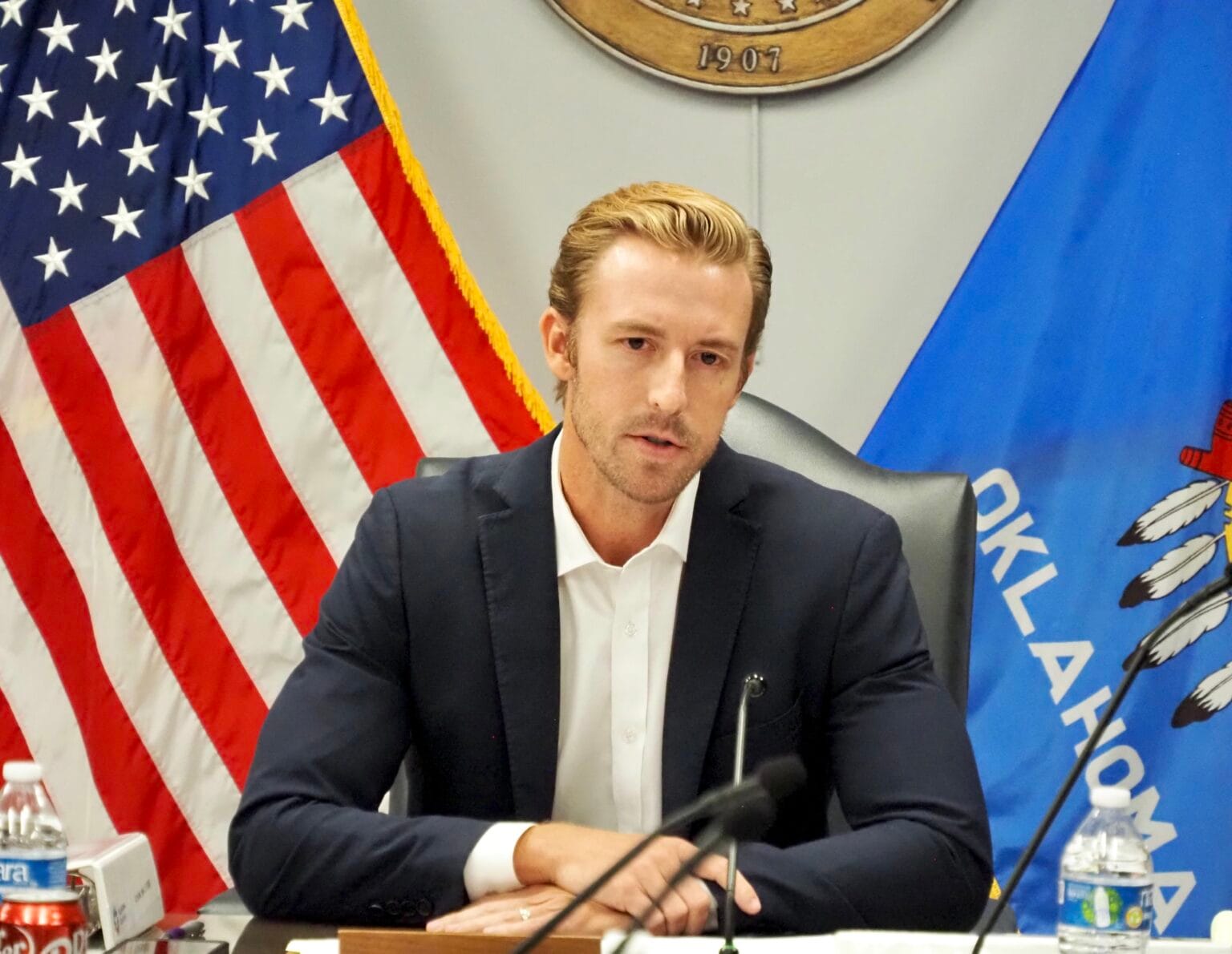
At the center of this scandal stand two men: Oklahoma Governor Kevin Stitt and Ryan Walters, a former McAlester High School history teacher who would parlay his role in the scheme into the state's top education job. A multi-county grand jury investigation released in October 2024 painted a damning picture of what jurors called "irresponsible, disappointing, and indefensible" mismanagement driven by political ideology and a disregard for basic oversight.
This is the story of how $40 million in federal COVID relief became a case study in political corruption — and how the people responsible not only escaped criminal charges but continued to rise in Oklahoma politics.
The McAlester Connection
Ryan Walters grew up in McAlester, graduated from McAlester High School, and returned in 2012 to teach AP history at his alma mater. By all accounts, he was good at it. Students remember him as engaging and fair-minded. In 2016, the Oklahoma State Department of Education named him a Teacher of the Year finalist.
But Walters had political ambitions that stretched beyond the classroom. He came from a deeply conservative religious background — his father is a minister at McAlester's North Town Church of Christ, and Walters attended Harding University, a Christian college in Arkansas where students take mandatory Bible classes and attend chapel daily. In 2018, he published three articles in The Federalist, a conservative magazine, signaling his entry into political commentary.
That same year, Walters met Kevin Stitt at a tennis tournament. The two became friends. Stitt, a Tulsa businessman running for governor on a pro-business, school choice platform, saw potential in the young teacher. When Governor Mary Fallin appointed Walters to the Oklahoma Community Service Commission in 2018, and Stitt appointed him to the Commission for Educational Quality and Accountability in 2019, Walters' trajectory was set.
In 2019, Walters resigned from McAlester Public Schools and became executive director of Oklahoma Achieves, a nonprofit created by the State Chamber of Oklahoma. By March 2020, as the pandemic hit, Oklahoma Achieves transformed into an independent nonprofit called Every Kid Counts Oklahoma. Walters was its CEO — and its only employee.
That would soon prove significant.
The Political Bypass
When Congress passed the CARES Act in March 2020, it included the Governor's Emergency Educational Relief (GEER) Fund: $3 billion in federal money distributed to governors to address educational disruptions caused by COVID-19. Oklahoma received $39.9 million.
Under normal circumstances, this money would have gone through the Oklahoma State Department of Education, which had the infrastructure, expertise, and oversight mechanisms to distribute federal grants properly. But Stitt had a problem with that: the State Superintendent at the time was Joy Hofmeister, who disagreed with him on school closures, mask mandates, and school choice.
The grand jury investigation found that Stitt's decision to bypass the State Department of Education was driven entirely by political ideology. "Witnesses privy to the decision-making process all agreed the decision to bypass SDE was driven by another perceived policy difference over so-called 'school choice,'" the report stated. "Without consulting the agency, the governor's office assumed SDE would be unwilling to support such initiatives instead of support public schools."
The grand jury noted they "received evidence the governor's assumption was unfounded" — meaning Stitt cut out the state education department based on an incorrect political assumption, not an actual operational problem.
Instead of using the state's professional education bureaucracy, Stitt turned to his friend Ryan Walters and his one-person nonprofit.
The Suspicious Drawdown
On April 30, 2020, Stitt signed the application for GEER funds and designated Ryan Walters as the State's Program Representative. Then came the first red flag.
On July 2, 2020, just two months after applying, Stitt's office withdrew all $39.9 million from the federal fund — a complete, immediate drawdown of every penny, despite having no immediate cash need for the money and no clear plan for spending it.
This 100% immediate withdrawal was so unusual that it triggered targeted monitoring by the U.S. Department of Education. Federal auditors knew something was wrong.
"The drawdown is also emblematic of the pervasive problem we found throughout the implementation," the grand jury wrote, "namely that decision makers were ignorant of their own ignorance."
The Unvetted Nonprofits
During the summer of 2020, Governor Stitt began strategizing with two private citizens who led nonprofits aimed at advancing school choice policies: Ryan Walters of Every Kid Counts Oklahoma (EKCO) and a director from the American Federation for Children's Oklahoma chapter.
The grand jury found no evidence that Stitt made any effort to vet these nonprofits for their ability to handle tens of millions in federal funds. That's because there was nothing to vet.
Walters claimed that EKCO had the "staffing and expertise" to administer the grant. In reality, Walters was EKCO's only employee, and he had zero federal grant experience. There was no contract. There was no documentation holding these private citizens accountable to the state. They were Stitt's political allies running a school choice nonprofit, and that was apparently qualification enough.
By late June or early July 2020, both entities were engaged in implementing what would become known as the Bridge the Gap and Stay in School initiatives — distributing millions in federal funds through a system with virtually no oversight.
The No-Bid ClassWallet Deal
To actually distribute the money, Walters needed a digital platform. He selected ClassWallet, a Florida-based company that provides digital payment systems. Like the Swadley's BBQ scandal that would later rock Stitt's administration, this was a no-bid contract — no competitive bidding process, no comparison of vendors, no due diligence.
ClassWallet had a problem: it couldn't process applications from families to determine income eligibility, which was required under federal law. The company suggested contracting with an "Information Management Company" to handle that function.
Here's where it gets deliberately murky. Walters asked if ClassWallet could subcontract with the Information Management Company instead of the state contracting directly, "to avoid the governor seeming to pay two groups for one process." In other words, Walters wanted to hide the fact that multiple vendors were being paid for a process that should have been handled by the state education department.
The ClassWallet contract, crucially, never specified whether the company was a "sub-recipient" of the federal grant — which would make it legally responsible for adhering to federal requirements — or just a contractor. Because the Information Management Company was subcontracted through ClassWallet, it had no definitive obligation to comply with federal requirements at all.
This contractual ambiguity was not an oversight. It was deliberate.
"Blanket Approval"
In the fall of 2020, ClassWallet asked Walters what items families could purchase with the Bridge the Gap grants. Walters, running a federal education relief program from a one-person nonprofit with no grant experience, gave ClassWallet "blanket approval" to allow families to purchase items from approved vendors like Office Depot and Staples.
No restrictions. No guidelines. No oversight.
What happened next was predictable. State auditors would eventually determine that approximately $1.7 million in Bridge the Gap funds — roughly 21% of the $8 million allocated to the program — went to over 39,000 purchases of items with no educational value.
Oklahoma Watch and The Frontier's investigation, which broke the story in May 2022, found families purchased:
- At least 548 televisions totaling around $191,000
- Xbox gaming systems and a vintage Pac-Man arcade game
- Doorbell cameras and smartwatches
- Refrigerators, dishwashers, and home theater equipment
- Car amplifiers and car stereo systems
- Brad nailers and air compressors
- Scooters
- Christmas trees
Meanwhile, another $1.8 million in Stay in School funds went to private schools where students already attended tuition-free or received steep discounts — meaning the money wasn't helping low-income families access private education, because they already had access.
The Coverup and the Lies
When The Frontier and Oklahoma Watch broke the story in May 2022, the response from Stitt and Walters was to blame ClassWallet. In 2022, then-Attorney General John O'Connor filed a lawsuit claiming ClassWallet had failed to prevent mismanagement.
But when Gentner Drummond became Attorney General in January 2023, he reviewed the case and dismissed it, calling the lawsuit "frivolous" and "a smokescreen for negligent state actors." Drummond was clear: ClassWallet wasn't responsible — Stitt and Walters were.
Drummond then called for a multi-county grand jury investigation. That's when Walters' story started to unravel.
During the investigation, Walters — who by then had been elected State Superintendent of Public Instruction — claimed he had no specific knowledge or involvement in Bridge the Gap beyond "public promotion."
The grand jury didn't buy it. In their October 2024 report, they wrote: "Walters made public statements boasting of his collaboration with ClassWallet and served as the primary administrator of Bridge the Gap. Any such claim by Walters [of limited involvement] is fully belied by all other evidence and testimony received by this Grand Jury."
In other words, the grand jury concluded that Ryan Walters lied to investigators.
Preferential Treatment and Political Favoritism
The grand jury investigation also uncovered evidence of preferential treatment in how grants were distributed. Families with political connections appeared to get faster approvals. The investigation found that grant access "may have been based on registered political party and voting district rather than established qualifications."
One particularly troubling detail: the director of the American Federation for Children's Oklahoma chapter had a spreadsheet containing personally identifiable information of grant applicants in her possession — information that should have been protected under federal privacy laws. There was no security protocol, no data protection, no accountability.
"The State bestowed these individuals and organizations with control over millions of dollars in federal funding without any vetting process or formal agreement assuring their accountability to the State," the grand jury concluded.
The Federal Audit
In August 2023, the U.S. Department of Education's Office of Inspector General released its own audit. Federal investigators found that Oklahoma had questionable expenditures and processes involving $31 million in GEER funds — over three-quarters of the total allocation.
The federal audit noted that Oklahoma "effectively disregarded all internal control options" that were available. The state failed to:
- Require proper documentation of eligibility
- Establish expenditure controls
- Monitor purchases for compliance
- Protect personally identifiable information
- Maintain required federal records
The grand jury noted that Oklahoma's mismanagement was so severe that it "may jeopardize Oklahoma's eligibility for future federal funds."
No Criminal Charges
Despite the mountain of evidence showing mismanagement, political favoritism, contractual manipulation, and outright lies to investigators, the grand jury concluded there was "no criminal action or willful corruption."
How is that possible?
The answer appears to be that proving "willful corruption" — criminal intent to defraud — requires a higher standard of evidence than proving incompetence, negligence, and ideological decision-making. Stitt and Walters were "ignorant of their own ignorance," as the grand jury put it, not necessarily criminal masterminds.
But make no mistake: the grand jury's report is scathing. They characterized the handling of grant money and lack of internal controls as "irresponsible, disappointing, and indefensible." They found that Stitt let political ideology override proper fund management. They found that Walters lied about his involvement. They found evidence of preferential treatment based on political party.
They just couldn't prove it rose to the level of criminal corruption under Oklahoma law.
The Aftermath
So what happened to the people responsible?
Ryan Walters served as State Superintendent of Public Instruction from January 2023 to September 2025, using the position to wage culture wars against teachers, librarians, and public education. He attempted to mandate Bible instruction in public schools, appointed far-right activist Chaya Raichik to a state library board, and successfully pushed to remove Tulsa Public Schools Superintendent Deborah Gist. In January 2025, the Oklahoma Ethics Commission investigated him for using his official title to support Donald Trump's presidential campaign; Walters paid a $5,000 settlement. In March 2025, he settled another ethics complaint regarding campaign finance violations from his 2022 election, paying $18,300. He resigned in September 2025 to become CEO of the Teacher Freedom Alliance, an anti-union organization.
Kevin Stitt completed his term as governor in January 2027, though his administration was plagued by scandals. Beyond the GEER fund debacle, his Swadley's BBQ restaurant contracts in state parks involved similar no-bid deals and allegations of waste. Throughout the GEER investigation, Stitt maintained that his administration acted appropriately and blamed ClassWallet for the problems.
ClassWallet, the supposed villain in Stitt's narrative, was vindicated when Attorney General Drummond dismissed the lawsuit against them and the grand jury confirmed the company was not responsible for the state's mismanagement.
The Bigger Picture
The GEER fund scandal represents more than simple mismanagement. It's a case study in how political ideology can corrupt the distribution of public funds when proper oversight is deliberately dismantled.
Governor Stitt received $39.9 million in federal money designated to help Oklahoma students struggling through a pandemic. Rather than use the state's professional education infrastructure, he bypassed it for political reasons and handed control to a political ally with no grant experience running a one-person nonprofit.
That ally, Ryan Walters — a former McAlester teacher who understood the importance of education but apparently not the importance of fiscal accountability — gave "blanket approval" for families to spend federal education funds on televisions and Xbox systems.
When journalists exposed the scheme, Stitt and Walters tried to blame the vendor. When a Republican Attorney General called them out, they still faced no criminal consequences.
And perhaps most troublingly, both men faced no political consequences either. Walters was elected State Superintendent despite the scandal. Stitt served out his term. The only people who suffered were Oklahoma students — who lost out on $1.7 million in genuine educational support — and Oklahoma taxpayers, whose reputation for stewardship of federal funds may be damaged for years to come.
Questions That Remain
The grand jury investigation, while thorough, left several questions unanswered:
Why was there no competitive bidding for the ClassWallet contract? Oklahoma law requires competitive bidding for large state contracts. How did this contract avoid that requirement?
What was the relationship between Walters and ClassWallet before the contract? The no-bid contract and rapid implementation suggest prior coordination. Had Walters identified ClassWallet before GEER funds were even available?
Were any of the politically connected families who received preferential treatment also Stitt or Walters donors or supporters? The grand jury found evidence of preferential treatment but didn't identify the specific families or their political connections.
What happened to the remaining $20 million in GEER funds not allocated to Bridge the Gap or Stay in School? The federal audit identified $31 million in questionable processes out of $39.9 million total, but only about $20 million has been accounted for in public reporting.
Will Oklahoma face consequences for potentially jeopardizing future federal funding eligibility? The grand jury noted this risk, but it's unclear whether the U.S. Department of Education has taken or will take any action.
Lessons for East Oklahoma
For readers in Eastern Oklahoma, this scandal hits particularly close to home. Ryan Walters is one of ours — a McAlester product who was trusted with power and, according to a grand jury investigation, misused it.
The GEER fund scandal shows what happens when political loyalty trumps competence, when ideology overrides oversight, and when personal ambition takes precedence over public service. It shows how no-bid contracts, deliberately ambiguous agreements, and the bypassing of professional state agencies can enable waste and abuse.
Most importantly, it shows that in Oklahoma, you can mismanage $40 million in federal education funds meant for struggling students, lie to investigators about your involvement, and still rise to the state's highest education position.
That's not just a scandal. That's a system failure.
And until Oklahoma voters demand accountability — real accountability, not just grand jury reports with no criminal charges — it will happen again.
This investigation was compiled from public records including the October 2024 Multi-County Grand Jury report, the U.S. Department of Education Office of Inspector General audit, reporting by Oklahoma Watch and The Frontier, and statements from the Oklahoma Attorney General's office. EastOklahoma.com requested comment from representatives for both Governor Stitt and former State Superintendent Walters but received no response by publication time.
READ MORE:
- Multi-County Grand Jury Report on GEER Funds (October 2024)
- U.S. Department of Education OIG Audit (August 2023)
- Oklahoma Watch & The Frontier Investigation (May 2022)
SHARE THIS STORY: This investigation is free to republish under Creative Commons license. Please credit EastOklahoma.com and link back to this article.