

An eight-year scheme of fraud, luxury gambling, and broken trust in Indian Country
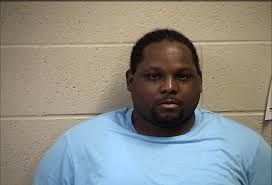
Michael Anthony Houser appeared to be living the American dream. The 36-year-old accountant from Broken Arrow, Oklahoma, had climbed the corporate ladder at one of the most successful tribal gaming enterprises in the nation. He drove luxury vehicles—a 2024 Lexus, a 2022 Cadillac. He owned a high-end boat. His children attended private schools. And when he traveled to Las Vegas, casinos treated him like royalty.
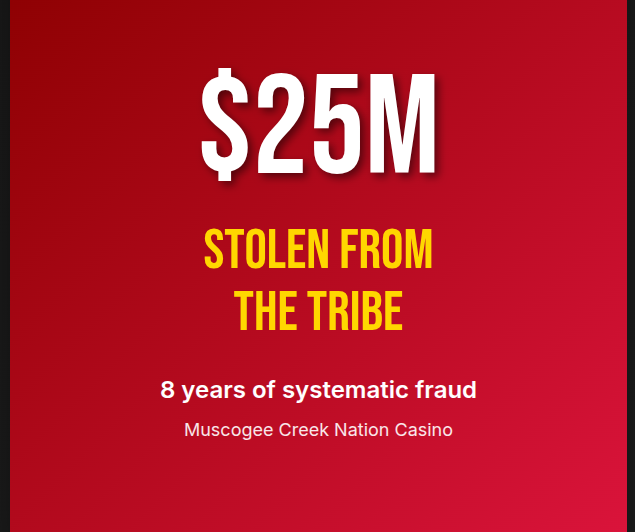
But Houser's lifestyle wasn't built on shrewd investments or a lucky inheritance. For nearly eight years, from July 2016 through February 2024, he systematically looted the Muscogee (Creek) Nation Gaming Enterprises, embezzling $24,907,436.07 from the tribe whose casinos he was entrusted to manage.
In November 2025, a federal judge sentenced him to just under six years in prison—a reckoning that came far too late for the Muscogee (Creek) Nation, one of the largest tribal governments in the United States, which lost millions that should have supported education, healthcare, and economic development for its citizens.
This is the story of how one man exploited the trust of an entire nation, the sophisticated scheme that kept the fraud hidden for years, and the federal investigation that finally brought him down.
From Accountant to Accounts Payable Manager
The Muscogee (Creek) Nation is no stranger to adversity. Forcibly removed from their ancestral homelands in the Southeast during the Trail of Tears in the 1830s, the tribe rebuilt in what is now eastern Oklahoma. Today, the Muscogee (Creek) Nation is one of the most economically successful tribal governments in the United States, with gaming operations that anchor its self-determination and sovereignty.
The Muscogee Nation Gaming Enterprises operates multiple casino properties across eastern Oklahoma, including its flagship River Spirit Casino Resort in Tulsa, which draws roughly 10,000 guests daily. These aren't small operations—they're sophisticated entertainment complexes that compete with the best Las Vegas has to offer, generating millions in revenue that funds tribal government services, healthcare, education, and economic development for the Nation's citizens.
Michael Houser joined this enterprise in 2011 as an accountant. By all accounts, he was competent and reliable. He understood the complex financial systems that tracked millions of dollars flowing through the casinos daily. He knew the vendors, the payment systems, the approval processes.
In 2016, he was promoted to accounts payable manager—a position of extraordinary trust that gave him administrative authority to approve payments to vendors and contractors. It was a promotion that would prove catastrophic.
Exploiting a Ghost Vendor
The fraud Houser engineered was elegant in its simplicity, devastating in its execution.
According to federal prosecutors and court filings, Houser identified a legitimate vendor who had previously done work for the Muscogee (Creek) Nation but whose contract had ended. Critically, this vendor's profile remained active in the Nation's accounting system—a digital ghost that could still receive payments, even though no actual work was being performed.
Houser changed the vendor's banking information to an account he controlled. Then he began generating a steady stream of bogus invoices in the vendor's name. Sometimes he approved these fraudulent invoices using his own administrative authority. When questioned by colleagues or supervisors, he produced fabricated paperwork, including documents with copied signatures from his supervisor.
The amounts weren't small. Over the course of nearly eight years, Houser siphoned $24,907,436.07 from funds owned by and under the care, custody, and control of the Muscogee (Creek) Nation—money that came from programs receiving federal funds, making this not just theft from a tribal government but theft of federal resources.
What makes the scheme particularly audacious is its duration. This wasn't a one-time theft or a crime of opportunity. Month after month, year after year, Houser systematically transferred millions while maintaining the appearance of a dedicated employee managing the Nation's accounts.
Las Vegas, Luxury Goods, and Living Large
Where did $25 million go? The answer paints a picture of stunning extravagance.
Federal prosecutors detailed Houser's spending in court filings, and the portrait that emerges is one of a man addicted to the lifestyle his stolen millions could buy. Approximately once a month, Houser would travel to Las Vegas, where much of the embezzled money flowed into casino accounts. There, he lived as what prosecutors called a "high-dollar gambler," enjoying the VIP treatment reserved for whales—the industry term for ultra-high-rolling players.
The casinos lavished him with "countless amenities and perks" due to his status as a heavy bettor. He made "lavish purchases from the casino stores," according to court documents, including at least one Rolex watch and Louis Vuitton merchandise.
But the spending extended far beyond the gambling tables. Back in Oklahoma, Houser was building a life of conspicuous consumption:
- A 2024 Lexus and a 2022 Cadillac sat in his driveway
- A high-end boat for recreational use
- Private school tuition for his children
- Investment accounts and savings accounts padded with stolen funds
- Regular purchases of luxury goods
All of this was funded by money that should have been supporting Muscogee (Creek) Nation citizens—elders who needed healthcare, children who needed educational programs, families who needed economic opportunity.
Compounding the Crime
Stealing $25 million from his employer wasn't enough. Houser also decided to cheat the American taxpayer by hiding his illegal windfall from the Internal Revenue Service.
During tax years 2016 through 2022, Houser knowingly and intentionally underreported his Adjusted Gross Income to the IRS. The scale of the tax fraud was staggering. In tax year 2022 alone, Houser failed to report $7,851,027.28 in income—nearly $8 million in unreported illegal proceeds from a single year of embezzlement.
In total, Houser's false and fraudulent tax filings deprived the U.S. Treasury of $8,205,834.00 in payments he owed as a result of the embezzled proceeds. This wasn't an oversight or an accounting error. This was a deliberate scheme to avoid paying taxes on stolen money, compounding federal crime upon federal crime.
Federal Agents Close In
The scheme that had run successfully for nearly eight years began to unravel in 2024. While the public record doesn't detail exactly how the fraud was initially detected, the investigation that followed was thorough and unforgiving.
The U.S. Secret Service and IRS Criminal Investigation took the lead, working in close partnership with the U.S. Attorney's Office for the Eastern District of Oklahoma and the Muscogee (Creek) Nation's own authorities. These weren't routine financial crimes investigators were dealing with—this was one of the largest embezzlement cases from a tribal entity in Oklahoma history.
The investigation required tracing millions of dollars through casino accounts in Las Vegas, documenting years of fraudulent invoices and forged approvals, and building an airtight case that would compel Houser to plead guilty rather than risk trial.
By the time investigators finished their work, they had documented nearly eight years of systematic theft, compiled evidence of the lavish spending, and calculated both the embezzlement total and the tax fraud to the penny.
Guilty Plea and Sentencing
On February 20, 2025, facing overwhelming evidence, Michael Anthony Houser pleaded guilty to two federal charges:
- One count of Theft Concerning Programs Receiving Federal Funds
- One count of Tax Fraud
The plea agreement meant Houser would avoid the uncertainty of trial, but it also meant admitting in open court what he had done to the people who had trusted him with their financial operations.
On October 9, 2025, Chief U.S. District Judge Ronald A. White presided over Houser's sentencing hearing in the United States District Court for the Eastern District of Oklahoma. Judge White noted Houser's previous financial fraud convictions and the seriousness of the offense before handing down the sentence.
Houser received 70 months in prison for the theft charge and 36 months for the tax fraud charge, to be served concurrently—meaning a total of just under six years behind bars. It's a non-paroleable sentence, meaning Houser would serve the full term.
But the prison time was only part of the consequence. The court also ordered Houser to pay restitution:
- $17,337,949.50 to the Muscogee (Creek) Nation
- $8,205,834.00 to the Internal Revenue Service
- Total restitution: $25,543,783.50
By the time of sentencing, Houser had already surrendered more than $7.5 million in cash, casino credits, and forfeited assets that were traced to the embezzlement. But that left roughly $18 million still owed to his victims.
On November 10, 2025, Houser was ordered to self-report to a designated United States Bureau of Prisons facility to begin serving his sentence.
Voices of Justice and Betrayal
The officials who prosecuted the case didn't mince words about what Houser had done.
"The United States Attorney's Office is committed to pursuing and prosecuting those who defraud Tribal nations in the Eastern District of Oklahoma," said United States Attorney Christopher J. Wilson. "In this case, we were honored to join together with our partners in the Muscogee (Creek) Nation and federal law enforcement to promote the mutual protection of Tribal assets and resources."
Christopher J. Altemus Jr., Special Agent in Charge of the IRS Criminal Investigation Dallas Field Office, emphasized the nature of the betrayal: "Stealing from the community you are entrusted to serve is a serious betrayal. Mr. Houser's crimes harmed the Muscogee (Creek) Nation and undermined trust in public and tribal institutions. By stealing from the Muscogee (Creek) Nation and falsifying his tax return, Mr. Houser not only defrauded his employer but also the American public."
Special Agent in Charge Kyle Smith of the U.S. Secret Service Oklahoma Field Office highlighted his agency's historic mission: "I am proud of the work conducted by our special agents in this case to ensure that justice was brought to the Muscogee (Creek) Nation. The U.S. Secret Service at its origin was created to identify, monitor and bring to justice those who seek to defraud. Protecting our communities here in Oklahoma is a mission we take very seriously, and I am grateful for the strong partnership we share with the Internal Revenue Service Criminal Investigation as we work together to bring fraudsters to justice."
Tribal Gaming and Vulnerability
The Houser case highlights a troubling vulnerability in tribal gaming operations. While the Muscogee Nation Gaming Enterprises had implemented security measures across its casinos, the fraud went undetected for years. The question that haunts this case is simple: How did it take so long to discover?
Tribal gaming is big business in Oklahoma. Following the Supreme Court's landmark 2020 decision in McGirt v. Oklahoma, which affirmed the existence of tribal reservations in eastern Oklahoma for jurisdictional purposes, tribal sovereignty and the economic enterprises that support it have taken on even greater importance.
Gaming revenues fund tribal governments, providing healthcare, education, housing, elder care, and economic development that the federal government has often failed to adequately provide. When someone steals from tribal gaming operations, they're not just stealing from a casino—they're stealing from children who need schools, elders who need medical care, and families who need economic opportunity.
The case also raises questions about internal controls. Houser's scheme exploited a ghost vendor account—a profile that remained active in the accounting system long after the legitimate business relationship had ended. He was able to change banking information, generate invoices, and in some cases approve his own fraudulent payments. When questioned, fabricated paperwork with forged signatures was apparently sufficient to allay concerns.
These are systemic vulnerabilities that likely exist in organizations beyond just this one tribal gaming enterprise. The question for other gaming operations, tribal or otherwise, is whether they're conducting the kind of regular audits and implementing the kind of controls that would detect this type of fraud before it runs for eight years and reaches $25 million.
The Human Cost: What $25 Million Means
It's easy to become numb to large numbers. Twenty-five million dollars is an abstraction. But consider what that money could have meant to the Muscogee (Creek) Nation:
- Scholarships for thousands of tribal citizens pursuing higher education
- Healthcare services for elders in underserved rural communities
- Economic development programs to create jobs and opportunity
- Language preservation programs to keep Mvskoke culture alive for future generations
- Housing assistance for families struggling with Oklahoma's high cost of living
- Addiction treatment and mental health services
Every dollar Houser spent on gambling, luxury watches, and expensive cars was a dollar taken from programs that support real people with real needs. Every fraudulent invoice he approved was a betrayal of the trust placed in him by tribal leadership and citizens.
The Muscogee (Creek) Nation, like all tribal governments, operates with limited resources and enormous responsibilities. Gaming revenue is meant to bridge the gap between federal trust obligations that are often underfunded and the actual needs of tribal citizens. When someone steals that revenue, they're not just committing fraud—they're undermining tribal sovereignty and self-determination.
Unanswered Questions and Ongoing Challenges
Several important questions remain unanswered in the public record:
How was the fraud finally detected? The court documents and press releases don't specify what finally triggered the investigation in 2024 after eight years of ongoing theft. Was it an internal audit? A whistleblower? A suspicious transaction that caught someone's attention? Understanding how the fraud was discovered could provide valuable lessons for other organizations.
Were there warning signs that were missed? Did anyone raise concerns about the vendor payments that were dismissed or explained away by Houser's fabricated documentation? Were there anomalies in spending patterns or financial reports that should have prompted earlier investigation?
What controls have been implemented since? The Muscogee Nation Gaming Enterprises is presumably not eager to broadcast the specific security measures they've put in place, but there's public interest in knowing that steps have been taken to prevent similar schemes in the future.
Will the full restitution ever be recovered? Houser surrendered $7.5 million, but roughly $18 million remains owed. Much of that money was gambled away in Las Vegas or spent on depreciating assets. The Muscogee (Creek) Nation and the IRS may never recover the full amount they're owed.
Lessons for Indian Country and Beyond
The Houser case offers several critical lessons:
Trust must be verified. No matter how long someone has worked for an organization or how reliable they seem, financial controls must be in place to verify that money is being spent appropriately. Trust is important, but accountability is essential.
Internal controls must be robust. Ghost vendor accounts should be purged regularly. Banking information changes should require multiple levels of approval. Large or unusual payments should trigger automatic reviews. The ability to both approve and process payments should be separated across different employees.
Regular audits are non-negotiable. Independent external audits can catch irregularities that internal staff might miss or explain away. For organizations handling tens of millions of dollars, the cost of regular professional audits is trivial compared to the cost of years of undetected fraud.
Tribal sovereignty includes the responsibility to protect tribal assets. Strong financial controls aren't just good business practice—they're essential to protecting the resources that support tribal self-determination and the wellbeing of tribal citizens.
The Price of Betrayal
Six years in prison seems almost inadequate for someone who stole $25 million and systematically betrayed the trust of an entire nation. By the time Houser is released, he'll be in his early 40s—still with much of his life ahead of him. But he'll carry the label of federal felon, and he'll be burdened with restitution payments he likely can never fully satisfy.
The Muscogee (Creek) Nation, meanwhile, continues the work of governing, of providing services to its citizens, of maintaining its sovereignty and self-determination. The $7.5 million recovered helps, but it doesn't fully heal the wound of betrayal or compensate for the years of stolen resources.
This case stands as a stark reminder that the greatest threats to tribal nations don't always come from outside. Sometimes they come from within—from individuals who exploit positions of trust, who prioritize personal enrichment over communal responsibility, who see an opportunity to steal and decide that the risk is worth it.
Michael Anthony Houser made that calculation. He spent eight years living large on money that belonged to the Muscogee (Creek) Nation. He gambled away millions in Las Vegas, bought luxury goods, and built a lifestyle of affluence on a foundation of fraud.
Now he sits in federal prison, owing more than $25 million he will likely never repay, having lost his freedom, his reputation, and any claim to having served his community with honor.
The Muscogee (Creek) Nation endures, as it has endured far worse over centuries. But it endures $25 million poorer, its trust betrayed by someone who was supposed to be a steward of its resources.
That's the true cost of Michael Houser's crime—not just the dollars and cents, but the broken trust, the stolen opportunity, and the reminder that vigilance can never be relaxed when it comes to protecting the resources that belong to the people.
This investigation was compiled from federal court documents, press releases from the U.S. Attorney's Office for the Eastern District of Oklahoma, statements from the IRS Criminal Investigation Division and U.S. Secret Service, and public reporting on the case. Michael Anthony Houser is currently serving his sentence at a federal Bureau of Prisons facility.