




How Oklahoma's Cash Bail System Imprisons the Innocent
An Investigation into America's Highest Incarceration Rate
On any given morning in Oklahoma, more than 9,000 people wake up behind bars who have never been convicted of a crime. They are legally innocent—presumed so by the Constitution itself. Yet they remain locked away, not because a judge found them guilty, not because they pose a danger to society, but because they cannot afford to pay bail.
This is not an anomaly. It is the system working exactly as designed.
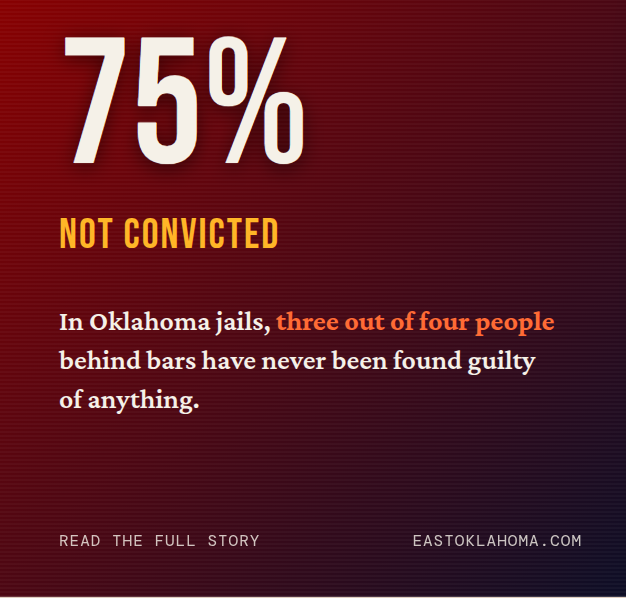
With an incarceration rate of 905 per 100,000 residents—counting all forms of confinement including prisons, jails, juvenile facilities, and immigration detention—Oklahoma locks up a higher percentage of its people than any independent democratic country on earth. That statistic alone is staggering. But perhaps even more disturbing is this: three-quarters of people sitting in Oklahoma's county jails have not been convicted of anything.
75% of people in Oklahoma jails have not been convicted of a crime, meaning they're legally innocent.
They are awaiting trial. Awaiting their day in court. Awaiting the justice system to do what it promises: presume their innocence until proven guilty. Instead, the system presumes they are too poor to matter.
The Geography of Injustice
The pretrial detention crisis in Oklahoma is not uniform—it varies wildly depending on where you are arrested. In some jurisdictions, people wait as long as 90 days after arrest before being appointed a lawyer. In many counties, defendants sit in jail for more than a week before they even see a judge. During that time, they are unrepresented, uninformed, and increasingly desperate.
Bond amounts for identical offenses differ dramatically across county lines. Nonviolent felony bonds range from $5,000 in Rogers County to $10,000 in Logan, Ellis, and Pushmataha counties. Two people charged with the same crime can face vastly different outcomes based solely on geography and resources.
Oklahoma County Jail, designed to hold 1,200 inmates, has routinely held double that number. Approximately 80 percent of those inmates are pretrial detainees—people who haven't been convicted but can't afford bail. Tulsa County's incarceration rate has ballooned nearly 200 percent since 1970, costing taxpayers more than $30 million annually.
On any given day, more than 9,000 Oklahomans sit in local jails—nearly 70% of them legally innocent and jailed simply while awaiting their day in court.
The public foots the bill for this mass pretrial detention. In Tulsa County alone, jailing people for failure to appear in court cost taxpayers nearly $1.2 million in 2022. These are not violent offenders or flight risks. They are people who missed a court date—often because they never received adequate notice.
The Mechanics of a Broken System
The pretrial system in Oklahoma operates on a simple but devastating principle: wealth determines freedom. If you can afford bail, you go home. If you cannot, you stay locked up—sometimes for months—while your case moves through the courts.
The consequences of pretrial detention extend far beyond the jail cell. Even a few days behind bars can cost someone their job, their housing, their car, or custody of their children. For families already living paycheck to paycheck, the financial devastation is immediate and total.
This creates immense pressure to plead guilty, regardless of actual guilt. Defendants detained before trial are far more likely to accept plea deals—not because the evidence against them is strong, but because a plea bargain offers the fastest route out of jail. Studies have shown that pretrial detention increases the likelihood of pleading guilty by 12 percent.
The system also reinforces racial inequalities. Black people in Oklahoma are incarcerated at a rate five times higher than white people. Research shows that white defendants receive more favorable plea deals than Black and Latino defendants. Poor women in rural areas receive longer sentences than those who can afford private attorneys for the same crimes.
Black people in Oklahoma are incarcerated at a rate 5 times higher than white people.
The Human Cost
Behind every statistic is a person. A single mother facing a wrongful robbery charge based on mistaken identity, held on $50,000 bail she could never afford, risking the loss of her children. A barber arrested for a low-level offense who loses his shop because he can't make rent from behind bars. A student whose life is derailed by a charge that is later dismissed—but only after weeks in detention have already destroyed their scholarship and housing.
Nicole, a single mother of three in Tulsa, was wrongfully accused of armed robbery and faced $50,000 bail. She risked losing everything—her job, her home, custody of her children. With help from The Bail Project and a public defender, her bail was eventually reduced and she was released. Her case was later dismissed. But the trauma remains. She still lives with anxiety and fear of rearrest.
These stories repeat themselves thousands of times each year across Oklahoma. Each year, at least 96,000 different people are booked into local jails. Most will be released eventually. But the damage—to their employment, their families, their mental health—has already been done.
For some, the wait is even longer. Throughout much of Oklahoma, people sit in jail for over a week before seeing a judge. During that time, they may lose their job, fall behind on rent, or have their children placed in state custody. The presumption of innocence becomes a cruel joke when the punishment begins before the trial.
Does Cash Bail Work?
The central claim behind cash bail is that it ensures defendants return to court and protects public safety. The evidence suggests otherwise.
A 2025 study by The Bail Project tracked more than 3,300 individuals booked into Tulsa County Jail over the course of a year. The findings were striking: defendants released on their own recognizance were slightly more likely to appear at all of their court appearances than those who used a bail bondsman.
In other words, the system designed to guarantee court appearances was actually less effective than simply releasing people without requiring payment. Cash bail does not improve court appearance rates. It does not make communities safer. What it does is lock up thousands of legally innocent people every year simply because they cannot afford to buy their freedom.
More than 14 percent of jail bookings in Oklahoma in 2022 were related to failure to appear in court. These are not dangerous criminals. They are people who missed a court date—often because they never received a reminder or adequate notice. Other jurisdictions have shown that simple text message reminders dramatically reduce failures to appear. But Oklahoma continues to criminalize poverty instead.
Defendants released on their own recognizance were slightly more likely to appear at all court appearances than those who used a bail bondsman.
A World Apart
Oklahoma's incarceration crisis cannot be understood in isolation. When compared to other democracies around the world, the numbers become even more shocking.
Countries with far lower incarceration rates include Afghanistan (45 per 100,000), Syria (60), Angola (79), China (165), Iraq (179), Venezuela (199), and Iran (228). In every one of these nations—some considered authoritarian regimes or failed states—the share of citizens behind bars is lower than in any U.S. state.
Oklahoma's rate of 905 per 100,000 is not just higher than other American states. It exceeds the incarceration rate of every independent democratic country on the planet. Even among U.S. states known for harsh criminal justice policies, Oklahoma stands out. Only Louisiana, Mississippi, and Arkansas come close.
This is not because Oklahomans are more criminal than people in other democracies. Violent crime rates in the United States are actually lower than in many countries with far fewer people behind bars. The difference is not in the behavior of citizens. The difference is in the response of the state.
Oklahoma has made incarceration the default solution to social problems that other societies address through mental health services, addiction treatment, housing assistance, and economic support. The result is a system that incarcerates at a rate nearly ten times higher than Canada—a country with similar cultural roots and comparable wealth.
The Path Forward
The pretrial detention crisis in Oklahoma is not inevitable. Other jurisdictions—both within the United States and around the world—have demonstrated that there are better ways.
In March 2026, the Oklahoma Senate advanced Senate Bill 1381, a three-year pilot program that would guarantee defendants access to legal counsel and a bond hearing within 48 hours of arrest on weekdays, or 72 hours on weekends and holidays. The bill stems from a federal court ruling that found Tulsa County's bail system violated the Equal Protection Clause of the U.S. Constitution by failing to provide timely bond hearings.
The proposed reforms are straightforward. Ensure access to counsel at bail hearings. Require that hearings happen within 48 to 72 hours of arrest. Provide court reminders to reduce failures to appear. These are not radical ideas. They are constitutional requirements that Oklahoma has been ignoring for decades.
Evidence-based risk assessment tools—such as the Arnold Foundation's Public Safety Assessment—can help judges determine whether someone poses a genuine flight risk or danger to the community. These tools have been implemented successfully in other states. Allegheny County, Pennsylvania, saw a 30 percent decrease in pretrial detention after integrating risk assessments into their bail process.
Washington, D.C., has gone even further by eliminating money bail entirely in favor of pretrial release with conditions such as GPS monitoring, drug testing, and regular check-ins. The result has been fewer people in jail, lower costs for taxpayers, and no reduction in public safety.
The 14th Amendment guarantees timely due process for the accused detained in our county jails. The longer someone sits in a county jail awaiting a hearing, the higher the costs for Oklahoma taxpayers.
Kentucky, New Jersey, and California have all adopted similar reforms with positive results. The solutions exist. The question is whether Oklahoma has the political will to implement them.
The Cost of Inaction
Every day that Oklahoma delays reform, the costs mount. Taxpayers spend millions to incarcerate legally innocent people. Families are torn apart. Communities are destabilized. Young people lose educational opportunities. Workers lose jobs and housing. Children enter state custody.
The economic costs are significant. Housing someone in jail costs the state money. Processing failure-to-appear warrants costs money. Appointing lawyers for defendants who have already spent weeks in jail unrepresented costs money. The current system is not just unjust—it is fiscally irresponsible.
But the human costs are incalculable. How do you measure the trauma of wrongful detention? The psychological damage of sleeping on a jail floor when you are innocent? The shame of losing custody of your children because you could not afford $5,000? The permanent employment consequences of a weeks-long gap in your work history?
Oklahoma releases roughly 160,559 men and 56,316 women from its prisons and jails each year. What is the state doing to support them upon reentry? Very little. The same system that detained them without trial now releases them without support, creating a cycle of poverty, instability, and re-incarceration.
This is not justice. This is not public safety. This is a system designed to punish poverty and perpetuate inequality.
The Choice Ahead
Oklahoma stands at a crossroads. The state can continue defending the highest incarceration rate in the democratic world, insisting that its citizens are uniquely criminal and require uniquely harsh treatment. Or it can acknowledge what the evidence has been screaming for years: the system is broken.
The presumption of innocence is not merely a legal principle. It is a moral commitment—a statement that we value human dignity, that we refuse to punish people before proving their guilt, that we will not allow wealth to determine who deserves freedom and who does not.
Every day, more than 6,000 legally innocent Oklahomans sit behind bars because they are poor. Every day, taxpayers pay millions to keep them there. Every day, families are destroyed, jobs are lost, and futures are foreclosed.
The evidence is overwhelming. The solutions are proven. The constitutional violations are clear. The only question that remains is whether Oklahoma will choose justice over inertia, fairness over tradition, and the presumption of innocence over the presumption of guilt.
With an incarceration rate of 905 per 100,000 people, Oklahoma locks up a higher percentage of its people than any independent democratic country on earth.
The answer to that question will define not just the state's criminal justice system, but its values. It will reveal whether Oklahoma truly believes in equal justice under law, or whether those words apply only to people who can afford to pay for them.
Three-quarters of people in Oklahoma jails have not been convicted of a crime. They are presumed innocent by law. It is time the system started treating them that way.
SOURCES
This investigation draws on data from the Prison Policy Initiative, The Bail Project, Oklahoma Policy Institute, Vera Institute of Justice, Oklahoma Watch, ACLU of Oklahoma, and court records from Tulsa and Oklahoma counties. Additional reporting includes analysis of Senate Bill 1381 and federal court rulings on pretrial detention practices in Oklahoma.