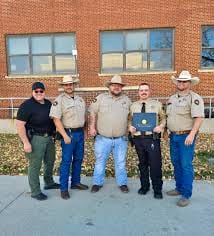


When the voters' choice doesn't matter and inherited failures become grounds for prosecution
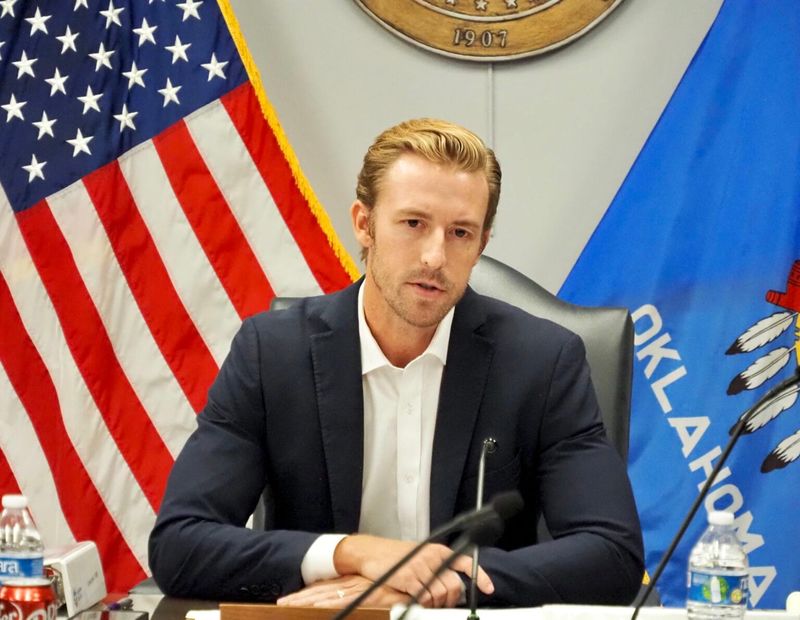
OKEMAH, OKLAHOMA — Sheriff Logan Manshack's hands were steady as he typed out his resignation statement on May 6, 2026. But the words he chose were careful, deliberate — the language of a man who knows he's being watched, who understands that what he doesn't say matters as much as what he does.
"This was not a decision I wanted to make," Manshack wrote. "If it were up to me, I would continue serving this county for as long as the people placed their trust in me."
Then came the key phrase, the one that community members immediately seized upon: "However, given the circumstances surrounding this situation, it became clear that stepping aside was the path being placed in front of me."
Not the path he chose. The path PLACED in front of him.
Manshack's last day will be Friday, May 8, 2026, at noon — less than two years into a four-year term. The voters of Okfuskee County elected him in June 2024 with 52.46 percent of the vote in the Republican primary. There was no Democrat challenger. The people's choice was clear.
But according to sources close to the sheriff and community members who have spoken out publicly, that democratic choice is being overridden by a District Attorney wielding the threat of felony prosecution like a cudgel — not in pursuit of justice, but in pursuit of a political outcome.
This is the story of how systemic failures inherited from previous administrations, a five-year-old jail already falling apart, and a politically motivated prosecutor combined to force an elected official from office against the will of the people who put him there.
THE JAIL MANSHACK INHERITED: A Five-Year-Old Facility Already Obsolete
When Logan Manshack took office in January 2025, he inherited the Okfuskee County Jail — a facility that, on paper, should have been state-of-the-art. It was only five years old, built around 2020, and replaced the older detention facilities that had served the county for decades.
But as Manshack would quickly discover, the jail had been constructed with critical flaws that were already manifesting as serious security problems.
The lock systems were already obsolete. The manufacturer had discontinued the model, making replacement parts nearly impossible to obtain. When locks began to malfunction — as they inevitably would in any correctional facility — there was no straightforward way to repair them.
"If one lock is obsolete, all of them are going to be," Manshack told reporters in January 2026, explaining the scope of the problem. "What we're trying to do now is bring in a company to replace them all at the same time."
The interior walls were unreinforced concrete. While this might pass minimum building codes for a standard structure, correctional facilities require reinforced walls specifically to prevent exactly what happened in December 2025: an inmate chiseling through to access utility chases and exit points.
The security camera system had already required a complete replacement just one year before Butler's escape. This suggests that whoever specified the original equipment either didn't understand the demands of a correctional environment or chose inadequate systems to save money during construction.
The facility design itself created vulnerabilities. Plumbing chases — the narrow spaces where pipes run through a building — should be inaccessible from inmate housing areas in a properly designed jail. Yet Butler was able to access one simply by removing a wall-mounted sink.
These weren't problems Logan Manshack created. He took office in January 2025. The jail was built in 2020. The design flaws, the inadequate materials, the obsolete lock systems — all of these were baked into the facility before Manshack ever raised his right hand to take the oath of office.
The question that hangs over this case is simple: How does inheriting someone else's failures become grounds for criminal prosecution?
THE PREVIOUS ADMINISTRATION: Roy Wilburn and the Systemic Issues
Before Logan Manshack, the Okfuskee County Sheriff was Roy L. Wilburn, who was appointed to the position in 2023. Wilburn attempted to run for reelection in 2024 but was deemed ineligible for the ballot because he had changed his party affiliation less than six months before the candidate filing period began in April 2024.
The jail that Butler escaped from? That was Wilburn's jail for at least two years, possibly longer depending on exactly when he took over operations after his 2023 appointment.
During Wilburn's tenure, the lock problems that would prove critical in December 2025 were already developing. The obsolete lock systems didn't become obsolete overnight — manufacturers typically phase out products over months or years, giving facilities time to plan for replacements.
The unreinforced walls that Butler chiseled through didn't suddenly become unreinforced when Manshack took office — they were built that way in 2020, years before Manshack became sheriff.
The staffing protocols that failed to detect Butler's absence for five days? Those were established and operated under previous administrations. Manshack had been in office for less than one year when the escape occurred.
Yet when the escape happened, it was Manshack — and only Manshack — who faced the threat of criminal charges.
Wilburn? He agreed to serve as Manshack's undersheriff after the 2024 election. He was still working in the sheriff's office when Butler escaped. There's no indication he faced any threat of prosecution for the systemic failures that developed during his tenure.
The county commissioners who approved the inadequate jail design in 2020? No indication they faced any consequences.
The contractors who built a five-year-old jail with obsolete lock systems? No indication of any investigation into whether they fulfilled their contractual obligations.
The pattern is clear: the elected official who inherited the problems is being held criminally responsible, while those who actually created the problems face no accountability whatsoever.
THE ESCAPE: December 20, 2025
Joshua Butler was not supposed to be in the Okfuskee County Jail. He was a Hughes County inmate serving multiple life sentences for assault with a dangerous weapon, obstruction of an officer, and malicious property damage.
But on December 16, 2025, Butler was transferred to Okfuskee County Jail while awaiting a court appearance in Hughes County. This is a common practice in Oklahoma's criminal justice system — county jails house inmates from other jurisdictions when needed for court proceedings.
Just four days later, on December 20, 2025, Butler made his move.
Working during overnight hours when supervision is necessarily lighter, Butler removed a wall-mounted sink from his cell. Behind it, he found the unreinforced concrete wall. Using improvised tools, he chiseled through, creating access to a narrow plumbing chase.
He crawled through the chase to an exterior door. The lock — part of the obsolete system that Manshack had been trying to replace — had been frozen open for over a month due to water damage.
Butler walked out.
"We had a water leak on the inside that damaged the lock and froze it open basically," Manshack explained to News On 6 in early January. "The way the lock was frozen open, more or less he just busted through it."
The lock had been an ongoing maintenance issue for more than a month. Replacement parts were difficult to obtain because the lock model was no longer manufactured — the same problem Manshack had been warning about since he realized the scope of the facility's obsolete systems.
This wasn't negligence. This was a sheriff trying to address systemic infrastructure problems with limited county budgets and obsolete equipment. Manshack had invited an outside agency to conduct a full review of jail policies, procedures, and infrastructure. He had been working to secure funding to replace all the locks at once.
But infrastructure improvements take time and money. Butler's escape took one night and a pair of improvised tools.
THE FIVE DAYS: A Breakdown in Protocols
Here's where the case becomes more complicated — and where legitimate questions about jail operations arise.
Butler escaped on December 20. Jail staff didn't realize he was missing until December 25 — Christmas Day.
Five days.
An inmate serving multiple life sentences was unaccounted for. For five days.
This is indefensible. Full stop. There is no scenario in which an inmate should go unnoticed for five days in a county jail.
But here's the critical question: Were the protocols that failed protocols that Logan Manshack established during his less-than-one-year tenure? Or were they protocols inherited from previous administrations?
Jail count procedures, shift protocols, cell check schedules — these are typically established over years, becoming the institutional culture of a facility. A new sheriff doesn't walk in and immediately overhaul every operational procedure, especially not in their first year when they're still learning the facility and the staff.
Manshack didn't hide from this failure. He acknowledged it immediately and publicly.
"This incident has revealed two serious concerns," Manshack said in his statement after Butler's death. "The first involves deficiencies in the jail's physical infrastructure, including unreinforced interior walls and outdated locking systems that contributed to the breach and demonstrated the need for modernization and repair."
"The second concern, the delay in discovering Butler's escape, is now under investigation by an outside agency."
Notice what Manshack did: he called for an outside investigation. Not an internal review. Not a whitewash. An independent investigation to determine exactly how the five-day delay happened.
This is not the behavior of a sheriff trying to cover up wrongdoing. This is the behavior of a sheriff who wants to know the truth and fix the problems.
THE MANHUNT AND THE DEATH: December 25-31
Once Butler's absence was discovered on Christmas Day, a massive manhunt began. The Okfuskee County Sheriff's Office worked with Hughes County officials and other law enforcement agencies across eastern Oklahoma.
For six days, Butler was on the run. He was originally from Wetumka and still had family in Hughes County, making the area familiar territory for someone trying to evade capture.
On December 31, 2025, Oklahoma Highway Patrol troopers located a vehicle connected to Butler in Hughes County. They initiated a traffic stop.
Butler fled the vehicle on foot. He was armed with a .22-caliber rifle.
During the confrontation, OHP troopers shot and killed him.
Butler's death ended the immediate crisis. But it didn't end the political calculation that was already underway about what to do with Sheriff Logan Manshack.
THE THREAT: A Grand Jury and Felony Charges
According to sources close to the sheriff and community members who have spoken out publicly, the District Attorney began applying pressure on Manshack almost immediately after Butler's death.
The threat was explicit: a grand jury investigation that could result in felony charges. The potential charges would likely be framed as criminal negligence — failing to properly secure an inmate, resulting in death.
Never mind that Butler's death occurred during a confrontation with highway patrol, not during the escape itself. Never mind that no sheriff in Oklahoma history has ever been criminally convicted for a jail escape where there was no malice or intentional wrongdoing. Never mind that the infrastructure failures that enabled the escape predated Manshack's tenure by years.
The threat was enough.
Manshack has a wife and a small child. The prospect of facing felony charges, potential prison time, and the destruction of everything he'd built was too much to bear.
Community members who know the situation are outraged.
"The DA here has threatened this man with a grand jury resulting in the possibility of a felony and prison!" one resident wrote in a public Facebook message. "Our community is outraged! Logan Manshack has a wife and a small child. He gave into their demands for his resignation due to fear of the threats."
Another community member was even more direct: "Sir, there has never been sheriff convicted of anything due to an escape where there was no malice. I feel our DA with some of the county commissioners are using the DA's weight to get what they want."
This is the allegation at the heart of this case: that the District Attorney is using the threat of criminal prosecution not to pursue justice, but to remove an elected official that the DA or county commissioners want gone.
THE LEGAL REALITY: No Precedent for Prosecution
The community members defending Manshack aren't wrong about the legal precedent — or rather, the lack thereof.
A review of Oklahoma legal history reveals no case where a county sheriff was criminally prosecuted and convicted for a jail escape that involved no malicious intent, no deliberate wrongdoing, and no corruption.
The infamous 1980s county commissioner scandal that resulted in convictions of 230 people across 60 counties? Those were cases of deliberate corruption — kickbacks, bribes, and theft of public funds.
The 1960s Oklahoma Supreme Court bribery scandal? Again, deliberate corruption — justices taking payoffs to influence decisions.
Former Governor David Hall's 1975 conviction? Misusing the powers of office to direct a state retirement fund to help a friend.
These were all cases of intentional criminal conduct. People knowingly breaking the law for personal gain.
What happened in Okfuskee County was fundamentally different: infrastructure failures, obsolete equipment, and a breakdown in count procedures. These are failures of systems, budgets, and institutional practices — not criminal acts.
Broken locks aren't crimes. Unreinforced walls built by contractors in 2020 aren't crimes. Obsolete security systems aren't crimes.
Even the five-day delay in discovering the escape, while completely unacceptable, doesn't rise to the level of criminal negligence in the absence of evidence that Manshack personally established inadequate protocols or deliberately failed to supervise his staff.
Oklahoma law does provide for removal of public officials through impeachment or recall for "incompetence, neglect of duty, or corruption in office." But those are administrative and political remedies, not criminal prosecutions.
Using the criminal justice system to remove an elected official for inherited systemic failures crosses a line that should trouble anyone who believes in democratic accountability.
THE COMMUNITY RESPONSE: "We Need to Keep the Man We Voted In"
The backlash from Okfuskee County residents has been swift and fierce.
"This man is one of the good ones!" one community member wrote. "He is an excellent sheriff and Officer. He has learned a lot through this escape experience and fixed all the things.... Do you know of anything this community/County can do to help this man? We need to keep the man we voted in as our Sheriff!"
This sentiment has been echoed across social media, in conversations at local businesses, and in the informal networks that connect small rural communities.
The people of Okfuskee County are not naive. They understand that the escape happened on Manshack's watch. They understand that the five-day delay is unacceptable.
But they also understand context. They know the jail was built with flaws before Manshack took office. They know he'd been working to fix the problems. They know he called for an outside investigation instead of trying to sweep things under the rug.
And they know that in June 2024, they went to the polls and chose Logan Manshack to be their sheriff. Not the DA. Not the county commissioners. The voters.
"I feel our DA with some of the county commissioners are using the DA's weight to get what they want," one resident wrote. "It is so wrong this man is one of the good ones!"
This is the core grievance: that unelected or differently-elected officials are using the threat of criminal prosecution to override the democratic choice of the county's voters.
If Manshack was truly incompetent or negligent, the remedy is recall or the next election. Voters can choose not to re-elect him. They can petition for his removal.
But threatening criminal charges to force a resignation short-circuits the democratic process. It substitutes the DA's judgment for the voters' judgment. And it sets a dangerous precedent for how county officials can be removed from office in Oklahoma.
THE POLITICAL CONTEXT: More Than Meets the Eye
Sheriff Manshack's carefully worded resignation statement hints at deeper currents beneath the surface.
"While the recent incident has been the focus of public attention, the circumstances surrounding my decision involve broader considerations," Manshack wrote. "There are factors and discussions that the public may never fully see, but I stand by the work that was being done and the direction we were heading."
What are these "factors and discussions that the public may never fully see"?
Multiple sources suggest that Manshack and certain county officials — potentially including the DA and some county commissioners — had been at odds over jail operations, budget allocations, and law enforcement priorities since well before the December escape.
In August 2025, just seven months into his tenure, Manshack had to issue a public statement about developments within the Okemah Police Department and the governing body of the City of Okemah that required intervention by the Oklahoma Attorney General's Office.
"The Okfuskee County Sheriff's Office is working in close collaboration with the remaining Okemah Police Department officers and the Attorney General's Office to provide any and all assistance necessary during this transitional period," Manshack's statement read.
This suggests significant dysfunction in local law enforcement and government well before Butler's escape. Manshack positioned himself as working with the state Attorney General to provide stability during a crisis.
Could this have created political enemies? Could Manshack's cooperation with the AG's office have put him at odds with local officials who saw state intervention as embarrassing or threatening?
The timing is suggestive. Manshack takes office in January 2025. By August 2025, he's dealing with a crisis in the city police department that requires AG intervention. By December 2025, an inmate escapes from a jail with infrastructure problems dating back years. By May 2026, Manshack is forced to resign under threat of felony prosecution.
The pattern looks less like a sheriff failing in his duties and more like a sheriff who stepped on the wrong toes and paid the price.
THE PRECEDENT: What This Means for Oklahoma Sheriffs
If the threat of criminal prosecution succeeds in forcing Logan Manshack from office, it will set a troubling precedent for elected sheriffs across Oklahoma.
Every county jail in the state has infrastructure problems. Every facility has aging equipment, limited budgets, and inherited systemic issues. Every sheriff walks into an office where previous administrations made decisions that can't be easily undone.
If those inherited problems can become grounds for criminal prosecution when something goes wrong, then no sheriff is safe.
Consider the incentive structure this creates:
A newly elected sheriff discovers serious infrastructure problems in the county jail. Does he:
(A) Publicly acknowledge the problems and work to fix them, knowing that any incident before the fixes are complete could be used to prosecute him?
Or (B) Keep quiet about the problems, document them privately, and hope nothing goes wrong before he can secure funding for repairs?
Option A is what Logan Manshack did. He was transparent. He called for outside investigations. He explained the scope of the infrastructure problems.
And he's being forced out of office for it.
The lesson other sheriffs will take from this is clear: don't be transparent about problems you inherit. Cover your ass. Build a paper trail showing you reported the issues to county commissioners, then wash your hands of responsibility.
This is terrible for public safety and accountability. But it's the rational response to a system where inheriting someone else's failures can end your career and land you in prison.
THE SHARED RESPONSIBILITY: County Commissioners and Budgets
Manshack made a point in his resignation statement that deserves emphasis: oversight of a county jail "involves multiple layers of leadership, administration and funding."
This is not buck-passing. This is an accurate description of how county governments work.
The sheriff operates the jail, but the sheriff doesn't fund the jail. County commissioners control the budget. They decide how much money the sheriff's office receives for staff, equipment, maintenance, and infrastructure improvements.
If the jail has obsolete locks that need replacing, the sheriff can identify the problem and request funding — but it's the commissioners who have to approve spending potentially hundreds of thousands of dollars to replace an entire lock system in a five-year-old building.
If the jail needs structural reinforcement of interior walls, that's a major capital project requiring engineering assessments, contractor bids, and significant expenditure. Again, the commissioners control that process.
"As sheriff, I have always believed in taking responsibility for my office, and I do so," Manshack said. But he also noted that the jail's problems "did not happen overnight and cannot be solved by one person."
This is the reality of county government: problems are often collective, but accountability is usually individual.
When something goes wrong, it's the elected sheriff who faces the consequences, even when the root causes trace back to decisions by previous administrations and current budget constraints imposed by commissioners.
THE LESSONS LEARNED: What Manshack Did Right
Lost in the controversy over the escape and the forced resignation is an important fact: Logan Manshack responded to this crisis in exactly the way a good sheriff should.
He didn't hide. When reporters came asking questions, he answered them. He explained the infrastructure problems. He detailed the water leak that froze the lock open. He acknowledged that the lock had been a maintenance issue for over a month.
He didn't make excuses. "As sheriff, I have always believed in taking responsibility for my office, and I do so," he said clearly and without equivocation.
He called for accountability. Not just internal review, but outside investigation by an independent agency to determine how the five-day delay happened.
He worked to prevent future incidents. Before the escape even happened, Manshack had been trying to secure funding to replace the obsolete lock systems. After the escape, he brought in a company to replace them all at once.
He prioritized transparency. "I believe in being transparent with the public," Manshack told reporters. "I don't want to hide anything. I want people to know exactly what happened, how it happened, and make sure those issues are addressed."
This is how a professional law enforcement officer handles a crisis. With honesty, accountability, and a commitment to fixing the problems.
And the system's response was to threaten him with felony charges and force him from office.
What message does this send to other sheriffs facing infrastructure problems and budget constraints? What incentive does it create for transparency and accountability?
THE FRIDAY DEADLINE: May 8, 2026
As this article goes to press, Sheriff Logan Manshack has just over 48 hours left in office. His last day is Friday, May 8, 2026, at noon.
The investigation into the jail's operations is ongoing. No charges have been filed. The grand jury that was allegedly threatened has not been convened — at least not publicly.
Manshack will leave office having never been charged with a crime. He will leave having been forced out by the threat of prosecution, not by actual prosecution.
His replacement will be appointed by the governor until a special election can be held. The voters of Okfuskee County will not get to choose who serves the remaining two-plus years of the term they thought they were electing in 2024.
Former Sheriff Roy Wilburn, who served as undersheriff under Manshack, may or may not remain in that position depending on who the governor appoints.
The jail's infrastructure problems will remain. The obsolete locks will still need replacing. The unreinforced walls will still be unreinforced. The systemic issues that enabled Butler's escape will not magically disappear when Manshack walks out the door.
But the elected official who was working to fix those problems — who was transparent about their scope, who called for outside investigation, who took responsibility while also explaining the context — that official will be gone.
Forced out not by voters, not by impeachment, not by recall, but by the threat of criminal prosecution for problems he didn't create.
The Path Forward
The people of Okfuskee County deserve better than this.
They deserve a sheriff who can address infrastructure problems without fearing that inherited failures will be criminalized.
They deserve county commissioners who take shared responsibility for jail operations and funding instead of letting elected sheriffs take the fall alone.
They deserve a DA who uses prosecutorial discretion to pursue actual criminals, not to remove elected officials through intimidation and threats.
And they deserve to have their votes count.
In June 2024, the voters of Okfuskee County went to the polls and chose Logan Manshack as their sheriff. They made that choice knowing who he was, what he stood for, and what he promised to do.
Less than two years later, that choice is being overridden by a DA wielding the threat of a grand jury like a political weapon.
This is not how democracy is supposed to work. It's not how the criminal justice system is supposed to work. And it's not how Oklahoma should treat elected officials who inherit systemic problems and work in good faith to fix them.
Sheriff Manshack's resignation statement concluded with a note of thanks to the community:
"I remain thankful to the people of Okfuskee County for the opportunity to serve. I will continue to support this community in any way I can moving forward."
The community's response has been equally clear: "We need to keep the man we voted in as our Sheriff!"
But it appears that what the community wants, and what the community voted for, doesn't matter as much as what a politically motivated DA threatens.
As Manshack himself said, this was not the path he chose.
It was the path being placed in front of him.
The only question that remains is whether the people of Oklahoma will accept a system where that's how elected officials are removed from office — not by voters, not by impeachment, not by recall, but by threats from prosecutors pursuing political outcomes instead of criminal justice.
Sheriff Logan Manshack's term ends Friday at noon. But the precedent being set will echo across Oklahoma's 77 counties for years to come.
And every sheriff in the state will be watching.
NOTE: This article is based on publicly available statements from Sheriff Logan Manshack, community members' public social media posts, media reporting from Oklahoma news outlets, and official records. Specific allegations regarding threats from the District Attorney are based on statements from sources close to the sheriff and community members but have not been independently confirmed by the DA's office. Sheriff Manshack has not been criminally charged with any offense related to the December 2025 escape. The investigation into jail operations remains ongoing as of May 6, 2026.