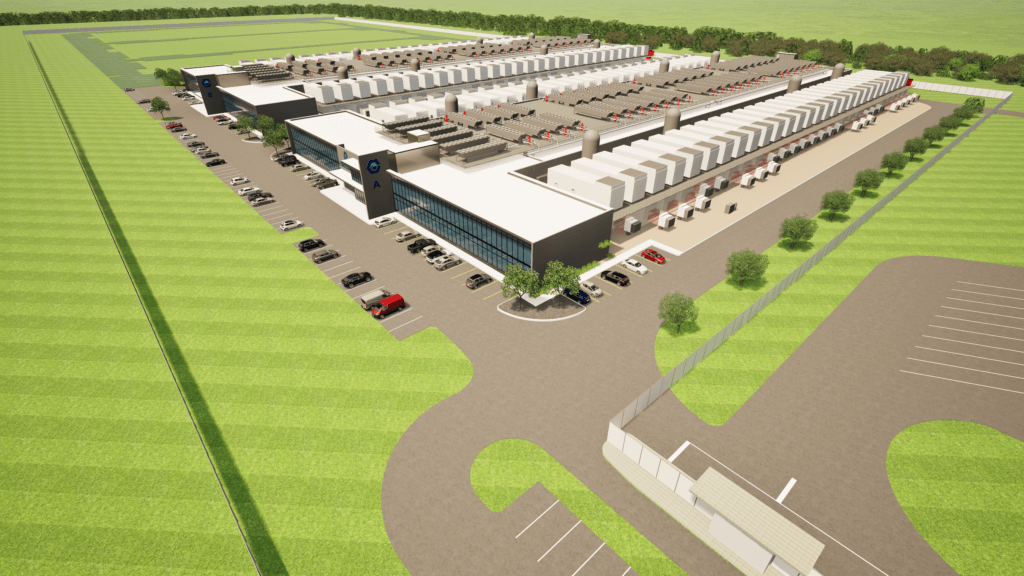


While Oklahoma communities revolt against Big Tech, one county embraces billions in AI infrastructure — but at what cost?
An investigation into the divergent paths of data center development in Oklahoma
Mark Hughes doesn't trust the government or big corporations. Standing in Muskogee, Oklahoma, where Google just announced plans for two massive data centers as part of a $9 billion state investment, Hughes voiced what many in his community feel but few say publicly.
"There are people here who are living paycheck to paycheck," Hughes said in November 2025, his concern palpable. "I think we have almost 25% of our population just in the city of Muskogee is considered poverty and every penny they've got to account for."
His caution represents a minority view in a county where local officials have enthusiastically welcomed what they call "transformational" investments. But Hughes's skepticism hints at a more complex story unfolding beneath Muskogee's surface — one that sharply diverges from the heated battles playing out just miles away in neighboring Oklahoma communities.
A Tale of Two Oklahomas
Drive 45 minutes northwest from Muskogee to Sand Springs, and you'll find a city in revolt. Residents there packed city council meetings, formed opposition alliances, and ultimately forced their government to pump the brakes on data center development. The controversy grew so intense that activists launched a recall effort against city officials, accusing them of conducting deals behind closed doors.
Travel south to Coweta, and you'll encounter similar fury. Residents flooded a high school gym demanding their council reject a proposed data center. When officials approved it anyway, the backlash was swift and unforgiving. The project was eventually scrapped, but not before residents called for council members to resign.
In Rogers County, Claremore resident Debbie Casida captured the sentiment driving opposition across Oklahoma: "I want them to understand that there's more important things than money and that if they're going to build something like this, they need to build it somewhere where it doesn't directly affect the people that live there."
Yet in Muskogee County, these scenes of public confrontation are notably absent. Local news outlets have reported "no large-scale organized resistance" to the data centers proliferating across the region. The question is: why?
The Economic Pitch
The answer, according to local officials, is straightforward: economic necessity.
"These data center projects represent an enormous capital investment in Muskogee County," explained Muskogee County General Counsel John Tyler Hammons. "They will attribute approximately $100 million in additional tax revenue to local community services including schools, EMS and vocational education."
Mayor Patrick Cale struck an even more optimistic tone when Google announced its latest expansion: "This project represents a major investment in our community, solidifying our position as a regional tech hub. Google is not only bringing strong economic development to our area, but their commitment to responsible resource use aligns with our water and energy stewardship goals, ensuring long-term sustainability."
The numbers being touted are staggering. Core Scientific's data center project alone is projected to generate $182 million in net economic benefits over a decade, supporting 150 jobs with average salaries exceeding $65,000. Google has pledged $1 million directly to support school districts, small businesses, and skilled trades training.
Kimbra Scott, executive director of Port Muskogee, described the developments as "a defining moment for Muskogee," affirming that the city has "the infrastructure, the workforce, and the community partnerships to compete on a world stage."
For a county where nearly a quarter of residents live in poverty, these promises carry weight.
The Hidden Costs
But Hughes's concerns aren't unfounded. Scratch beneath the surface, and the picture becomes more complicated.
Water bills are rising. The City of Muskogee recently increased water rates by 2.2%, plus a $7.75 monthly sewage service rate increase. City spokesperson Judy Villalobos confirmed the increases are related to plans for new data centers, specifically to fund a new wastewater treatment plant.
The water consumption itself is staggering. Google's existing data center in nearby Pryor consumed more than 1.1 billion gallons of water in a single year — enough to fill roughly 1,666 Olympic-sized swimming pools. Polaris Technologies, a cryptocurrency mining center already operating in Muskogee, used about 150 million gallons between July 2024 and June 2025.
Records obtained by The Frontier reveal that the Polaris facility currently uses more electricity than any other OG&E customer in the area. The company received OSHA fines, though details remain murky.
Energy concerns extend beyond individual facilities. State Representative Amanda Clinton led an interim study examining what she described as "significant concerns over hyperscale data centers' growing demands on Oklahoma's water resources and energy infrastructure." An engineer from the Oklahoma Water Resources Board testified that "the new and emerging users, such as data centers, will contribute to the strain depending on how data centers source water."
These aren't abstract worries. They translate directly to household budgets. A recent Bloomberg analysis showed electricity costs up 267 percent in areas near data centers — a finding that gives Hughes's anxiety about residents living paycheck to paycheck a sharper edge.
The Jobs Promise Under Scrutiny
The employment picture is equally murky. While officials tout 150 jobs from Core Scientific and unspecified positions from Google's facilities, research suggests these numbers may be overly optimistic.
Core Scientific's announcement emphasized that many positions would be in "facilities support, systems administration, data center technicians, and additional support services." But how many of these jobs will actually go to Muskogee residents? The companies haven't provided detailed breakdowns.
National data on data center employment tells a sobering story. These facilities are notoriously automated, requiring far fewer workers than traditional manufacturing plants of equivalent investment size. A $4 billion capital investment might generate only a few dozen permanent jobs once construction is complete.
Voices from the Margins
The most striking omission in Muskogee's data center narrative may be the voices of ordinary residents. Unlike Sand Springs, Coweta, or Claremore — where local newspapers extensively quoted concerned citizens at packed town halls — coverage of Muskogee's data center expansion has been dominated by official statements and corporate press releases.
When residents do speak, their concerns echo those voiced elsewhere. Hughes questioned whether the development could "protect the small farmers, still protect the river the streams out there and protect the watershed and keep enough power and electricity available for the 37,000 people that live in this community."
These aren't the complaints of NIMBYism or anti-progress sentiment. They're questions about who benefits and who pays.
Indigenous Opposition
The most significant resistance to data center development in the Muskogee area hasn't come from the city itself, but from tribal citizens of the Muscogee (Creek) Nation, whose reservation encompasses 11 counties in Oklahoma.
Jordan Harmon and Kenzie Roberts, both Muscogee citizens, spent months traveling across the reservation holding town halls to organize against a proposed AI data center on Looped Square Ranch — a 5,570-acre plot where the tribe runs its food sovereignty initiative.
"It didn't seem like something that should align with our values as Indigenous people," Roberts explained. The ranch hosts youth agricultural activities, provides hunting and gathering grounds for tribal citizens, and runs a functioning cattle ranch and meat processing center.
Their grassroots campaign succeeded. Harmon reported that National Council representatives "were getting more calls about the data center than anything they ever had before." Former Principal Chief James Floyd joined the opposition, arguing that every aspect of the proposal seemed "in opposition to traditional Muscogee values."
Their victory stands in stark contrast to the city and county government's embrace of similar facilities. It also highlights a broader pattern: According to Honor the Earth, a national organization promoting Indigenous sovereignty, there are currently at least 106 proposed data center projects near or on Native lands across the country.
Krystal Two Bulls, executive director of Honor the Earth, described the trend bluntly: "It's just layer upon layer of exploitation, of violence, of continued colonialism. All in the name of imperialism."
The Transparency Problem
Perhaps the most troubling aspect of Muskogee's data center boom is what remains unknown.
Kate Franco, public affairs manager for Google's Oklahoma data centers, "refused to answer questions from The Frontier about the Sand Springs project or any of Google's planned or existing data centers in the state." This stonewalling extends to basic operational details that communities deserve to know.
How much water will the new facilities actually use? Google claims one Council Hill facility will need only 20,000 gallons per day — a fraction of the Pryor center's consumption. But the company won't confirm whether both new Muskogee facilities will use this "dry" cooling system or water-intensive methods.
What are the actual job numbers? Beyond vague assurances, hard employment data remains elusive.
What environmental impact studies have been conducted? If they exist, they haven't been made public.
Who negotiated the tax incentives, and what exactly did the county give away? Details of the economic development agreements remain murky.
This opacity stands in sharp contrast to communities like Broken Arrow, which has taken a different approach. City Manager Michael Spurgeon explicitly cited the controversies in other communities as reason for transparency: "What has happened in the last three to five months in other communities and seeing the concern residents have... obviously we try to be as transparent about what is happening at City Hall and around the community."
Statewide Reckoning
The data center debate has reached Oklahoma's legislature. A proposed bill would require data centers to generate their own electricity and, critically, would force developers to disclose their intentions early in the planning process.
The legislation directly responds to accusations that local officials across the state negotiated deals behind closed doors, sometimes under nondisclosure agreements that prevented meaningful public input.
Tulsa resident Cheyenna Morgan captured the frustration driving this legislative push: "We don't want these data centers in our community. These are incredibly dangerous, they are extractive, they affect our everyday life, our power bills, our water. This is not only going to impact us today, but it'll impact us for future generations as well."
The City of Tulsa imposed a temporary moratorium on new data center construction while officials review zoning and protections. Other communities are following suit.
The National Pattern
Muskogee's experience mirrors a national trend. In Festus, Missouri, residents recently voted out every city council member who had approved a data center project. The electoral rebellion became national news, described by Politico as "the latest example of growing public backlash against cities agreeing to host hyperscale data centers over the objections of residents."
From New Brunswick, New Jersey to San Marcos, Texas, communities are rising up against data center proposals. The pattern is consistent: local officials emphasize economic benefits and tax revenue, while residents focus on quality of life impacts — water usage, noise pollution, rising utility costs, and environmental degradation.
What makes Muskogee unusual isn't the presence of these concerns — Hughes and others clearly share them — but the absence of organized resistance.
The Silence of Consent?
Why has Muskogee avoided the revolts seen elsewhere? Several factors likely contribute.
Economic desperation: With a poverty rate approaching 25%, the promise of jobs and tax revenue may simply carry more weight than in wealthier communities.
Political alignment: Local officials present a united front in support of data centers, leaving little space for opposition to organize.
Regulatory capture: Port Muskogee, a key player in attracting these facilities, operates with significant autonomy and has clear incentives to pursue large industrial projects regardless of community sentiment.
Media ecosystem: Local news coverage has largely amplified official narratives rather than investigating potential downsides or amplifying resident concerns.
Fatigue: Muskogee has already absorbed multiple data centers. Polaris Technologies opened in 2023, Core Scientific broke ground in 2024. Resistance may feel futile when the transformation is already underway.
But the silence may also reflect something darker: a sense that communities like Muskogee don't have the luxury of saying no.
What Happens Next?
The data centers will be built. That much is certain. Construction is already underway on some facilities, and Google has committed billions to the expansion.
The real question is what Muskogee will look like in five or ten years.
Will the tax revenue materialize as promised, or will creative accounting and incentives minimize actual payments? Will 150 jobs become 50, or 500? Will water rates continue climbing, pricing out the very residents who are supposed to benefit from development? Will the electricity grid handle the strain, or will households face brownouts and soaring bills?
And perhaps most importantly: Will residents feel they had any say in the transformation of their community?
Hughes's cautious question remains unanswered: Can Muskogee do this "and still protect the small farmers, still protect the river the streams out there and protect the watershed and keep enough power and electricity available for the 37,000 people that live in this community?"
Google's assurance that it will "add 600 megawatts of new clean energy to Oklahoma's electricity grid" through nearby solar farms, and its commitment to "a regenerative agriculture program that seeks to replenish approximately 1.4 billion gallons of water in North-Central Oklahoma over the next seven years" sound promising.
But these are the same promises made to every community hosting data centers. Whether they materialize is another matter entirely.
The Larger Stakes
Muskogee's data center boom represents more than local economic development. It's a test case for how communities navigate the AI revolution's physical infrastructure demands.
Tech companies need somewhere to put their massive server farms. They're drawn to places with cheap land, available water, reliable electricity, and friendly local governments. Places like Muskogee.
But every gallon of water cooling Google's servers is a gallon unavailable for agriculture, drinking water, or ecosystem health. Every megawatt powering AI computations is energy that could power homes and businesses. Every tax dollar foregone in incentives is a dollar not spent on schools, roads, or social services.
The AI boom's benefits — the convenience, the innovation, the productivity gains — are distributed broadly across society. But the costs are concentrated in places like Muskogee.
This is environmental injustice in its modern form. It's not a coal plant or a toxic waste dump, but the principle is the same: poor communities shoulder the burdens of infrastructure that benefits wealthier populations elsewhere.
A Plea for Accountability
This investigation doesn't argue that Muskogee should reject data centers entirely. Economic development is necessary, and the jobs and tax revenue are real, even if perhaps overstated.
But communities deserve honesty. They deserve transparency. They deserve the right to understand what they're agreeing to before contracts are signed and groundbreaking ceremonies are held.
They deserve to hear from independent experts, not just company representatives and the officials who negotiated the deals. They deserve detailed environmental impact assessments. They deserve enforceable guarantees, not aspirational promises.
Most of all, they deserve the opportunity to say no.
As Oklahoma legislates and communities like Broken Arrow demand transparency, Muskogee offers a cautionary tale about what happens when economic desperation meets corporate opacity.
The data centers are coming. The question is whether communities will have any control over the terms.
The companies and officials cited in this article were given opportunities to respond to specific questions. Google and Polaris Technologies did not respond to requests for comment. OG&E provided a statement emphasizing its commitment to protecting current customers. Muskogee city and county officials pointed to their public statements regarding economic benefits.
This investigation is based on public records requests, legislative testimony, news reports from multiple Oklahoma outlets, and interviews conducted by journalists across the state. Additional reporting and resident perspectives are urgently needed to complete the picture of this rapidly evolving situation.