$4 Billion Aluminium Smelter by a Company with a History of Spewing Toxic Dust

Oklahoma is about to hand out historic subsidies for a massive aluminum smelter. Its operating partner has a track record of spewing toxic dust, its emissions threaten local cattle, and your electric bill may end up paying for it.
Inola, Okla.
To hear state economic developers tell it, the sleepy Rogers County town of Inola is about to become the epicenter of a triumphant American manufacturing renaissance.
The pitch has all the buzzwords modern politicians love: a $4 billion mega-project, 1,000 permanent jobs, hundreds of millions in federal clean-energy incentives, and a plan to double domestic production of primary aluminum. It sounds like an unassailable win for domestic industrial sovereignty.
Except when you peel back the shiny corporate press releases, the picture in Green Country looks far less heroic.
Behind the venture—a partnership between Emirates Global Aluminium and Chicago-based Century Aluminum—lies a troubling brew of fine print: an American operating partner fresh off hundreds of thousands of dollars in environmental penalties, an insidious airborne byproduct that threatens generational cattle herds, and an astronomical electrical demand that risks being quietly subsidized by everyday utility ratepayers.
Here is what isn't making it into the ceremonial ribbon-cutting speeches.
1. The Operator’s Messy Track Record
Smelting aluminum is not a clean, tidy process. It involves dissolving alumina inside massive reduction pots at nearly 1,000 degrees Celsius, using violent electrical currents to break chemical bonds. Keeping the resulting cocktail of dust, gases, and particulate matter contained requires airtight operational discipline.
Which brings us to Century Aluminum, the domestic partner slated to operate the facility.
While Century and its partners assure Oklahoma regulators that the Inola smelter will feature state-of-the-art scrubbers, you don't have to look far into the past to see how that promise plays out in the real world. At Century’s Mt. Holly smelter in Berkeley County, South Carolina, nearby homeowners spent years dealing with clouds of industrial fallout that coated their roofs, cars, and lungs.
The consequences were concrete:
- State Fines: The South Carolina Department of Environmental Services levied $361,500 in civil penalties against Century for exceeding federal Clean Air Act pollution limits for particulate matter and fluoride between 2019 and 2024, citing repeated inspection failures and unmonitored emission points.
- A Federal Class Action: Century agreed to a $944,000 settlement with more than 700 neighboring property owners who sued after plumes of aluminum oxide dust rained down on their subdivisions.
Now, that same operator is moving into Inola to build a greenfield smelter designed to pump out 750,000 metric tons of aluminum per year—a footprint that dwarfs Mt. Holly several times over.
2. The Silent Toxin That Breaks Cattle Bones
If you drive ten minutes outside the industrial port in Inola, you aren't in factory country; you are in the heart of Oklahoma cattle country. High-protein Bermuda grass pastures, cow-calf operations, and commercial hay farming make up the economic spine of Rogers County.
And that agricultural heritage is running directly into the chemistry of aluminum smelting: hydrogen fluoride.
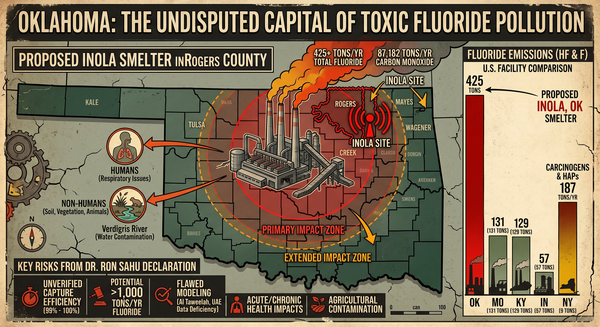
Primary aluminum production inherently creates gaseous and particulate fluorides. While modern dry-scrubbers capture the vast majority of these gases, industrial air permits allow a continuous, legal baseline emission rate.
For row crops, fluoride might not immediately kill the plant. But for grazing livestock, it is devastating.
                  THE PATH OF INDUSTRIAL FLUOROSIS

  [ Smelter Stacks ] ──► Airborne Fluoride Plumes
                                │
                                ▼
                       Settles on Bermuda Hay & Pastures
                                │
                                ▼
                       Ingested by Grazing Cattle
                                │
                                ▼
  [ Chronic Fluorosis ]
  • Teeth soften and grind away to exposed nerves
  • Bone spurs, extreme lameness, and joint fusion
  • Severe weight loss and collapsed milk production
When forage absorbs airborne fluoride, cattle ingest it day after day. The chemical replaces calcium in their skeletal systems, causing industrial fluorosis. Teeth wear down to sensitive stumps, making eating agonizing. Bones develop painful calcium spurs, crippling cattle with permanent lameness.
In downwind agricultural communities around older smelters, entire herds have had to be liquidated. Rogers County ranchers are asking a question state regulators have yet to satisfactorily answer: when you build the largest smelter in North American history, even a 1% leakage rate across 750,000 tons of production adds up to tons of fluoride settling on their hay fields every year.
3. An Insatiable Appetite for Power (and Who Might Foot the Bill)
There is a reason aluminum was historically dubbed "congealed electricity." Smelting raw alumina into ingots requires an around-the-clock current so vast it beggars belief.
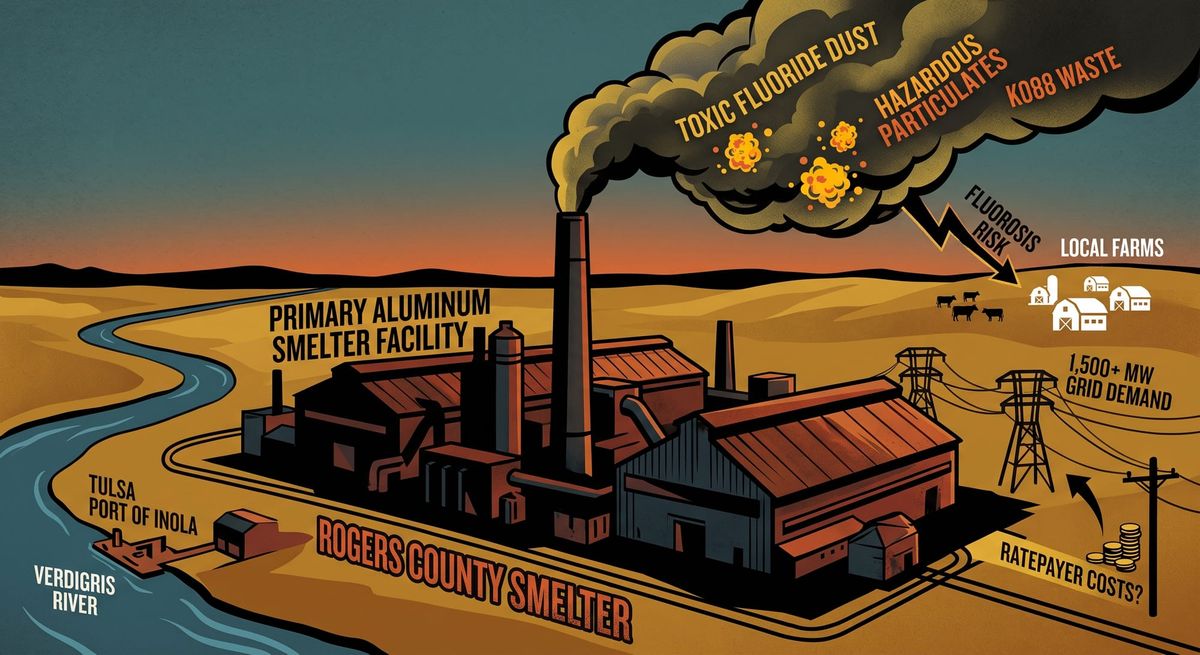
To run at full capacity, the Inola smelter will demand an estimated 1,500 to 2,000 megawatts of electricity continuously.
To put that in perspective: that is more power than the entire residential base of the City of Tulsa consumes on an average day.
ESTIMATED POWER DEMAND COMPARISON

Inola Smelter (Full Capacity)  ██████████████████████████████ ~1,500+ MW
City of Tulsa (Base Res.)      ██████████████
Rural Rogers County            ██
Where will that power come from, and who pays for the wires?
The joint venture is negotiating with Public Service Company of Oklahoma (PSO) for a dedicated industrial mega-contract. But keeping a 2,000-megawatt load energized 24/7 requires massive capital expenditures: dedicated transmission lines, new high-voltage substations, and firm peaker capacity to ensure the regional grid doesn't collapse during brutal summer heatwaves or winter deep freezes.
Before the Oklahoma Corporation Commission (OCC), consumer advocates are already raising the red flag. If industrial giants are handed cut-rate power tariffs to lure them into the state, the billions required for grid upgrades and transmission expansion have a funny way of trickling down onto the monthly utility bills of residential households and local small businesses.
The Bottom Line
Economic growth is easy to cheer for when it comes wrapped in federal grant announcements and promises of reindustrialization. But industrial progress has a cost, and it is rarely borne by the executives in boardrooms thousands of miles away.
As the state Department of Environmental Quality reviews the air permits and the courts weigh legal challenges over the foreign sovereign ownership of the plant, Rogers County residents are left looking at the fine print: an operator with a history of spewing dust, a ranching economy exposed to invisible chemical fallout, and a power grid that could make every ratepayer in the state an involuntary financial partner.