Oklahoma Inola Smelter Positions Oklahoma to Become Undisputed Capital of Toxic Fluoride Pollution

THE POTLINE ARITHMETIC
How a proposed $4 billion aluminum megaproject in Rogers County promises green jobs while quietly positioning Oklahoma to become America's undisputed capital of toxic fluoride pollution.
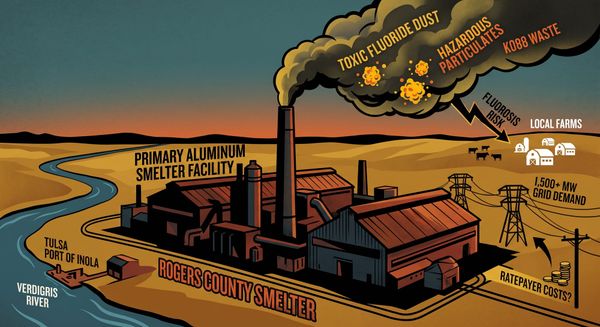
INOLA, Okla. -- If you drive twenty-five miles east of Tulsa into Rogers County, the landscape softens into rich, undulating prairie along the Verdigris River. Here lies the Tulsa Ports Industrial Park in Inola, a quiet swath of green field that state economic developers have spent years pitching as the crown jewel of Oklahoma’s industrial future. In February 2026, foreign industrial giant Emirates Global Aluminum (EGA), alongside domestic titan Century Aluminum Company (operating under Aluminum Oklahoma, LLC), unveiled an ambitious blueprint: a state-of-the-art primary aluminum smelter that would become the largest in North America.
On paper, the pitch sounded like a textbook Rust Belt revival story tailored for the Sooner State: billions in capital investment, hundreds of high-paying industrial jobs, and domestic manufacturing muscle for a metal crucial to defense, aerospace, and the green energy transition. But behind the glossy press releases and municipal celebration lurked an engineering calculation so jarring that it prompted Oklahoma’s top law enforcement officer to take the extraordinary step of suing the project's developers in court.
KEY FINDINGS FROM COURT RECORDS & EXPERT ANALYSIS
- Unmatched Scale: If constructed as designed, the Inola facility will be the largest primary aluminum smelter by production tonnage in the United States.
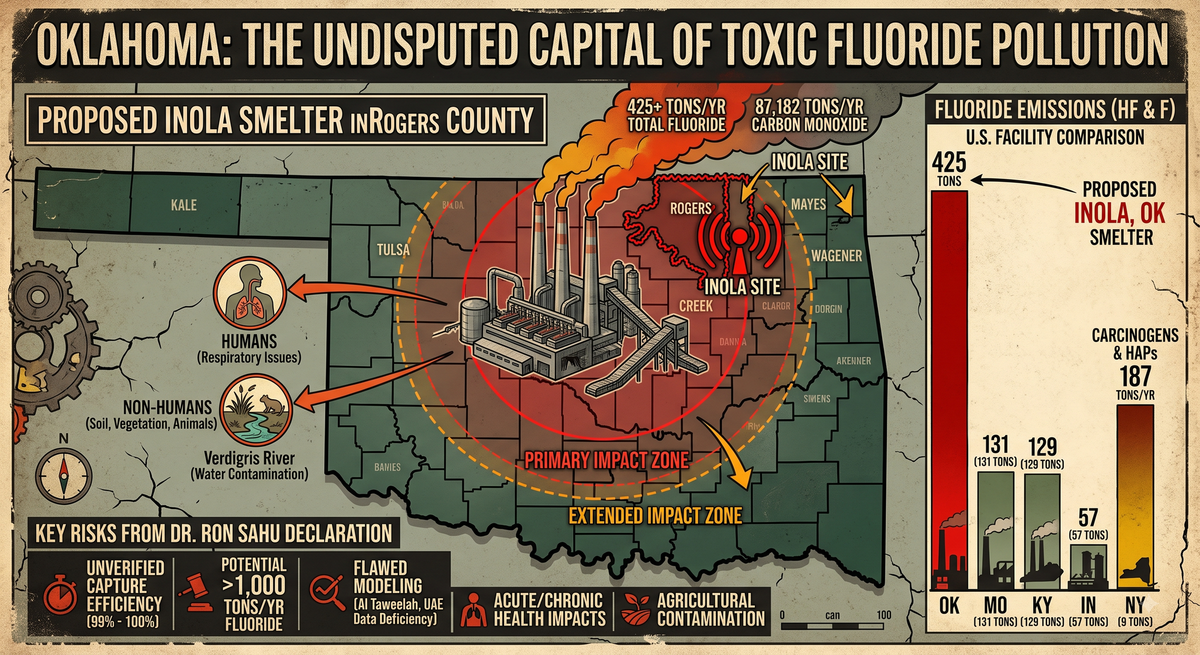
- Nationwide Emissions Leader: Even under the developer’s own baseline calculations, the facility would emit 425+ tons of total fluoride per year--making it the #1 single source of fluoride pollution across ALL industrial sectors nationwide.
- Carbon Monoxide Colossus: The plant's air permit application projects 87,182 tons per year of carbon monoxide, along with hundreds of tons of PM2.5, nitrogen oxides, and carcinogens.
- Fantasy Efficiency Assumptions: Expert analysis filed in federal court reveals the permit relies on unverified 99% to 100% pollutant capture assumptions and foreign benchmark data from Abu Dhabi that lack raw operating logs. Slight drop-offs in capture could push fluoride emissions past 1,000 tons annually.
THE LEGAL FIRESTORM
On June 2, 2026, Oklahoma Attorney General Gentner Drummond filed a civil lawsuit in Rogers County (subsequently removed to the U.S. District Court for the Northern District of Oklahoma, Case No. 26-cv-00450-SEH-SH) seeking to abate and enjoin the anticipated public nuisance. The state's action was backed by a crushing 43-page expert declaration from Dr. Ranajit "Ron" Sahu, a Caltech-trained chemical and mechanical engineer with over 35 years of environmental consulting experience for the U.S. Department of Justice, EPA, and state regulatory bodies.
Dr. Sahu’s evaluation of the Prevention of Significant Deterioration (PSD) air permit application--submitted to the Oklahoma Department of Environmental Quality (DEQ) on February 9, 2026--peels back the corporate boilerplate to reveal an environmental footprint of unprecedented magnitude.
According to the permit filings, the proposed plant will unleash a staggering array of regulated air contaminants into the atmosphere surrounding Rogers County every single year:
- 87,182 tons per year of Carbon Monoxide (CO), an asphyxiant gas;
- 731 tons per year of particulate matter, including 265 tons of fine particulate matter (PM2.5) that penetrates deep into human pulmonary tissue;
- 316 tons per year of Nitrogen Oxides (NOx) and 217 tons per year of Volatile Organic Compounds (VOCs), primary atmospheric precursors to ground-level smog;
- 187 tons per year of hazardous air pollutants (HAPs), including known human carcinogens;
- Over 425 tons per year of total fluoride compounds (including hydrogen fluoride, HF).
A FLUORIDE FOOTPRINT WITHOUT EQUAL
Fluoride emissions in primary smelting originate from the electrolytic reduction of alumina in massive molten salt baths ("pots") containing cryolite. When gaseous hydrogen fluoride releases into ambient air, it deposits into surrounding soils and vegetation, posing severe risks to agriculture, livestock, and local populations.
To understand just how extraordinary the Inola plant’s 425-ton annual fluoride projection is, Dr. Sahu cross-referenced official data from the EPA’s National Emissions Inventory (NEI). When measured against every existing primary aluminum smelter operating in the United States today, the proposed Oklahoma facility does not merely top the charts--it eclipses the entire domestic industry combined.
U.S. Primary Aluminum Facilities Comparison:
Proposed Inola Smelter (EGA / Century) -
Inola, OK - 425.0 Tons/Yr
Magnitude 7 Metals - Marston, MO - 131.0 Tons/Yr Century Aluminum Sebree LLC -
Robards, KY - 129.0 Tons/Yr Century Aluminum of KY LLC -
Hawesville, KY - 77.0 Tons/Yr Alcoa Warrick LLC -
Newburgh, IN - 57.0 Tons/Yr Century Aluminum of South Carolina Inc. -
Goose Creek, SC - 31.0 Tons/Yr Alcoa Primary Metals Intalco Works -
Ferndale, WA - 29.0 Tons/Yr Alcoa USA Corp - Massena, NY - 9.0 Tons/Yr
(Data Source: EPA NEI & DEQ Permit Application Case 26-cv-00450. Figure includes total fluorides).
The highest emitting operating smelter in the country today--Magnitude 7 Metals in Missouri--emits 131 tons of hydrogen fluoride per year. The proposed Inola smelter would produce more than three times that volume. In fact, Inola’s fluoride output would exceed the combined emissions of all seven major operating aluminum smelters in North America.
"The proposed plant would not only be the highest fluoride emitter among the primary aluminum plants in the US... it would also rank as the highest-emitting plant considering all industrial plants across all industries in the US." -- Dr. Ranajit Sahu, Expert Declaration filed in U.S. District Court
The anomaly becomes even starker when comparing Inola against every industrial facility in the United States--including massive chemical manufacturing complexes, phosphate fertilizer plants, and coal-fired electric utilities. Under current EPA records, the single largest industrial fluoride polluter in North America is Mosaic Fertilizer’s plant in Mulberry, Florida, which emits 310 tons of HF annually. The Inola smelter would comfortably leapfrog Mosaic to claim the #1 spot in the nation.
Top U.S. Industrial Fluoride Emitters Across All Sectors:
1 (Projected). Oklahoma Primary Aluminum (EGA/Century) -
Aluminum Smelter - OK - 425.0 Tons/Yr 1 (Current).
Mosaic Fertilizer LLC - Fertilizer Plant - FL - 310.0 Tons/Yr 2.
Nebraska Public Power District - Power Generation - NE - 259.0 Tons/Yr 3.
Luminant Generation Company LLC - Power Generation - TX - 168.0 Tons/Yr 4.
Associated Electric Cooperative, Inc. - Power Generation - MO - 151.0 Tons/Yr 5.
NRG Texas Power LLC - Power Generation - TX - 143.0 Tons/Yr 6.
Magnitude 7 Metals - Aluminum Smelter - MO - 131.0 Tons/Yr
THE "AL TAWEELAH" SHELL GAME: FLAWED MODELING & OPTIMISTIC MATH
How did the permit applicants arrive at 425 tons per year? According to Dr. Sahu’s evidentiary report, even that astronomical number relies on baseline assumptions that border on engineering fantasy.
In their filing with Oklahoma DEQ, the developers claimed their two massive potlines (Potlines A and B) would achieve a 99% to 100% capture efficiency of raw fluoride gases escaping the pot hoods, followed by a 99.96% control efficiency through dry scrubbers. However, the application provides zero continuous monitoring systems or verifiable engineering mechanisms to guarantee these extreme capture rates on a day-to-day operational basis.
Dr. Sahu notes that in real-world metallurgical operations, capture efficiency routinely fluctuates due to pot maintenance, hood opening frequencies, draft variations, and heat spikes. If the capture efficiency and/or control efficiency were to be even slightly smaller--say, 98 percent capture followed by 99 percent control--total fluoride emissions would be dramatically higher than 425 tons per year, potentially well above 1,000 tons per year.
Moreover, to justify their baseline emissions, the applicant relied on benchmark operational data provided via a brief email on July 8, 2026, from Emirates Global Aluminum's flagship Al Taweelah smelter in the United Arab Emirates. As Sahu pointed out to the court, the Al Taweelah data consisted of a high-level five-year summary table lacking raw stack test reports, operating parameters, or variability metrics. Because bauxite ore composition and operational parameters in the Middle East differ fundamentally from materials intended for Oklahoma, using unverified summary data from Dubai to model air quality impacts in Rogers County is scientifically unsound.
WHAT LIES AHEAD FOR INOLA?
The fight over the Inola smelter represents a pivotal moment for eastern Oklahoma. State leaders face a high-stakes choice: embrace a multi-billion-dollar industrial windfall, or side with Attorney General Gentner Drummond in halting a project that could alter the environmental profile of Rogers County for generations.
As federal court proceedings unfold in Tulsa, public scrutiny of Oklahoma DEQ’s permitting process is intensifying. For the residents of Inola and the greater Tulsa area, the question is no longer just how many jobs the new economy will bring--but what, exactly, those jobs will cost to breathe.
Sources & Legal Citations:
- State of Oklahoma ex rel. Gentner Drummond v. Century Aluminum Co. & Aluminum Oklahoma, LLC, Case No. 26-cv-00450-SEH-SH (U.S. District Court, Northern District of Oklahoma). Declaration of Dr. Ranajit Sahu filed August 11, 2026.
- Emirates Global Aluminum (EGA) / Aluminum Oklahoma LLC Prevention of Significant Deterioration (PSD) Air Permit Application, Oklahoma DEQ (Filed Feb 9, 2026).
- U.S. Environmental Protection Agency (EPA) National Emissions Inventory (NEI) Point Source Air Emissions Data.