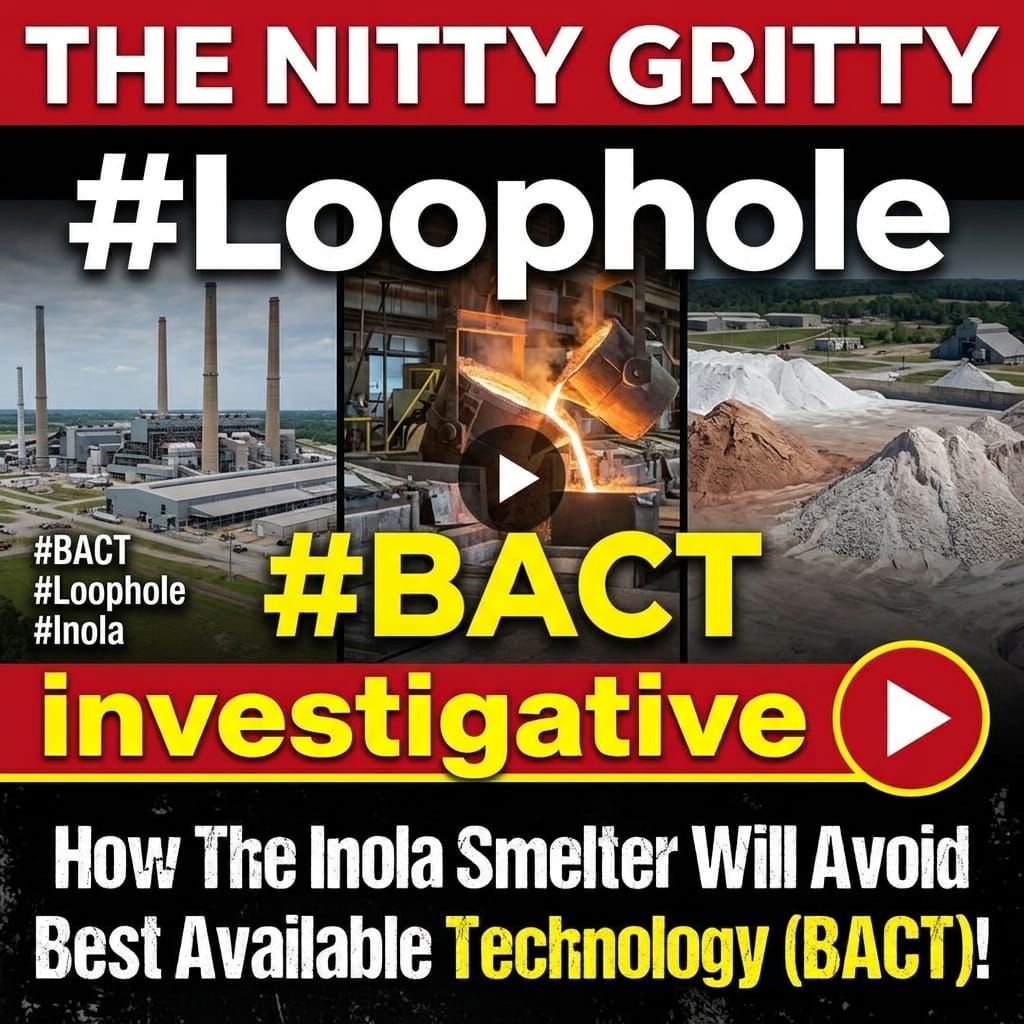
The Nitty Gritty - How The Inola Smelter Will Avoid Environmental Best Available Technology (BACT) in Oklahoma

When officials from the Oklahoma Department of Environmental Quality (ODEQ) stepped up to the podium inside the Inola High School Fine Arts Center, the atmosphere was thick with bureaucratic composure. The agency had brought along crisp presentation decks filled with multi-colored process arrows, flowcharts, and administrative acronyms. The message was clear: there is a system, the system is rigorous, and the system exists to protect public welfare.
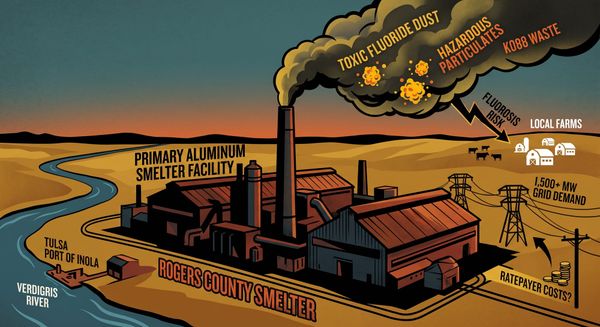
Yet for the hundreds of ranchers, landowners, and local residents packed into the auditorium, the clinical charts felt less like a protective shield and more like a procedural roadmap for industrial accommodation. As Oklahoma Primary Aluminum pushes forward with plans to construct a massive $4 billion primary aluminum smelter across 350 acres at the Port of Inola, ODEQ’s formal presentations lay bare a troubling reality.
The regulatory apparatus governing industrial development in Oklahoma does not exist to stop environmental degradation before it starts. It exists to quantify, categorize, and permit that damage right up to the legal limit—only springing into action once toxic volumes reach catastrophic scale.
The Architecture of an Exemption
To understand why Inola residents are sounding alarms, one has to look closely at slide six of the DEQ’s Prevention of Significant Deterioration (PSD) presentation. Titled “New Source Review (NSR) Pollutants,” the slide outlines how the state categorizes airborne industrial byproducts.
On the left side of the ledger are standard criteria pollutants: Nitrogen Dioxide ($NO_2$), Sulfur Dioxide ($SO_2$), Particulate Matter ($PM_{2.5}$ and $PM_{10}$), and Carbon Monoxide ($CO$). These are governed by National Ambient Air Quality Standards (NAAQS) and subjected to comprehensive computer modeling to verify that outdoor air remains safe to breathe.
On the right side of the slide sits a far more volatile roster of toxins:
- Hydrogen Fluoride ($HF$)
- Hydrogen Chloride ($HCl$)
- Polycyclic Aromatic Hydrocarbons ($PAHs$)
These are classified under federal law as Hazardous Air Pollutants (HAPs)—compounds designated by the Environmental Protection Agency as acutely toxic, carcinogenic, or capable of inflicting severe chronic health defects.
One might reasonably assume that because these toxins are exponentially more dangerous than ordinary dust or combustion gases, they would face the most stringent review imaginable. Under Oklahoma's regulatory implementation, however, the exact opposite occurs.
Under state and federal PSD frameworks, these hazardous chemicals are formally excluded from standard NSR pollutant status. Instead of automatically requiring the developer to install top-tier filtration systems to eliminate toxic output at the source, the state subjects Hazardous Air Pollutants to Oklahoma Best Available Control Technology (BACT) review only if two steep benchmarks are satisfied:
- The facility must already be classified as a "major source" by emitting at least 10 tons of the toxin per year.
- Projected emissions for that individual hazardous pollutant must exceed 100 tons per year.
The Reality of 100 Tons of Acid Gas
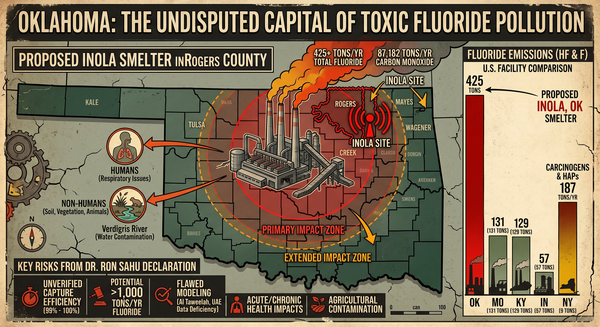
In the language of industrial permitting, "100 tons" is tossed around as a routine administrative benchmark. In chemical reality, 100 tons of Hydrogen Fluoride represents 200,000 pounds of an aggressively corrosive, reactive acid gas capable of transforming the surrounding ecology.
Unlike common particulate matter that settles passively on the ground, gaseous fluorides interact directly with moisture in the atmosphere and on plant surfaces to form hydrofluoric acid. Pasture grasses, clover, and agricultural crops actively absorb and bioaccumulate these fluoride deposits directly into their tissues.
For Rogers County’s agricultural economy, that bioaccumulation poses an existential threat. Cattle grazing on fluoride-contaminated forage develop fluorosis—a degenerative condition where fluoride replaces calcium in bone structures. Teeth turn soft, blacken, and erode down to the gums, preventing animals from chewing, while leg bones thicken, deform, and fracture under their own weight.
Under Oklahoma’s legal baseline, an industrial facility could emit tens of thousands of pounds of hydrogen fluoride across the Verdigris River basin every single year without meeting the 100-ton statutory trigger required to force Oklahoma BACT filtration for that chemical.
The regulatory framework does not step in to ask whether nearby herds will be maimed or if downwind children will suffer chronic respiratory inflammation. It simply logs the volume on a ledger, confirms it sits beneath the statutory ceiling, and stamps the application compliant.
Permitting the Problem
This statutory architecture exposes the fundamental design flaw at the heart of state environmental oversight: the burden of proof is systematically placed on the community, while the margin of tolerance is granted entirely to the polluter.
Under Oklahoma law, DEQ regulators possess no statutory authority to reject a permit simply because a facility poses an inherent hazard to the surrounding area. If an applicant demonstrates through theoretical dispersion models that its toxic output does not breach arbitrary regulatory caps, state regulators are legally obligated to advance the permit toward issuance.
This dynamic turns public meetings into an exercise in containment rather than oversight. Citizens are encouraged to step to a microphone for three minutes to express their fears regarding water contamination, livestock losses, and declining property values. In response, agency officials explain that state statutes only allow them to assess technical metrics, not prevent the project from breaking ground.
By the time legal mechanisms like Title V operating reviews, EPA objections, or court appeals become active, the plant is already constructed, the steel is erected, and the stacks are operational. At that stage, enforcement transitions entirely into a post-mortem exercise: issuing administrative fines or reporting citations while the surrounding community lives with the permanent environmental burden.
A System Operating as Intended
The escalating public battle over the Inola smelter—complete with municipal moratoriums, legislative resolutions, and federal court interventions—is often framed as an administrative oversight breakdown.
The reality is far more sobering. The system is not failing; it is working exactly as designed.
Oklahoma’s environmental statutes were not crafted to preemptively protect rural communities from toxic heavy-industrial expansion. They were designed to provide legal authorization for that expansion, establishing generous allowable thresholds for dangerous toxins like Hydrogen Fluoride and treating ecological contamination as an acceptable cost of doing business until someone can prove the numbers crossed an arbitrary red line.
Until state statutes are reformed to prioritize human health and agricultural survival over industrial convenience, Inola and communities like it will remain locked in the same losing cycle: forced to breathe the emissions, monitor the fallout, and prove their own ruin long after the damage is done.