

How Vian's Culture of Political Protection Shielded Joshua Smith—Until Federal Prison
A Follow-Up Investigation
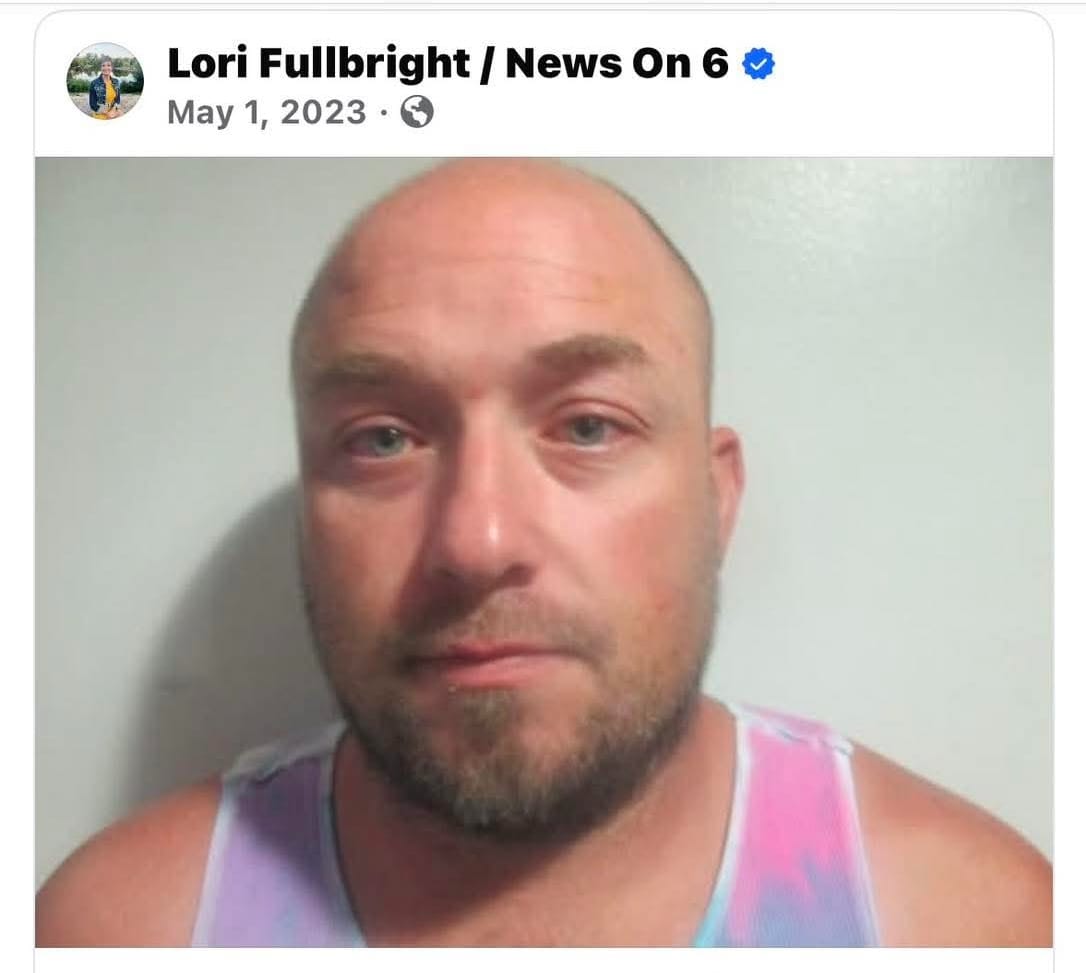
When Joshua Smith was sentenced to 30 years in federal prison for the aggravated sexual abuse of a child, the national media focused on the crime itself—as they should have. A predator removed from society. Justice, however delayed, finally served.
But in Vian, Oklahoma, the conviction carried a different weight. Because Joshua Smith wasn't just another convicted sex offender. He was the man whose repeated arrests—and repeated political rescues—had destroyed two police departments over two decades.
He was the nephew who made that phone call in 2006, summoning his city councilman uncle to a traffic stop.
He was the driver who spent exactly 15 minutes in jail in 2017 before Mayor Dennis Fletcher ordered his release.
And somewhere between those acts of political interference—between a culture that taught him consequences were negotiable and accountability was for other people—Joshua Smith committed unspeakable crimes against an 11-year-old child.
This is the story of what happened when Vian's leadership chose political loyalty over law enforcement. When they fired good officers rather than hold a councilman's nephew accountable. When they built a culture where one family learned they were above the law.
And what it cost.
The 2006 Traffic Stop: When Joshua Smith Learned to Make the Call
It started with a cracked windshield.
In 2006, Vian Police Officer Steve Brackett pulled over Joshua Smith for a minor equipment violation. Routine. By-the-book. The kind of stop officers make dozens of times each week.
But Joshua Smith didn't respond the way most drivers do. He didn't accept the citation. He didn't call a friend for a ride.
He called his uncle, City Councilman James Smith, to make it go away.
And his uncle came. To an active traffic stop. Where he allegedly threatened Officer Brackett's job if he didn't let his nephew go.
Think about that moment. Not just what it reveals about James Smith's abuse of power, but what it reveals about Joshua Smith's expectations.
At some point before that traffic stop—perhaps many times before—Joshua Smith had learned that when law enforcement became inconvenient, you didn't accept consequences. You made a phone call. You summoned someone with political power. And the problem disappeared.
Officer Brackett, to his enormous credit, didn't cave to the pressure. He did his job. He arrested James Smith for interfering with the issuance of a citation—exactly what the law required.
The Sequoyah County District Attorney declined to prosecute James Smith, determining his actions, while inappropriate, weren't criminal. Fine. That's a judgment call prosecutors make.
But Vian's political machine had a longer memory than the DA's office.
James Smith immediately placed the firing of Vian's police chief on the next city council meeting agenda. The chief survived when Smith didn't show up for that meeting—perhaps someone advised him the optics were too toxic.
But a year later, in 2007, James Smith voted successfully to fire Officer Brackett. The stated reason: citizen complaints. The real reason was obvious to everyone in Vian.
The response was unprecedented: the entire Vian Police Department resigned in protest.
Every officer walked out. Sequoyah County sheriff's deputies had to provide law enforcement coverage until new officers could be hired.
The lesson Vian's leadership sent that day was crystal clear: Arrest someone from the Smith family, and we will end your career.
The lesson Joshua Smith learned was equally clear: The rules don't apply to me.
The 2017 Arrest: Mayor Fletcher's Direct Intervention
Fast forward eleven years.
Joshua Smith is still driving. Still breaking the law. And still protected.
On May 2, 2017, Officer Lindsey Green—Vian's first paid female officer and the department's Officer of the Month for March—received a tip from an off-duty colleague. Joshua Smith, who had recently been cited for driving without a valid license, was behind the wheel again.
Green located Smith's vehicle, observed multiple moving violations, and pulled him over. She confirmed through dispatch that Smith's license had been revoked—not just suspended, but revoked, making this a more serious offense.
As a repeat offender driving on a revoked license, Smith met every criterion for arrest. Officer Green made the decision any competent officer would make: she took him into custody.
"I didn't think Vian was like that," Green would later tell the Tulsa World, her voice carrying the weight of disillusionment.
During the booking process at the Vian jail, Smith revealed his identity. "He told me as I was booking him into jail that he was the son of E.O. 'Junior' Smith," Green recalled. She knew Junior Smith as a city councilman. The realization hit immediately: "I thought, 'Well, this is gonna be interesting.'"
The Phone Calls Begin
While transporting Smith to jail, Green contacted Police Chief Ted Johnson and asked about reducing Smith's fine. Johnson advised against it, noting that Smith "didn't learn his lesson the first time"—standard police judgment for repeat offenders.
Green returned to town hall 45 minutes after the arrest to write her report. That's when things got interesting.
The town clerk handed Green a cell phone. City Attorney Larry Vickers was on the line.
According to Green's account to the Tulsa World: "He asked me what happened, I told him. He said I did not have probable cause to make the arrest. I told him I did have probable cause and he wouldn't listen. He said 'Hand the phone back to the clerk.' That's when he told her the ticket will be dropped and he will be released from jail."
Read that again. The city attorney—who wasn't at the scene, didn't observe the violations, and didn't run the license check—unilaterally declared the arrest invalid and ordered Smith's release.
Green, concerned about the legal implications, contacted a local judge for clarification. The judge confirmed what she already knew: she had probable cause. The arrest was justified. The city attorney was wrong.
But in Vian, being legally correct doesn't matter when you've arrested the wrong person.
Enter Mayor Dennis Fletcher
What happened next is documented in multiple news reports and Green's own account.
Mayor Dennis Fletcher arrived at town hall. According to reports, Fletcher told Green she had violated Smith's civil rights by taking him to jail. Then Fletcher ordered the court clerk to release Smith from custody.
Not through proper legal channels. Not through a judicial review process. Not through the city attorney filing a motion. Through mayoral decree.
The arrest report is explicit: "The report says Vian's mayor told her she'd violated Smith's civil rights by taking him to jail, then sent the court clerk to get Smith."
Joshua Smith spent exactly 15 minutes in jail before being released on the mayor's orders.
Think about the legal gymnastics required to reach that conclusion. An officer observes a driver commit multiple moving violations. She pulls him over. She confirms through official channels that his license is revoked—meaning he has no legal authority to drive. She arrests him for a crime—driving under revocation as a repeat offender.
At what point did civil rights get violated? At what point did the process become improper?
The answer: never. Unless "being the son of a city councilman" is now a protected civil right that exempts you from arrest.
The Coverup
Fletcher's immediate response was to threaten Green's job. According to multiple reports, Green was told she would "more than likely" be fired.
Police Chief Johnson stood by his officer. "She did what she was supposed to do," Johnson said publicly. "By law, she didn't do anything wrong. She was only doing her job."
Rather than face termination for doing her job correctly, Officer Lindsey Green resigned. "I know that I am in the right," she stated. "I don't want a termination on my record."
Chief Johnson resigned two days later in solidarity with his officer. "I don't work for a town that controls the police department," Green explained.
The Vian Police Department then posted a cheerful Facebook statement claiming Green had resigned "to further her career" and wishing her "all the best in her future endeavors." No mention of the Smith arrest. No acknowledgment of mayoral interference. Just corporate-speak covering up political corruption.
Fletcher's Public Response: Deflection and Investigation
When questioned by Tulsa World reporters, Mayor Fletcher declined to provide details about his intervention. "I'll decline at this time to answer that," he said. "I'll have to talk to Larry, but I'd love to get back with you on that."
Fletcher insisted there was no discussion of firing Green—a claim contradicted by Green's own account of being told she'd "more than likely" be fired.
Then came Fletcher's most audacious claim: the city was "looking at hiring an outside agency to review the findings and to investigate whether or not there was any misconduct with the officers."
Let that sink in. The mayor who had just ordered a lawfully arrested man released from jail, causing two law enforcement professionals to resign rather than work under political interference, was now claiming he would investigate the officers for misconduct.
City Attorney Vickers and the city council scheduled a special meeting to examine whether Green's actions were proper. The message was unmistakable: arresting a councilman's son was what needed investigation, not the mayor's interference with that arrest.
"The law's for everyone," Green told reporters. "It doesn't matter if your dad's a council member or not."
In Vian, it mattered.
Seven Months Later: The Crimes
Between December 2017 and March 2018—just seven months after Mayor Fletcher ordered his release—Joshua Smith sexually abused an 11-year-old child.
Multiple times.
According to federal prosecutors, Smith penetrated the child with his hand on numerous occasions. The victim, testifying at trial, recounted the abuse in detail that led to Smith's conviction.
On June 29, 2022, a federal jury found Joshua Thomas Smith, then 41, guilty of aggravated sexual abuse of a child in Indian Country. The case was prosecuted federally because Smith is a member of a federally recognized Indian tribe and the crimes occurred within Cherokee Nation reservation boundaries.
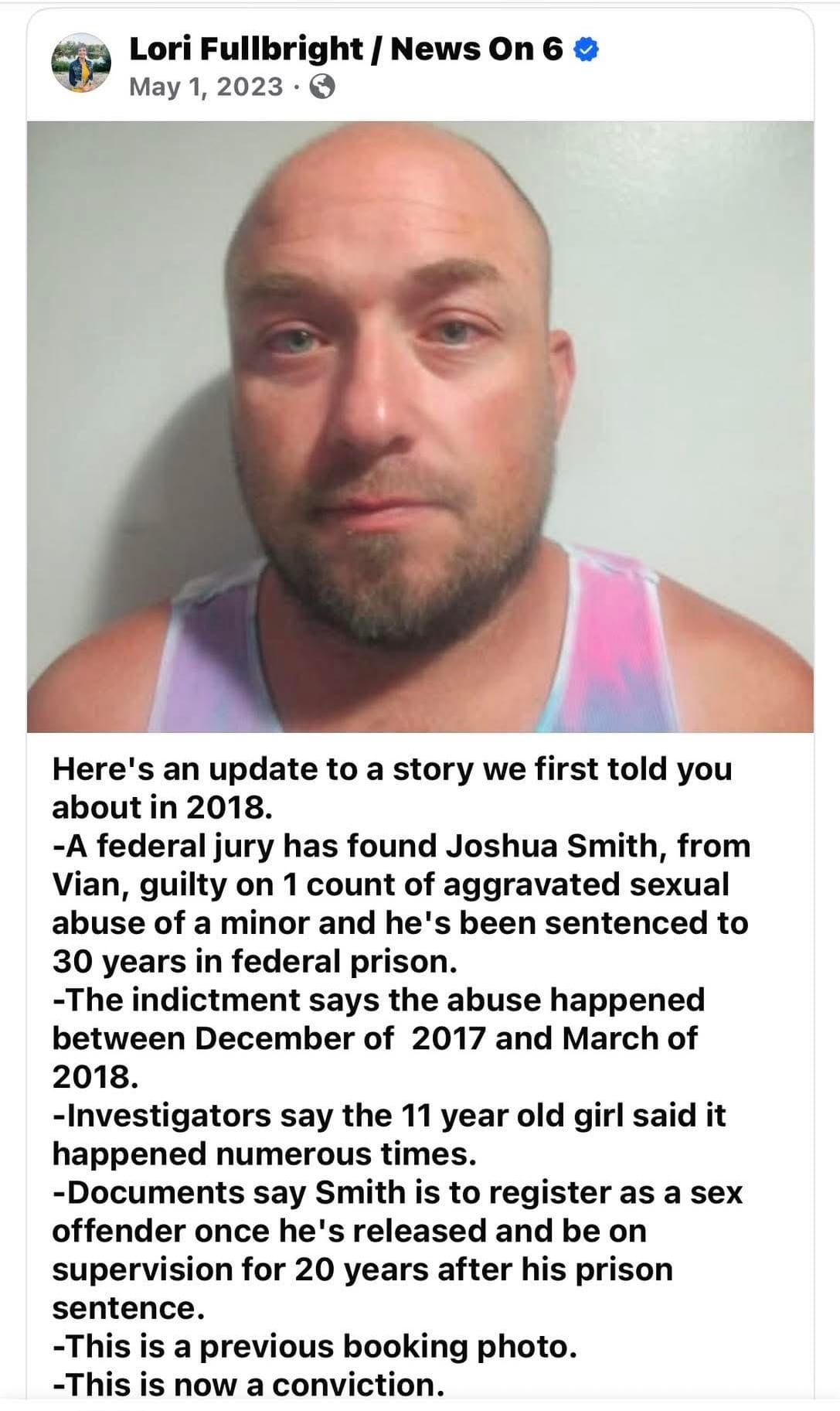
In 2023, Smith was sentenced to 30 years in federal prison. Upon release, he will be required to register as a sex offender and remain under supervision for 20 years.
He is currently serving that sentence in federal custody.
The Question No One Wants to Ask
Did Vian's political protection of Joshua Smith contribute to his crimes?
The answer is complicated, uncomfortable, and essential.
Let me be absolutely clear: Joshua Smith alone is responsible for the sexual abuse he committed. No amount of political corruption forced him to harm that child. Those crimes were his choices, his evil, his moral failure.
Child sexual abuse happens in every community—rich and poor, corrupt and clean. Predators exist regardless of political systems.
But here's what we can say: When someone spends their adult life learning that consequences don't apply to them, that rules are negotiable, that a phone call to the right person makes accountability disappear—what culture does that create?
Consider the timeline:
2006: Joshua Smith, in his 20s, calls his uncle during a traffic stop to make the problem go away. His uncle shows up and allegedly threatens the officer. The officer who arrests the uncle gets fired a year later. The entire police department quits rather than work under political interference. Smith walks free.
Lesson learned: I'm above the law. My family has power. Officers who try to hold me accountable lose their jobs.
2017: Joshua Smith, now in his late 30s, drives repeatedly on a revoked license. Officer Green arrests him legally and appropriately. Within an hour, the mayor and city attorney order his release. He spends 15 minutes in jail. The officer and police chief resign within days. Smith walks free again.
Lesson reinforced: Nothing has changed. I'm still untouchable. Even as a repeat offender, even when the arrest is legally solid, the rules still don't apply to me.
December 2017 - March 2018: Seven months after that improper release, Joshua Smith sexually abuses an 11-year-old child multiple times.
I'm not suggesting a direct causal link. Human behavior is more complex than simple cause and effect.
But I am asking: When someone watches two police departments collapse rather than hold him accountable for traffic violations, does that person come to believe he's truly untouchable?
When city officials repeatedly demonstrate that political connections override law enforcement—that the Smith family operates by different rules—does that embolden someone who's already inclined toward predatory behavior?
When accountability becomes theoretical rather than real, when consequences are something that happens to other people, when the system bends to protect you time and time again—what boundaries remain?
We know from extensive research on criminal behavior that accountability matters. That consistent consequences for lesser offenses can prevent escalation to more serious crimes. That when people learn the system won't hold them responsible, some will push boundaries further and further.
We'll never know what might have been different if Joshua Smith had served real jail time in 2006. Or 2017. If officers hadn't been fired for doing their jobs. If mayors hadn't intervened to protect him.
What we know is this: Vian's leadership chose to sacrifice law enforcement integrity to protect the Smith family. They fired good officers rather than allow a councilman's nephew to face consequences.
And somewhere in that culture of political protection and selective accountability, an 11-year-old child's life was destroyed.
Dennis Fletcher's Reckoning—and His Silence
The cosmic irony of Mayor Fletcher's 2026 arrest for interfering with law enforcement has not been lost on anyone paying attention to Vian's history.
On March 21, 2026, Fletcher was arrested at a youth baseball tournament in Ripley, Oklahoma, and charged with misdemeanor obstruction. A Payne County deputy, investigating parking complaints and reports of profanity at a sporting event, ordered Fletcher to maintain a 25-foot distance under Oklahoma's new buffer zone law. According to body camera footage, Fletcher "refused to comply with repeated commands to step away from the scene."
The parallels to 2017 are striking:
2017: Officer makes lawful arrest → Mayor Fletcher intervenes → Arrested person improperly released → Officer's career destroyed
2026: Deputy conducting investigation → Mayor Fletcher approaches → Deputy enforces law → Mayor arrested
The difference: In 2026, a Payne County deputy had the independence and institutional support to arrest someone who interfered with law enforcement—regardless of their political position.
It's exactly what Officer Lindsey Green tried to do in 2017 when she arrested Joshua Smith. It's exactly what Officer Steve Brackett tried to do in 2006 when he arrested Councilman James Smith.
But they worked for Vian. And in Vian, political power trumps law enforcement.
Since his arrest, Fletcher has declined all media requests for comment. The Vian Town Board has issued no statement about whether Fletcher's arrest affects his standing as mayor. He was reappointed to a two-year term in May 2025—just ten months before his arrest—and remains mayor as of this writing.
Fletcher's silence is strategic. Speaking publicly about his arrest invites questions about 2017. It invites scrutiny of his intervention on behalf of Joshua Smith. It invites accountability he has never faced.
But his silence also speaks volumes. There has been no apology to Officer Green or Chief Johnson. No acknowledgment that his interference with Smith's arrest was improper. No recognition that his actions contributed to a culture where political protection mattered more than public safety.
The Smith Family: Still Influential, Still Unaccountable
Despite being at the center of three separate police scandals spanning two decades—and despite his son's federal conviction for child sexual abuse—E.O. "Junior" Smith has never faced meaningful political consequences.
Smith served on the Vian City Council during both the 2006 and 2017 incidents. He ran for the District 5 seat on the Cherokee National Tribal Council. As recently as 2016, he stood alongside Mayor Fletcher and other city officials at ceremonial events, representing Vian in official capacities.
There is no evidence he has ever publicly addressed his family's role in destroying two police departments. No statement about his son's crimes. No acknowledgment that his family's pattern of political interference undermined law enforcement in his community.
His nephew, Joshua Smith, is now 43 years old, serving 30 years in federal prison. His earliest possible release date would be sometime in the 2050s, when he'll be in his 70s.
The officers who tried to hold him accountable in 2006 and 2017? Their careers in Vian were destroyed. Officer Steve Brackett—fired. Officer Lindsey Green—forced to resign. Police Chief Ted Johnson—resigned rather than work under political interference.
The child Joshua Smith abused? She'll carry those scars for life.
The people of Vian? They've lost decades of institutional law enforcement knowledge, experienced officers who understood their community, and the trust that comes from knowing police can do their jobs without political interference.
The Questions That Still Need Answers
Five years after Joshua Smith's conviction, fundamental questions remain unanswered:
1. Did Mayor Fletcher ever face internal review for his 2017 intervention?
Fletcher claimed the city would hire an outside agency to investigate whether Officers Green and Johnson committed misconduct. Did that investigation ever occur? If so, what were the findings? If not, why not?
2. Has the Vian Town Board ever addressed the pattern?
After three major incidents over twenty years—all involving the Smith family, all resulting in police resignations—has the town board ever held hearings? Implemented reforms? Established oversight mechanisms to prevent mayoral or council interference with arrests?
3. What is the nature of the Fletcher-Smith relationship?
Political favor-trading exists everywhere. But Fletcher's 2017 intervention on behalf of Joshua Smith cost his town a police chief and rising officer. What is the relationship between Fletcher and the Smith family that made such a sacrifice politically worthwhile?
4. Has Vian's insurance carrier addressed liability?
When a mayor orders the improper release of a legally arrested individual, the municipality assumes enormous civil liability. When a pattern of such behavior exists, insurance carriers typically demand reforms or refuse coverage. What has Vian's insurer said about this?
5. Did anyone in Vian's leadership know about Joshua Smith's crimes before his arrest?
This is the darkest question, and one that may never be answered. The abuse occurred between December 2017 and March 2018. Smith wasn't arrested until later (the precise date isn't public). Federal prosecution began in 2021-2022. Was there any earlier knowledge? Any warning signs that were ignored because of Smith's political protection?
6. What reforms, if any, has Vian implemented?
Has the town established policies prohibiting political interference with arrests? Created an independent review board? Implemented civil service protections for officers? Anything to prevent this from happening again?
The Cost of Corruption
When we talk about political corruption, we often think in abstractions: "undermining institutions," "eroding public trust," "compromising integrity."
But Joshua Smith's case puts a human face—specifically, a child's face—on what corruption actually costs.
The officers who tried to do their jobs: Careers destroyed. Steve Brackett fired. Lindsey Green forced out. Ted Johnson resigned. Years of experience and institutional knowledge lost to Vian.
The community: Two complete police department collapses in eleven years. Ongoing difficulty recruiting and retaining quality officers who research Vian's history and decide to work elsewhere. A culture where citizens learn that political connections matter more than the law.
The child: An 11-year-old girl who was sexually abused by a man who had learned, over two decades, that consequences didn't apply to him. A survivor who will carry that trauma for life.
The Smith family's other victims: We know about the 2006 and 2017 incidents because they resulted in police resignations and media coverage. How many other times did Joshua Smith commit offenses that never made the news? How many other officers pulled him over, called it in, and were quietly told to let him go? How many other victims might exist who never came forward because they saw how Vian's system protected the powerful?
This is what corruption costs. Not just money. Not just institutions. Not just careers.
Lives.
Why This Story Matters Beyond Vian
Vian, Oklahoma, has a population of 1,374 people. In the grand scheme of American governance, it's a tiny municipality. Most readers have never been there and never will.
So why does this story matter?
Because Vian is not unique.
Small-town political interference with law enforcement happens across rural America. Stories emerge periodically of mayors firing police chiefs, councils dismissing officers, and elected officials intervening in arrests of politically connected individuals.
But Vian's twenty-year pattern is remarkable for its brazenness, its repetition, and its documentation. Most small towns have one such incident that generates headlines and prompts reforms. Vian has had three major incidents with no reforms and no accountability.
The town offers a case study in how institutional corruption becomes self-perpetuating:
- Initial incident establishes precedent (2006): Political interference succeeds; officer is punished, not officials
- Precedent becomes pattern (2017): Officials repeat same interference, knowing there will be no consequences
- Pattern becomes culture (2020s): Everyone understands the unwritten rules; quality officers self-select out
- Culture produces tragedies (2017-2018): Protected individual escalates criminal behavior with impunity
And here's the most chilling part: Joshua Smith's case shows how political corruption in seemingly unrelated areas—traffic enforcement—can intersect with the worst crimes imaginable.
When we allow politicians to interfere with "minor" law enforcement—traffic stops, misdemeanors, suspended licenses—we're not just compromising institutional integrity. We're teaching certain individuals that they're above all laws. We're creating a culture where accountability is theoretical. We're emboldening people who might already be predisposed to push boundaries.
We're protecting monsters.
Three Possible Outcomes
As of this writing, Dennis Fletcher's criminal case in Payne County remains pending. He faces a maximum of one year in jail and a $500 fine if convicted of misdemeanor obstruction.
But the legal case is almost beside the point. Even if Fletcher is acquitted, even if charges are dismissed, even if he negotiates a plea deal, the damage is done.
For twenty years, Vian has demonstrated that political power trumps the rule of law. For twenty years, the town has cycled through police officers and departments rather than hold its elected officials accountable. For twenty years, the pattern has repeated because there have been no consequences for those perpetuating it.
Nothing Changes (Probability: High)
Fletcher's case resolves quietly. He remains mayor. The town board takes no action. Officers considering employment in Vian research the town's history and look elsewhere. The pattern continues, awaiting only the next politically connected individual who needs a citation to disappear.
This is what happened after 2006 and 2017. There's no reason to expect different results now.
Fletcher Falls, Pattern Continues (Probability: Moderate)
Fletcher loses his case or faces sufficient political pressure to resign. The town board appoints or elects a new mayor. But without structural reforms—civil service protections for officers, independent oversight of police operations, strict limits on political interference—the underlying incentives remain unchanged.
The next mayor, facing the same pressures from the same political culture, repeats the pattern. Different face, same corruption.
Scenario 3: Genuine Reform (Probability: Low)
Fletcher's arrest, combined with the renewed attention to Joshua Smith's conviction, serves as a catalyst for comprehensive reform. The town board acknowledges the twenty-year pattern and implements safeguards:
- Independent police commission with authority over hiring, firing, and discipline
- Civil service protections preventing political retaliation against officers
- Clear policies prohibiting interference with arrests, with penalties for officials who violate them
- Regular audits of arrest patterns to identify potential political influence
- Public reporting requirements when city officials interact with active police investigations
The Smith family's influence is curtailed through sunlight and accountability. Future mayors understand that defending law enforcement independence is part of the job description.
This scenario is possible. But it requires something Vian has never shown: the political will to prioritize public safety over political loyalty.
A Message to Vian's Citizens
To the people of Vian, Oklahoma:
You deserved better than Joshua Smith. You deserved better than Dennis Fletcher. You deserved better than a city government that valued political connections over law enforcement integrity.
Most importantly, that 11-year-old girl deserved better.
She deserved a community where predators faced consequences for lesser crimes before they could escalate to destroying a child's life. She deserved police officers who could do their jobs without political interference. She deserved leaders who understood that public safety matters more than protecting a councilman's nephew from a traffic ticket.
Your town has now lost:
- Two complete police departments (2006-2007, 2017)
- Multiple experienced officers who understood your community
- Decades of institutional law enforcement knowledge
- The trust that comes from knowing police can enforce the law equally
- And, most tragically, a child's innocence
The question is whether you'll demand change or accept this as normal.
Dennis Fletcher has been mayor through one of these incidents and was the central figure in another. He remains mayor despite his own arrest for interfering with law enforcement. The message his continued tenure sends is clear: political protection matters more than accountability.
You can change this. Show up to town board meetings and ask hard questions:
- What reforms have been implemented since 2017?
- What happened to the promised outside investigation of Officers Green and Johnson?
- What policies prevent future mayoral interference with arrests?
- Why does Fletcher remain mayor after his own arrest?
- What message does his continued leadership send about Vian's values?
Vote for candidates who commit to police independence and transparency. Vote against officials who have demonstrated they'll sacrifice public safety for political convenience.
Make it politically costly to protect the powerful at the expense of everyone else.
The next chapter of this story is yours to write. Will Vian continue to be a town where political connections trump law enforcement? Where good officers lose their jobs for doing them correctly? Where predators learn they're untouchable?
Or will you demand the reforms necessary to ensure this never happens again?
That child is counting on you to choose differently than your leadership did.
The Phone Call That Changed Everything
In 2006, Joshua Smith made a phone call during a traffic stop. He called his uncle, a city councilman, to make his problems go away.
That phone call set in motion a chain of events that would destroy two police departments, end multiple law enforcement careers, establish a culture of political protection over accountability, and—most tragically—failed to stop a predator before he could abuse a child.
We can't know what might have been different if Officer Brackett had been supported instead of fired. If Joshua Smith had served real jail time in 2006. If Mayor Fletcher had stood with Officer Green instead of ordering Smith's release in 2017.
What we know is this: Every time Vian's leaders chose political protection over accountability, they sent a message. Every time they fired an officer rather than hold a councilman's nephew responsible, they reinforced a culture. Every time they demonstrated that rules don't apply equally, they emboldened those who were already predisposed to harm.
Joshua Smith is now in federal prison for 30 years. He'll be in his 70s before he's eligible for release. That's justice—delayed, but justice nonetheless.
But the political corruption that protected him? The culture that taught him he was untouchable? The officials who valued political loyalty over public safety?
They're still in power in Vian.
Until that changes, the pattern will continue. Different names. Different crimes. Same outcome.
The people of Vian deserve better.
That 11-year-old girl deserved better.
And somewhere in Oklahoma right now, there may be another child whose safety depends on whether a small town finds the courage to choose accountability over political protection.
The next phone call may already be happening.
Appendix: Complete Timeline
2006
- Officer Steve Brackett pulls over Joshua Smith for cracked windshield
- Smith calls uncle, City Councilman James Smith, during traffic stop
- James Smith arrives at scene, allegedly threatens Brackett's job
- Brackett arrests James Smith for interference with citation
- DA declines to prosecute James Smith
- James Smith attempts to fire police chief; chief survives when Smith doesn't attend meeting
2007
- James Smith votes to fire Brackett, citing citizen complaints
- Entire Vian Police Department resigns in protest
- Sheriff's deputies provide interim law enforcement
2017, May 2
- Officer Lindsey Green arrests Joshua Smith for driving on revoked license (repeat offense)
- City Attorney Larry Vickers calls Green, claims no probable cause, orders release
- Mayor Dennis Fletcher tells Green she violated Smith's civil rights
- Fletcher orders court clerk to release Smith from jail
- Smith released after 15 minutes in custody
2017, May 9-10
- Green told she will likely be fired
- Green resigns to avoid termination on record
- Police Chief Ted Johnson resigns in solidarity
- Fletcher claims city will investigate officers for misconduct
2017, December - 2018, March
- Joshua Smith sexually abuses 11-year-old child multiple times
2022, June 27-29
- Federal jury trial begins
- Joshua Thomas Smith, 41, found guilty of aggravated sexual abuse of a child in Indian Country
2023
- Smith sentenced to 30 years in federal prison
- Required to register as sex offender and remain under supervision for 20 years upon release
2026, March 21
- Mayor Dennis Fletcher arrested at Ripley High School baseball tournament
- Charged with misdemeanor obstruction under Oklahoma's buffer zone law
- Released same day on personal recognizance bond
2026, Present
- Fletcher remains mayor of Vian
- No action taken by Vian Town Board
- Fletcher's criminal case remains pending
Sources
- U.S. Attorney's Office, Eastern District of Oklahoma: Press release announcing conviction of Joshua Thomas Smith (June 30, 2022)
- Muskogee Phoenix: "Federal jury convicts Vian man of aggravated child abuse" (July 1, 2022)
- News On 6 / Lori Fullbright: Social media post with sentencing details (May 1, 2023)
- Tulsa World: "Vian police chief, officer resign over pushback from arrest of city councilor's son" (May 2017)
- NewsOn6: "Vian Police Chief Steps Down Over Arrest Of City Councilor's Son" (May 10, 2017)
- 5News (KFSM): "Body Cam Footage Released Of Controversial Arrest By Vian Officer" (May 10, 2017)
- Reason Magazine: "Oklahoma Cop, Police Chief Forced Out For Arresting City Councilman's Son" (May 12, 2017)
- NewsOn6: "Vian mayor arrested under new state law requiring distance from law enforcement" (March 30, 2026)
- News9: "Vian mayor arrested under new Oklahoma law requiring distance from law enforcement" (March 31, 2026)
- Northwest Arkansas Democrat-Gazette: "Oklahoma mayor arrested relate to new state law giving first responders a 25-foot 'buffer' zone" (March 31, 2026)
- EastOklahoma.com: "The City of Vian & Twenty Years of Political Interference with Police" (May 15, 2026)
Reporter's Note: Multiple attempts were made to reach Mayor Dennis Fletcher, members of the Vian Town Board, E.O. "Junior" Smith, and current Vian Police Department officials for comment. None responded to requests for interviews. Fletcher has declined all media requests since his March 2026 arrest.
Update Policy: This article will be updated as Fletcher's criminal case proceeds and if any Vian officials choose to respond to the documented allegations of political interference with law enforcement.
*For tips or additional information about political interference with law enforcement in Vian or other Oklahoma municipalities, contact dustinreedterry@gmail.com. All sources will be protected.