









A comprehensive investigation into Governor Kevin Stitt's controversial midnight veto and the cascade of corruption allegations that defined his tenure
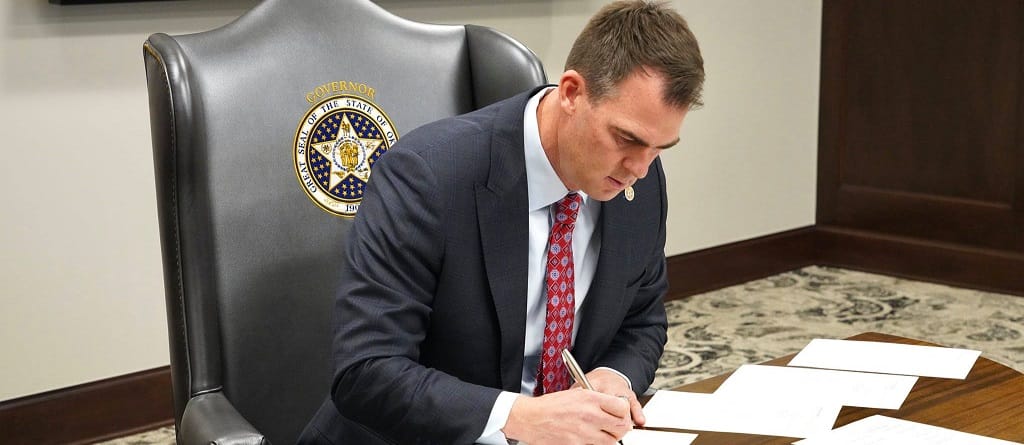
On a late spring night in May 2025, as most Oklahomans slept, Governor Kevin Stitt made a decision that would crystallize his administration's troubled relationship with accountability. In what Attorney General Gentner Drummond would call "incomprehensible and indefensible," Stitt vetoed House Bill 2164—an anti-corruption measure that had sailed through both chambers of the Oklahoma Legislature with unanimous, bipartisan support.
The veto was remarkable not just for its timing or its defiance of legislative will, but for what it represented: a governor who had spent years mired in scandal, accused of favoritism, mismanagement, and conflicts of interest, now actively blocking reforms designed to prevent precisely the kind of behavior that had plagued his administration.
"HB 2164 is smart, sensible legislation that would go a long way toward eliminating instances of collusion, bid-rigging and conflicts of interest involving government officials," Drummond said in a blistering statement released the day after the veto. "Oklahomans are rightfully sick and tired of public corruption. It is incomprehensible and indefensible that the Governor would veto this important legislation, but his action tells you everything you need to know about where he stands."
The veto came against a backdrop of mounting controversies that had turned Stitt's administration into what critics called one of the most scandal-plagued in recent Oklahoma history. From multi-million dollar restaurant deals gone bad to misused pandemic funds, from tribal gaming battles that cost taxpayers millions to allegations of political favoritism for drunk drivers, the Stitt era had become synonymous with the very corruption his veto now seemed designed to protect.
The Bridge to Nowhere: COVID Relief Funds and ClassWallet
Perhaps no scandal better encapsulates the Stitt administration's approach to oversight than the Bridge the Gap program disaster. What was intended as pandemic relief for struggling Oklahoma families instead became a case study in governmental negligence and wasted taxpayer dollars.
In 2020, as COVID-19 shuttered schools across Oklahoma, the Stitt administration launched a program to distribute $8 million in federal Governor's Emergency Education Relief (GEER) funds to low-income families. The money was earmarked specifically for educational supplies—computers, tablets, books, desks, the tools children needed to learn from home during the pandemic.
What happened instead reads like a farce, except real money and real children's education were at stake.
Through a no-bid contract awarded to a Florida-based company called ClassWallet, the Stitt administration distributed digital wallets loaded with federal funds to thousands of Oklahoma families. But the program was implemented, according to federal auditors, "with few safeguards to prevent fraud or abuse."
The results were predictable. Investigative reporting by The Frontier and Oklahoma Watch revealed that families used the education funds to purchase big-screen televisions, kitchen appliances including refrigerators and meat smokers, car stereos, power tools, and furniture. One audit found that $1.7 million was spent on non-educational items. In total, federal auditors recommended clawing back more than $650,000 in misspent funds and reviewing an additional $5.5 million in questionable purchases.
The FBI opened an investigation into the misspending of the $39.9 million GEER grant program.
At the helm of Bridge the Gap was Ryan Walters, then serving as Stitt's Secretary of Education. Walters, a former history teacher from McAlester who arranged the ClassWallet no-bid contract, would go on to become one of the most controversial figures in Oklahoma politics—and a case study in how Stitt rewarded loyalty over competence.
When confronted with the scandal, Stitt's office initially stonewalled reporters. Only after weeks of inquiries did spokesperson Carly Atchison release a statement attempting to shift blame to ClassWallet itself, threatening to sue the very company Stitt's administration had chosen without competitive bidding. The response avoided the central question: Why had the administration implemented a program with virtually no oversight, allowing millions in education funds to be diverted to consumer electronics and home appliances?
The Protégé: Ryan Walters' Reign of Chaos
If Kevin Stitt's governance philosophy could be embodied in a single appointee, it would be Ryan Walters. Stitt's youngest-ever education secretary became a laboratory for what happens when ideological fervor meets administrative incompetence, all with the governor's full backing.
Walters' tenure began with the ClassWallet scandal but escalated into something far more troubling—a systematic campaign to impose his personal religious and political beliefs on Oklahoma's public school system while enriching himself on the side.
As Secretary of Education, Walters maintained his position as executive director of Every Kid Counts Oklahoma, a nonprofit funded by school privatization advocates including the Walton Family Foundation and groups founded by Charles Koch. This side job paid Walters approximately $120,000 annually—three times his state salary of $40,000. When this dual employment was exposed, Attorney General Drummond ruled it was illegal for Walters to hold both positions simultaneously.
Stitt's response to his protégé's ethical violations? Unwavering support. "Secretary Walters is doing a great job fighting for parents' right to be in charge of their child's education," the governor's office said when Democrats called for Walters' resignation.
After Walters was elected as State Superintendent of Public Instruction in 2022, his administration descended into what even fellow Republicans called "a stream of never-ending scandal and political drama."
The lowlights included:
- The Nude Video Scandal: In July 2025, two State Board of Education members accused Walters of screening a movie containing full-frontal nudity on a television in his office during a board meeting. The film in question was Jackie Chan's 1985 action movie "The Protector," known for its explicit sex scenes. Though later cleared of criminal charges, the incident prompted calls for his removal.
- Misappropriation of Education Funds: Walters spent hundreds of thousands of state dollars meant for education on PR contracts with firms outside Oklahoma, specifically to promote his personal image. This continued even after Governor Stitt had banned such wasteful spending. Open records requests revealed he spent an additional $100,000 on self-promotion 15 months after the governor's orders, facilitating over 400 appearances on national news shows.
- Religious Mandate Controversies: Walters required Christian Bibles in every classroom and demanded schools incorporate his preferred religious text into curricula, drawing legal challenges and national condemnation.
- Targeting of LGBTQ Students: His response to the death of Nex Benedict, a 16-year-old non-binary student who died after a physical altercation at school, generated national calls for his removal. Critics accused him of creating a hostile environment that contributed to the tragedy.
- Calling Teachers Union a "Terrorist Organization": Walters repeatedly used inflammatory rhetoric against educators, ultimately resigning in September 2025 to lead an anti-union organization.
Throughout this chaos, Governor Stitt remained silent, offering no criticism of Walters' conduct until political pressure became overwhelming. The governor had created a monster and then refused to acknowledge it was terrorizing Oklahoma's education system.
Attorney General Drummond's assessment was withering: "From the mishandling of pandemic relief funds that resulted in families buying Xboxes and refrigerators to the latest squabbling with board members over what was or wasn't showing on TV, the Stitt-Walters era has been an embarrassment to our state. Even worse, test scores and reading proficiency are at historic lows."
By the time Walters resigned, Oklahoma was ranked 50th in the nation in school quality.
Swadley's Foggy Bottom: The Barbecue Boondoggle
If the ClassWallet scandal revealed the Stitt administration's disregard for oversight, the Swadley's Foggy Bottom Kitchen affair exposed something potentially more sinister: personal connections influencing multimillion-dollar state contracts.
In March 2020, Oklahoma's Tourism and Recreation Department awarded a contract to Swadley's Foggy Bottom Kitchen to renovate and operate restaurants at six state parks. The deal would eventually cost Oklahoma taxpayers approximately $17 million.
Almost immediately, red flags emerged. State audits found the Tourism Department lacked "effective internal controls" over spending. Swadley's charged the state inflated prices for equipment and renovations, maintained two sets of invoices—one showing actual costs, another with fraudulent charges submitted to the state—and even directed suppliers to inflate bills then "rebate" the difference back to Swadley's, which then sought reimbursement from Oklahoma for the overpriced items.
The state fire marshal reported that Swadley's never obtained building permits for any of the restaurants, citing numerous "life safety issues" with the buildings.
When the scandal broke in April 2022, Governor Stitt's response was remarkable for its brazenness. He claimed he had no relationship with Brent Swadley, the restaurant chain's owner and CEO.
"Let me be clear, I do not have any sort of relationship with Brent Swadley," Stitt declared.
There was one problem: a photograph showing Stitt posing with Swadley at a social event. The image was widely circulated, directly contradicting the governor's denial.
Confronted with the photo, Stitt doubled down. On television, Brent Swadley expressed his shock at the governor's denial: "What Kevin Stitt said, I mean, I was in tears. I couldn't believe he was going to act like he doesn't know me."
Records would later reveal that Swadley's wife, Sara, was a close friend and fraternity brother Rod Polston's wife—a connection that would become relevant in yet another Stitt scandal.
In February 2024, a multicounty grand jury indicted Brent Swadley, former Executive Vice President Curtis Ray Breuklander, and Chief Operating Officer Timothy Raymond Hooper on conspiracy to defraud the state and multiple counts of presenting false or fraudulent claims. The charges carried potential penalties of up to 10 years in prison and $25,000 in fines for the conspiracy count alone.
Tourism Director Jerry Winchester, who had overseen the Swadley's contract, resigned. The state filed a lawsuit against Swadley's to recover lost funds. And Oklahomans were left to wonder: How did a no-bid contract for state park restaurants balloon into a $17 million scandal?
The answer pointed back to the governor's management philosophy—or lack thereof. Stitt had populated his cabinet with business associates from his Young Presidents Organization network, prioritizing personal relationships over government experience. The result was an administration ill-equipped to manage public funds and vulnerable to the very "collusion, bid-rigging and conflicts of interest" that HB 2164 was designed to prevent.
Political Favoritism: The Sara Polston DUI Case
The most explosive accusation against Governor Stitt emerged in May 2026, when a multicounty grand jury report accused him of "rank political favoritism" in the case of Sara Polston, who was convicted of drunk driving in a crash that maimed a young woman.
Polston was sentenced to eight years in prison for the 2020 incident. She served just 73 days before being released to home confinement with an ankle monitor.
The grand jury report revealed that Governor Stitt made "multiple calls" to the interim head of the state Department of Corrections about Polston's case. Polston's husband, Rod, was Stitt's lifelong friend, fraternity brother at Beta Theta Pi, and political supporter. Rod Polston was also a friend of Brent Swadley—the same Swadley whose restaurant company received the controversial state contract.
During the investigation, recorded phone calls showed Rod Polston telling his wife Sara that he had spoken with "Kevin" about her case—a clear reference to the governor. The recordings captured Rod saying he would also contact Jon Echols, a former state politician and current candidate for state attorney general. (Echols ultimately had no role in the case and returned the $3,500 campaign contribution he'd received from Rod Polston.)
When confronted, Stitt claimed he had done "zero favors for this inmate" and said his calls to Corrections were actually questioning why Polston was being released. "When I found out she was going on an ankle monitor, I called to say this is weird. Are you sure this is right?" Stitt told KWTV. "I never called to say put her on an ankle bracelet."
But the grand jury report suggested otherwise, describing the intervention as demonstrating favoritism toward the wife of a political supporter and friend. The victim's family was appalled that someone who had nearly killed their daughter and left her with permanent injuries served just 73 days.
While the grand jury found no criminal wrongdoing, Attorney General Drummond's office noted that the calls themselves created an appearance of impropriety—the governor personally intervening in a criminal justice case involving his friend's wife.
Asked whether Polston should still be in prison, Stitt gave a revealing answer: "Under the current law, no, because of the ankle bracelet." It was a lawyer's answer, technically true but morally evasive, avoiding the fundamental question of whether justice had been served.
The Tribal Wars: Millions Wasted on Legal Battles
Perhaps no aspect of Kevin Stitt's governance has been more costly—both financially and politically—than his prolonged legal warfare with Oklahoma's tribal nations over gaming compacts.
Oklahoma has 38 federally recognized tribes, 31 of which have gaming compacts with the state. These agreements bring in more than $148 million annually in exclusivity fees, most of which funds education. The compacts, negotiated in 2004 and approved by voters, were set to automatically renew on January 1, 2020, under specific conditions outlined in the agreements.
Stitt, however, had a different idea. He believed the tribes should pay more—arguing that Oklahoma's 4-6% exclusivity fee was far below the 20-25% that other states received. In summer 2019, he sent letters to tribal leaders demanding renegotiation.
What followed was a masterclass in how to alienate allies, waste taxpayer money, and lose in court—repeatedly.
The tribes argued that Stitt's own actions had triggered the automatic renewal clause. By the end of 2019, Cherokee, Chickasaw, and Choctaw nations filed a federal lawsuit asking a judge to declare the compacts automatically renewed. More than 50 tribal leaders held a press conference at River Spirit Casino in Tulsa to reject Stitt's offer of a temporary extension.
In an apparent attempt to create leverage, Stitt signed new gaming compacts with four smaller tribes—the Comanche Nation, Otoe-Missouria Tribe, United Keetoowah Band of Cherokee Indians, and Kialegee Tribal Town. These compacts included provisions for sports betting not authorized under Oklahoma law and were negotiated without legislative approval.
The response was swift and damning:
- Then-Attorney General Mike Hunter sent a letter to the U.S. Department of Interior stating Stitt didn't have authority under the Indian Gaming Regulatory Act to enter into the compacts and warning they would "damage the relationship between the state and the tribes."
- Senate President Pro Tempore Greg Treat and House Speaker Charles McCall—both Republicans—sued Stitt, questioning whether he had authority to sign compacts without legislative consent.
- The Oklahoma Supreme Court ruled in favor of the legislators, declaring the compacts Stitt signed were invalid.
- In July 2020, a federal court ruled that the original tribal gaming compacts had indeed automatically renewed, handing the tribes a complete victory.
Rather than accept defeat, Stitt doubled down. He hired expensive Washington D.C. law firms to continue fighting in federal court, spending taxpayer money to defend compacts that his own state's Supreme Court had declared invalid.
By 2023, Attorney General Drummond—a fellow Republican—had had enough. In an extraordinary move, Drummond sought to take over the litigation from Stitt, writing to legislative leaders that he wanted to bring the case to "an expeditious end" and stop "the continued waste of State resources on this matter."
In a scathing letter, Drummond wrote: "Oklahoma's relationship with our tribal partners has suffered greatly as a result of your divisive rhetoric and refusal to follow the law. The citizens you were elected to serve are the ones who suffer from this irresponsible approach. Instead of working in partnership with tribal leaders to enact compacts that benefit all 4 million Oklahomans, you insist on costly legal battles that only benefit the elite law firms you hire. Millions of dollars of state resources have been squandered on these futile efforts."
Senate Pro Tem Treat echoed Drummond's frustration: "The governor has wasted untold amounts of taxpayer money on these lawsuits that have been an abject failure. Continuing them does nothing but alienate our tribal partners and undermine the very goals that the governor says he's trying to achieve."
The tribal gaming saga revealed multiple Stitt administration failures: poor legal judgment, unwillingness to accept court rulings, preference for conflict over negotiation, and a remarkable capacity to turn allies into adversaries. The tribes, who had been productive partners generating millions for Oklahoma education, became enemies in a war Stitt couldn't win.
Most remarkably, even as the lawsuits piled up losses, Stitt continued hiring outside counsel—spending money that, under state law, should have required approval from a joint committee of the Governor, House Speaker, and Senate President Pro Tempore. Stitt appears to have circumvented this requirement, raising questions about whether he was authorized to spend the money at all.
The Cabinet Shuffle: Defying the Attorney General
Even routine administrative matters became sources of conflict in the Stitt administration. In February 2024, Attorney General Drummond issued an opinion stating that Tim Gatz could not simultaneously serve as Transportation Cabinet Secretary, Oklahoma Turnpike Authority Executive Director, and Oklahoma Department of Transportation Executive Director.
The opinion, grounded in Oklahoma's prohibition on "dual office holding," immediately forced Gatz and another cabinet secretary to resign from their cabinet posts. Stitt responded with fury, claiming the opinion "affects every member of my cabinet that serves as an agency director" and accusing Drummond of pursuing a "politically motivated vendetta."
Rather than comply, Stitt sued. The case dragged on for nearly two years before the Oklahoma Supreme Court ruled 6-2 in Stitt's favor in November 2025, finding that state law does permit governors to appoint agency heads as cabinet secretaries.
Stitt's victory statement was characteristically combative: "The attorney general wasted precious taxpayer resources to pursue a politically motivated vendetta and grab campaign headlines."
But the episode revealed a deeper dysfunction: The governor and attorney general of the same party were in such open warfare that routine personnel matters became federal cases. The relationship between Stitt and Drummond—both Republicans—had deteriorated to the point where they communicated primarily through lawsuits and press releases.
The Pattern: No-Bid Contracts, Personal Connections, and Missing Oversight
Across the scandals that defined the Stitt administration, patterns emerged:
No-Bid Contracts: Both ClassWallet and Swadley's received lucrative state contracts without competitive bidding. This deprived Oklahoma of the cost savings and quality assurance that come from competition while creating opportunities for favoritism.
Personal Connections Over Qualifications: Stitt populated his cabinet with business associates from his Young Presidents Organization network and personal friends like Brent Swadley. When his friend's wife faced prison, he made calls on her behalf. Loyalty to Stitt mattered more than expertise or ethical conduct.
Lack of Oversight: Time and again, Stitt programs launched with inadequate safeguards. ClassWallet distributed millions with minimal fraud prevention. Swadley's charged the state inflated prices with no one noticing until auditors arrived. The administration seemed allergic to the boring work of proper oversight.
Attacking Critics: Rather than address substantive allegations, Stitt's response was often to attack those raising concerns—whether federal auditors, journalists, tribal leaders, or even his own attorney general.
Refusing Accountability: When scandals broke, Stitt deflected, denied, or blamed others. He didn't know Brent Swadley (despite photos). ClassWallet failed its obligations (not the administration that hired them without vetting). The tribes were being unreasonable (not the governor who lost in court repeatedly).
The Veto: A Statement of Values
Which brings us back to that May 2025 midnight veto of House Bill 2164.
The bill was designed to combat exactly the problems that had plagued Stitt's administration: collusion, bid-rigging, conflicts of interest. It had support from Democrats and Republicans, passing unanimously in both legislative chambers. This was as close to consensus as Oklahoma politics gets.
And Stitt vetoed it.
The veto wasn't just about one bill. It was a statement about Stitt's values and priorities. An administration genuinely committed to fighting corruption would have embraced additional safeguards, especially after the scandals of the previous years. Instead, Stitt actively blocked them.
Attorney General Drummond's characterization—"incomprehensible and indefensible"—was diplomatic. More accurate might be: revealing. The veto told Oklahomans exactly where their governor stood on accountability.
Drummond urged legislators to override the veto, and many Oklahomans hoped they would. But the damage was done. The governor elected to "clean up the mess" at the Capitol had become the mess itself, vetoing reforms that might have prevented future Swadley's scandals, future ClassWallet debacles, future instances of governors calling corrections officials about their friends' wives.
The Broader Context: Oklahoma's Corruption Problem
To understand the Stitt administration's scandals, it's important to recognize that corruption has long plagued Oklahoma politics. The state ranked 11th most corrupt nationwide in one analysis of federal anti-corruption convictions between 1976 and 2008.
Oklahoma's history is littered with corruption cases:
- The 1960s Oklahoma Supreme Court bribery scandal, where three justices were convicted of accepting payoffs to influence decisions—Time magazine called it one of the worst scandals in American history
- The 1975 conviction of Governor David Hall for extortion and bribery
- The 1980s county commissioner scandal, which resulted in convictions of over 230 people across 60 counties for kickbacks on road-building supplies—the largest public corruption case in U.S. history at the time
- Ongoing federal lawsuits alleging more than 50 Oklahoma sheriffs participated in an extortion scheme targeting impoverished residents
Against this backdrop, Oklahomans might have hoped that a governor campaigning as a business outsider would bring reform. Instead, Stitt demonstrated that business practices—no-bid contracts, personal networks, loyalty over competence—can be just as corrosive in government as traditional political corruption.
Where Do We Go From Here?
As of May 2026, many of these scandals remain unresolved:
- The FBI investigation into ClassWallet continues
- The Swadley's criminal case proceeds toward trial
- Tribal gaming litigation drags on in federal court, costing taxpayers with every filing
- Questions linger about whether Sara Polston received special treatment
- Ryan Walters, now leading an anti-union organization, faces no consequences for spending education funds on self-promotion
Governor Stitt, meanwhile, continues to govern as if none of this matters. He has expressed no regret for the millions wasted on losing legal battles with tribes. He has offered no apology to the Oklahoma children whose education funds bought televisions and refrigerators. He has acknowledged no conflict of interest in intervening in his friend's wife's criminal case.
And most tellingly, he vetoed legislation designed to prevent future abuses.
For Oklahomans watching this saga unfold, the message is clear: Their governor believes he is above accountability. He hired personal friends for lucrative contracts, defended a protégé whose scandals embarrassed the state, spent millions fighting tribes in unwinnable court battles, and when the legislature—unanimously—tried to strengthen ethics rules, he said no.
The veto of HB 2164 wasn't just bad judgment. It was a crystallization of everything wrong with the Stitt administration: the arrogance, the disregard for oversight, the prioritization of personal loyalty over public service, the refusal to learn from mistakes.
Attorney General Drummond was right: the veto tells you everything you need to know about where Kevin Stitt stands. And that position appears to be: firmly against the kind of accountability that might constrain his administration's conduct.
Oklahoma deserves better. Whether it will get better remains to be seen. But one thing is certain: the governor who promised to clean up the Capitol became its biggest mess, and when given the chance to support reforms that might prevent future scandals, he chose darkness over daylight, secrecy over transparency, and his own interests over the public good.
The midnight veto of an anti-corruption bill by a corruption-plagued governor will stand as a defining moment—not just of Kevin Stitt's tenure, but of how far Oklahoma's executive leadership had fallen from the principles of good governance that citizens deserve.
Key Figures in the Scandals
Kevin Stitt - Oklahoma Governor (2019-present), former mortgage company CEO, central figure in multiple scandals
Ryan Walters - Former Secretary of Education and State Superintendent, resigned September 2025 amid scandals over misused funds and inappropriate content; now heads anti-union organization
Brent Swadley - Owner of Swadley's Foggy Bottom Kitchen, indicted on conspiracy and fraud charges related to $17 million state park restaurant contract
Gentner Drummond - Oklahoma Attorney General (Republican), increasingly vocal critic of Stitt administration corruption
Sara Polston - Convicted drunk driver who served only 73 days of eight-year sentence; wife of Stitt's friend Rod Polston
Rod Polston - Stitt's fraternity brother, friend, and political supporter whose wife received allegedly favorable treatment
Jerry Winchester - Former Oklahoma Tourism Director who resigned amid Swadley's scandal
Tim Gatz - Transportation officials forced to resign from cabinet position after AG opinion on dual office holding
Timeline of Major Scandals
2020: Swadley's contract awarded; ClassWallet/Bridge the Gap program launches
2020: Tribal gaming compact battles begin; Stitt signs controversial compacts with four tribes
2022: ClassWallet scandal exposed; federal auditors find $650,000+ in misspent education funds
April 2022: Swadley's contract terminated; Jerry Winchester resigns; state files lawsuit
February 2024: Brent Swadley and two others indicted on fraud charges
February 2024: AG Drummond issues opinion on dual office holding, forcing cabinet resignations
July 2025: Ryan Walters accused of screening nude content during board meeting
September 2025: Ryan Walters resigns amid spending scandal—had spent hundreds of thousands on PR to promote himself
May 2026: Grand jury report accuses Stitt of favoritism in Sara Polston DUI case
May 2025: Stitt vetoes HB 2164 anti-corruption bill despite unanimous legislative support
This investigation is based on public records, court documents, news reports, and official statements from involved parties. Several criminal investigations remain ongoing.