Broken Arrow Denial of Mosque is Now A Federal & Civil Rights Battle

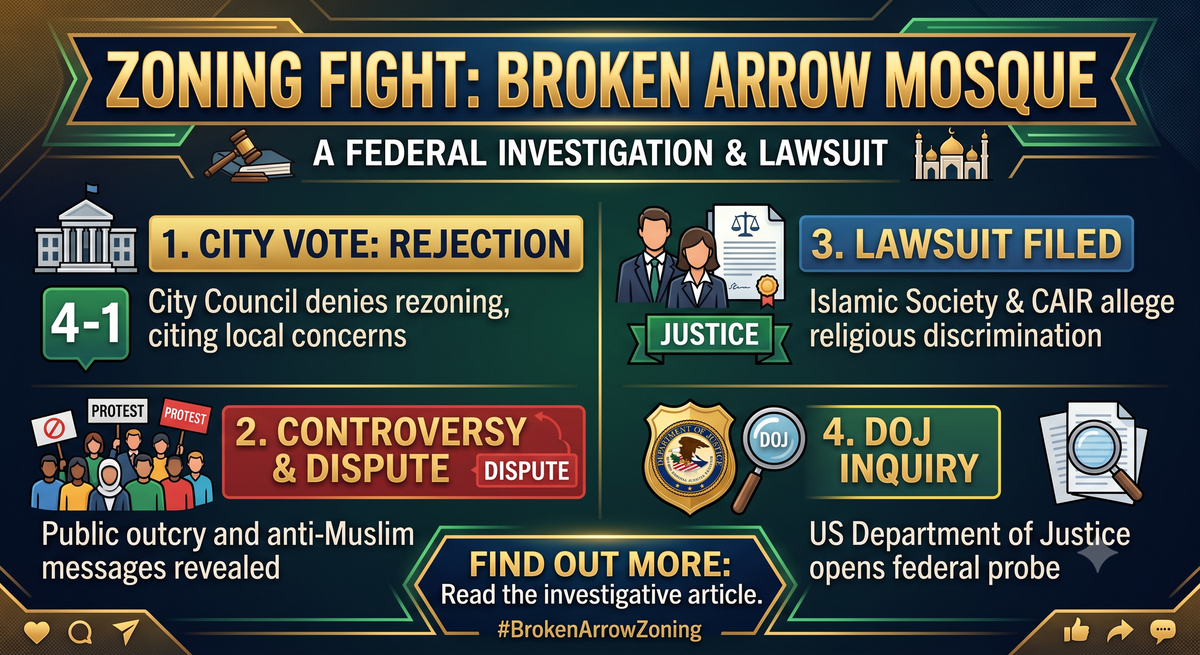
When the Broken Arrow City Council voted 4–1 in January to reject a rezoning request for a new mosque and commercial center, local officials insisted the decision was purely administrative. They cited routine municipal concerns: traffic congestion along Olive Avenue, floodplain grading, drainage management, and compatibility with the city’s comprehensive development plan.
However, seven months later, that local zoning decision has escalated into a high-stakes legal and political confrontation involving the U.S. Department of Justice (DOJ), the Oklahoma Attorney General, and national civil rights advocacy groups.
Following a federal civil rights inquiry launched by the DOJ under the Religious Land Use and Institutionalized Persons Act of 2000 (RLUIPA), the Council on American-Islamic Relations (CAIR) and the Islamic Society of Tulsa (IST) announced a joint lawsuit challenging the city's rejection in federal court.
The Proposal and the Initial Rationale
The controversy centers on a 15-acre parcel of land in south Broken Arrow, located on Olive Avenue just north of Tucson Street near the Creek Turnpike. Purchased in 2014 by the Islamic Society of Tulsa—with land title held by the North American Islamic Trust—the property was designated for a new mosque, community facility, and commercial complex intended to alleviate severe overcrowding at the society’s Midtown Tulsa location.
Initial technical evaluations favored the development:
- Professional Planning Staff: City civil staff reviewed the proposal and officially recommended approval.
- Planning Commission Recommendation: The Broken Arrow Planning Commission voted 3–2 in favor of recommending the rezoning request.
Despite these recommendations, public hearings surrounding the project attracted intense community pushback. Ahead of the final vote, public forums saw hundreds of residents gather, accompanied by political figures and activists who openly raised objections regarding Islam. When the City Council convened for its final vote, councilors overrode the Planning Commission’s recommendation, denying the rezoning in a 4–1 decision based on infrastructure and environmental impacts within the floodplain.
Public Statements vs. Private Inbox Communications
While city leaders publicly maintained that opposition was based solely on land-use criteria, subsequent media investigations into municipal public records revealed a sharper contrast.
An investigation examining hundreds of emails and messages received by Broken Arrow officials ahead of the vote disclosed that city leaders were flooded with anti-Muslim rhetoric from constituents. Public records showed that at least two elected officials responded favorably or expressively agreed with messages expressing anti-Islamic sentiments in their private correspondence prior to casting their votes.
Under federal civil rights statutes, establishing whether official land-use decisions are driven by legitimate municipal concerns or discriminatory intent is the core standard of review.
Federal Inquiry and Political Counter-Pushes
On July 17, the U.S. Department of Justice formally notified Broken Arrow officials that it had initiated an investigation under RLUIPA. Enacted in 2000, RLUIPA prohibits local governments from applying land-use regulations in a manner that:
- Imposes a "substantial burden" on the religious exercise of a person or institution without a compelling governmental interest advanced by the least restrictive means.
- Treats a religious assembly or institution on less than equal terms with a nonreligious assembly or institution.
- Discriminates against any assembly or institution on the basis of religion.
       [ Proposed Project ]  --->  Planning Staff & Commission Recommend Approval
                                            |
                                            v
       [ Public Resistance ]  --->  Anti-Muslim Communications & Public Demonstrations
                                            |
                                            v
       [ 4-1 Council Denial ]  --->  City Cites Traffic, Drainage & Floodplain Rationale
                                            |
                                            v
[ Federal & Civil Action ]  --->  DOJ Opens RLUIPA Inquiry  |  CAIR/IST File Federal Lawsuit
The DOJ's demand for five years of municipal land-use records drew swift political reaction at the state level. Oklahoma Attorney General Gentner Drummond sent formal correspondence to federal officials demanding the immediate closure of the inquiry, characterizing the federal investigation as "federal overreach" into local land-use authority. Drummond argued that municipal zoning decisions are properly reviewed through standard state judicial appeals rather than federal intervention.
CAIR Lawsuit and Municipal Legal Defense
Refusing to rely solely on the federal administrative inquiry, CAIR-OK and the Islamic Society of Tulsa initiated direct litigation against the City of Broken Arrow. CAIR representatives emphasized that local governments cannot use infrastructure arguments as a pretext for excluding religious minorities from equal protection under the law.
In response to the concurrent DOJ investigation and civil rights lawsuit, the Broken Arrow City Council scheduled emergency executive sessions to discuss strategy and retain specialized legal defense. The city moved to contract the law firm Troutman Pepper Locke at rates up to $925 per hour to represent the municipality against federal inquiries and incoming civil litigation.
Key Takeaways
| Dimension | Details & Development |
| Location & Site | 15 acres on Olive Ave, South Broken Arrow, OK |
| Initial Vote | Planning Commission recommended 3–2; City Council denied 4–1 |
| City's Position | Denied based on floodplain grading, drainage, and traffic impact |
| Federal Action | DOJ opened inquiry under RLUIPA (Religious Land Use & Institutionalized Persons Act) |
| Civil Action | CAIR & Islamic Society of Tulsa filed federal suit alleging religious discrimination |
| State Response | OK Attorney General requested DOJ halt the federal investigation |
As the case moves into federal court, the litigation in Broken Arrow stands as a significant test case for how RLUIPA balances local land-use authority against constitutional protections for religious assemblies.
For additional video reporting on the federal inquiry into Broken Arrow's zoning practices, see this coverage on theCAIR Welcomes DOJ Probe into Oklahoma City of Broken Arrow's Denial of Rezoning.
This news clip provides direct local broadcast coverage outlining the Department of Justice's formal notification to the city and the civil rights organization's response.