How An OKDHS Grant Helped Fund a Real Estate Playground in Eastern Oklahoma

By EastOklahoma.com Investigative Unit
When federal lawmakers in Washington injected billions of dollars into state agencies to solve heartland crises—specifically the lack of accessible healthcare and child care in working-class communities—the narrative was pitch-perfect.
In suburban strip malls and rural towns stretching across Eastern Oklahoma, working mothers were queuing for daycare slots that didn’t exist, while seniors waited weeks for basic pharmacy benefits. The fix, delivered via the Oklahoma Department of Human Services (OKDHS) and federally backed relief programs, arrived in a deluge of capital: targeted grants designed to build local infrastructure from the ground up.
Instead, court filings from the United States Attorney’s Office for the Northern District of Oklahoma reveal how those critical lifelines were converted into personal wealth vehicles.
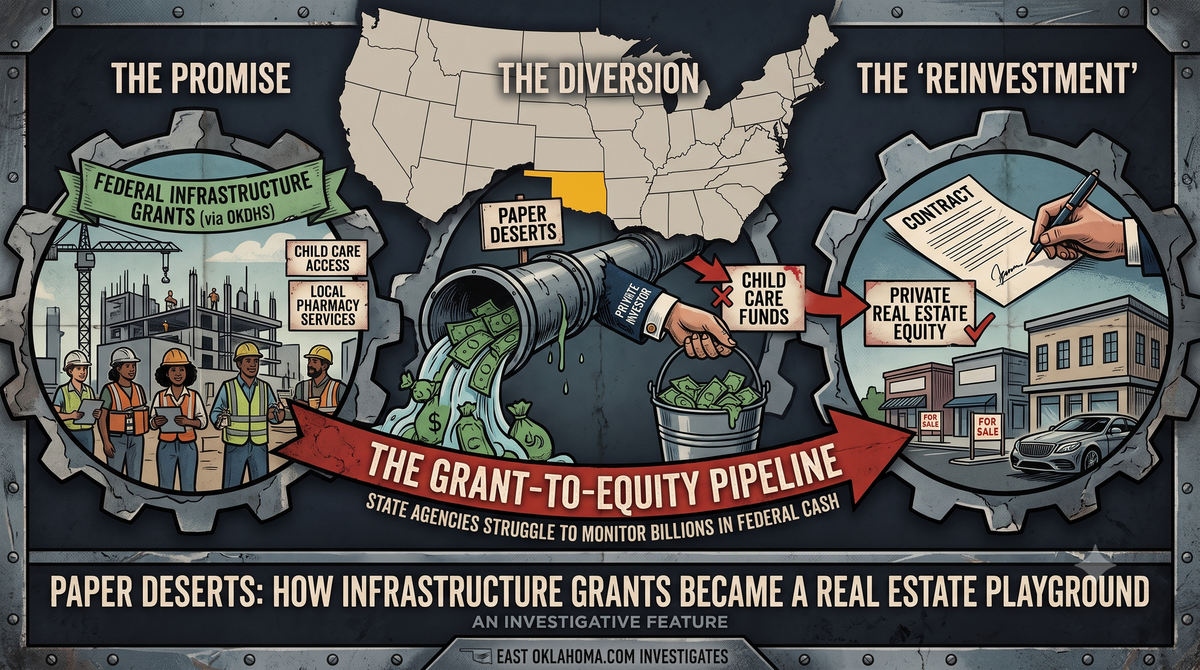
From ghost COVID-19 billing through suburban pharmacy fronts to a $600,000 OKDHS grant converted directly into Tulsa real estate, recent federal indictments showcase a troubling dynamic in post-pandemic state spending: When state administrative pipes are flooded with cash faster than regulators can monitor them, local infrastructure remains broken while self-dealing thrives.
Part I: The $600,000 “Child Care Desert” That Became Real Estate
In December 2022, Dameion Ray submitted an application to OKDHS for a "Child Care Desert Grant".
Funded through the federal Child Care Development Block Grant (CCDBG) program, these state-administered grants were intended to incentivize operators to open new child care facilities in communities desperate for early childhood education. In parts of Eastern Oklahoma, child care shortage rates exceed 60%, forcing working parents to make grueling compromises between employment and child supervision.
OKDHS awarded Ray $600,000.
The money was intended for staffing, operational setup, safety upgrades, and curriculum materials to build a working environment for children. However, federal prosecutors allege that Ray—working alongside brother and sister Tamara and Quincy Reid—had a different priority for the capital.
According to a civil forfeiture complaint filed in June 2026 by federal prosecutors, roughly $300,000—half of the entire grant—was diverted to purchase commercial real estate on Tecumseh Street in Tulsa.
[Federal CCDBG Infrastructure Grant]
               │
               ▼
   [OKDHS Allocation: $600,000]
               │
               ├───────────────────────────────┐
               ▼                               ▼
    [Intended Programmatic Use]      [Alleged Diversion: $300k]
    • Facility Ops & Staffing        • Purchased Real Estate
    • Local Child Care Slots           (Tecumseh St., Tulsa, OK)
Rather than increasing child care availability in an underserved community, hundreds of thousands of public dollars were effectively converted into private equity. The land was bought, but the community never received the expanded child care services promised by the grant agreement.
Part II: The Bixby Pharmacy Operator and the Ghost Billing Scheme
The diversion of infrastructure money was not isolated to child care grants. In Bixby—a suburb experiencing rapid population growth—41-year-old Jeremy Michael Bowles operated three local pharmacies.
To local residents, small, independent pharmacies represent an essential alternative to national retail chains. During the height of federal relief efforts, independent operators were granted streamlined billing processes to quickly disperse diagnostic kits and critical medicines.
Federal prosecutors allege Bowles turned that trust into a 16-count healthcare fraud operation.
               [Jeremy Michael Bowles / 3 Controlled Pharmacies]
                                     │
      ┌──────────────────────────────┴──────────────────────────────┐
      ▼                                                             ▼
[Medicare Billing Engine]                                [Medicaid (SoonerCare) Engine]
      │                                                             │
      └──────────────────────────────┬──────────────────────────────┘
                                     ▼
                  [16-Count Indictment: Healthcare Fraud]
            (Unrequested/Unreceived COVID-19 Test Claims)
According to federal court records, Bowles used his three pharmacies to systematically submit fraudulent claims to Medicare and Medicaid for COVID-19 tests. Beneficiaries never requested the tests, nor did they receive them.
Instead, the billing engines operated in the background, absorbing public healthcare funds meant to maintain regional safety nets.
Part III: The Administrative Vacuum
How do hundreds of thousands of dollars intended for child care end up in commercial real estate deals? How do local pharmacies submit thousands of phantom billing claims before triggering systemic audits?
The answer lies in the structural design of emergency grant and relief distribution.
| Program Layer | Intended Purpose | Systemic Weakness | Alleged Exploitation |
| OKDHS Child Care Desert Grants | Expand child care facilities in underserved zip codes | High-volume lump-sum disbursements without real-time asset tracing | $300,000 redirected into land acquisition |
| Medicare / Medicaid Reimbursements | Maintain suburban pharmacy & diagnostic access | Trust-based auto-adjudication of testing claims | Ghost-billing for unrequested diagnostic kits |
When state agencies like OKDHS are tasked with acting as clearinghouses for massive federal grants, the primary metric of success often shifts to speed of deployment over post-award audit verification.
"Emergency stimulus and infrastructure relief grants operate on trust," says one retired federal auditor familiar with regional grant monitoring. "State agencies are tasked with pushing funds out the door to hit federal deadlines. But if your audit infrastructure relies on self-reported receipts six months down the line, a bad actor can acquire physical assets like real estate long before an alarm goes off."
Part IV: The Local Cost
The real casualty of grant self-dealing isn't just the balance sheet of the federal government—it is the local community that never sees the promised investment.
When a $600,000 grant yields a real estate acquisition rather than a functioning child care facility, working families in Eastern Oklahoma continue to suffer from child care shortages. Mothers stay out of the workforce, small businesses struggle to retain workers, and children miss out on early childhood education programs.
Similarly, when local pharmacies become vehicles for fraudulent billing, trust in community healthcare providers erodes.
As federal prosecutors move forward with civil forfeitures on Tecumseh Street and criminal prosecutions in Tulsa's federal court, the broader question remains for state officials in Oklahoma City: How many more "desert grants" will be used to buy private real estate before state agencies fix their oversight mechanisms?