How Fake IDs and Paper Checks Drained $100K from Oklahoma Walmarts

Inside the multi-town fraud network that turned a routine retail courtesy into an automated cash machine.
By EastOklahoma.com Staff
If you have spent any time waiting in line at the customer service desk of a Walmart Supercenter on a Friday afternoon, you know the rhythm.
It is the civic crossroads of mid-sized America. In front of you, someone is returning an open air fryer. Behind you, a customer is trying to send a MoneyGram to a relative in Texas. And at the register, a customer hands over a paper payroll check and a temporary paper driver’s license, waiting for the cashier to punch the numbers into a terminal, hand over a thick stack of twenty-dollar bills, and call the next person in line.
To most people, it’s just the slow, tedious machinery of unbanked commerce. But between December 2023 and August 2025, a disciplined crew of fraudsters realized that this exact routine—specifically the friction-free intersection of temporary state documentation and high-volume retail check-cashing—was one of the easiest financial vulnerabilities in Oklahoma to exploit.
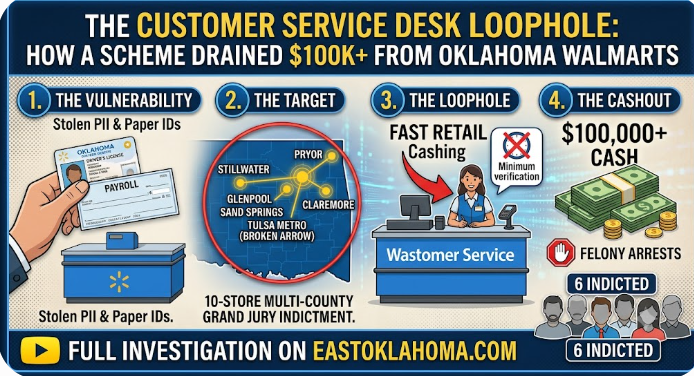
In May 2026, an Oklahoma Multi-County Grand Jury formally unsealed a 10-count felony indictment. The charges hit six individuals—Caleb Ali, Erika Watson, Dominique Price, Amber Smith, Aaron Hensley, and Jesus Martinez Jr.—for running an organized check-cashing and identity-theft syndicate.
Their target wasn’t a bank vault or a crypto exchange. It was the customer service counters of Walmart Supercenters scattered across Eastern and Central Oklahoma: Claremore, Broken Arrow, Pryor, Sand Springs, Glenpool, Stillwater, and beyond.
Before Attorney General Gentner Drummond’s prosecutors pulled the plug, the crew had walked away with over $100,000 in untraceable cash.
The scheme didn't rely on high-tech corporate espionage or sophisticated malware. It relied on something much simpler: understanding the human and digital cracks in the retail empire’s armor.
The Anomaly in the System
Walmart is famously the bank of last resort for millions of Americans. For a modest flat fee—typically $4 to $8—a customer can present a payroll, government, or tax check up to $5,000 and walk out with physical cash within three minutes.
For the unbanked, it’s a vital lifeline. For retail associates working a busy 8-hour shift in Claremore or Broken Arrow, check validation relies on automated third-party verification networks coupled with a quick visual inspection of the customer's state ID.
That visual check turned out to be the fatal flaw.
       [ Stolen PII & Paper IDs ]
                   │
                   ▼
     [ Fake Payroll / Bogus Check ]
                   │
                   ▼
  [ Walmart Customer Service Counter ]
   (Broken Arrow / Claremore / Pryor)
                   │
                   ▼
  [ Instant Cash Out ($100K+ Total) ]
According to court filings, the network operated using stolen personally identifiable information (PII) belonging to unsuspecting citizens. Using these hijacked identities, the group printed high-quality fake temporary paper driver's licenses—the kind states issue when you renew your registration online or update your address.
Matching these forged temporary IDs with meticulously generated, bogus payroll checks, members of the crew rotated through store locations.
To a customer service employee staring at a line of ten tired shoppers on a Tuesday evening, a paper ID matching the name on a professionally printed check rarely raises alarm. The barcode scans, the signature matches the piece of paper, and the register drawer pops open.
By the time the actual payroll bank rejected the fraudulent routing and account numbers days later, the crew was already three counties away, repeating the process at another Supercenter off Highway 169 or I-44.
A Tour of Oklahoma’s Supercenters
What makes the scheme so striking is its geographic footprint. The group didn't just target a single neighborhood; they treated the state's highway system like a conveyor belt.
| Location Target | Regional Hub | Scheme Role |
| Claremore & Pryor | Rogers / Mayes Co. | High-frequency rural counter runs |
| Broken Arrow & Sand Springs | Tulsa Metro | Multi-store daily rotations |
| Glenpool & Stillwater | Exurb Corridor | Inter-county transit hits |
| OKC & Edmond | Central OK | Systemic urban cash-outs |
By spreading the fraudulent transactions across dozens of store locations over a 20-month stretch, no single store manager noticed an unusual spike in returned checks. A $2,500 bad check in Pryor and another $1,800 loss in Sand Springs looked like isolated incidents of retail fraud.
It wasn't until state investigators synthesized loss-prevention data across multiple jurisdictions that the pattern clicked into place: the same core group, armed with rotated identities and forged paper, was methodically working through the state’s retail footprint.
The Felony Fallout
When Attorney General Gentner Drummond announced the Multi-County Grand Jury indictments, he framed the case not merely as shoplifting or petty larceny, but as systematic enterprise crime.
"Schemes such as these harm businesses, drive up costs, and end up hurting hardworking Oklahomans," Drummond said in a statement following the indictment.
The six defendants—four of whom carry prior felony convictions that carry enhanced sentencing under Oklahoma law—now face 10 felony counts ranging from second-degree forgery and conspiracy to false personation.
Indictment Breakdown:
- Total Defendants: 6
- Total Felony Counts: 10
- Primary Charges: Conspiracy, Forgery (2nd Degree), False Personation
- Estimated Total Loss: $100,000+
Beyond the immediate criminal trial, the case exposes a structural headache for major retailers. As states move toward digital vehicle registration, online driver's license renewals, and printable temporary paper documentation, the physical security features that once made fake IDs easy to spot—holograms, embossed plastics, UV ink—are being replaced by simple printouts.
For the retail industry, closing that loop without cutting off access to cash services for millions of unbanked citizens remains an expensive, unsolved dilemma.
And for the residents of Eastern Oklahoma whose stolen identities funded the $100,000 run, the fallout is even worse: cleaning up credit histories and identity profiles long after the fake paper cleared the register.
Every person charged in an indictment is presumed innocent unless and until proven guilty in a court of law.