How Ron Durbin Helped The Meta Data Center Steal a Veteran's Land

How a disbarred Oklahoma attorney championed the little guy in public — while a Marine veteran's land vanished into a billion-dollar data center corridor
An investigative report
New Year's Day, 2026
Seven hours into the New Year, Ron Durbin was already working.
The disbarred Tulsa attorney — 74,000 Facebook followers, YouTube channel, congressional candidate, self-described investigative journalist fighting for civil rights across the United States — began flooding his Guerrilla Publishing page with a rapid-fire series of posts. His target: a secret deal between the city of Claremore, Oklahoma, and a California company called Beale Infrastructure to build a massive data center in Rogers County, without telling the public.
He had screenshots. He had internal emails. He had the story that city leaders had tried to bury over Christmas and New Year's while residents weren't watching.
The response was immediate. Residents were furious. A petition formed. Standing-room crowds showed up at city council meetings. The Claremore Daily Progress covered it. Yahoo News picked it up. Ron Durbin, champion of the people, had done it again — exposed the powerful, protected the community, shone a light where the powerful hoped nobody would look.
It was a masterful performance.
And it raises a question that nobody in those 74,000 followers appears to have asked:
While Ron Durbin was playing the hero in Rogers County, what had he done to August Wakat?
The Veteran and His Land
August Wakat is a United States Marine Corps veteran. He came home from service and built something modest and real: Poe Boy Fleming Auto Salvage, Inc., an auto salvage business at 23780 East Admiral Place in Catoosa, Oklahoma — Wagoner County. His property adjoined Tract A at 23882 East Admiral Place, where a Lamar Advertising billboard stood, subject to a $12 million lien.
The land sits in an area historically known as Fair Oaks Township — a small, unincorporated community in Wagoner County that had existed, as far as Wakat knew, outside the reach of Tulsa's municipal government. He had built his life there. He had a business there. He believed he knew who governed his land.
He was wrong — or someone had made sure he would be wrong, and had the paperwork to prove it.
In 2023, Wakat found himself in a dispute with the City of Tulsa's Board of Adjustment over a zoning decision affecting his salvage business. He filed an appeal in Tulsa County District Court — Case No. CV-2023-1583 — on August 8, 2023. The case wound through Tulsa County, then to the United States District Court for Colorado, then to the United States Court of Appeals for the Tenth Circuit, which issued its mandate in February 2026 and returned jurisdiction to the lower court.
On March 6, 2026, Wakat signed a dismissal with prejudice — the most final of legal endings — releasing his claims against Henry J. Winn, Linda I. Winn, and Lamar Advertising Company.
He had lost. He was broke. He was living in Trinidad, Colorado. And his land sat in the heart of what would become, one month later, the most talked-about development corridor in Oklahoma.
The Billion-Dollar Corridor
On April 21, 2026 — six weeks after Wakat signed away his claims — Oklahoma Governor Kevin Stitt stood at a groundbreaking ceremony in east Tulsa and confirmed what had been the city's worst-kept secret.
Project Anthem was Meta.
The company behind Facebook, Instagram, and WhatsApp broke ground on a $1 billion AI-optimized data center at Fair Oaks Innovation Park — a 2,000-acre industrial campus in east Tulsa, near 11th Street and the Creek Turnpike, along U.S. Highway 412. It would span more than 2 million square feet. It would be Meta's first facility in Oklahoma, its 28th in the United States, its 32nd globally. It would generate $3.3 billion in economic activity during construction, employ more than 1,000 workers at peak, and eventually employ about 100 permanently.
Fair Oaks Innovation Park. The name should ring a bell for anyone who has read Wakat's court filings carefully.
Fair Oaks Township is where August Wakat's land is. Fair Oaks Ranch LLC is the entity connected to developer Joe Robson — identified in Wakat's subpoena documents as a Walmart developer and honorary member of the Oklahoma judicial nominating commission. The Tulsa Metropolitan Area Planning Commission project that consumed years of Wakat's legal fight is designated MPD-6, known in filings as the "Robson Development," and is part of the same development corridor that became Fair Oaks Innovation Park.
Project Anthem — the name Wakat used in his court filings when he alleged his property was being consumed by a data center development tied to ARPA funds, DARPA connections, and the Tulsa Airports Improvement Trust — turned out to be a Meta data center, confirmed and celebrated by the Governor of Oklahoma.
This was not a paranoid invention. This was real. The development was real. The corridor was real. The land assembly was real.
And the land Wakat had been fighting to protect sat directly in it.
The Annexation That May Never Have Happened Legally
The mechanism by which Wakat's land came under City of Tulsa jurisdiction is a document dated November 1, 2001.
A "Consent to Annexation" — purportedly signed by the Ann Landrith Trust — conveyed consent for properties at 23610, 23780, and 23882 East Admiral Place, Catoosa, Oklahoma, to be annexed into the City of Tulsa under what became City Ordinances No. 20244 and 20267.
Wakat's formal Zoning Change Protest Petition, filed with TMAPC in connection with MPD-6, identifies specific, documented deficiencies in that document:
The 2001 annexation form contains no proper notary seal. It has no filing number. It has no abstract reference to a document number, book, pages, or controlling ordinance numbers. These are not technicalities. Under Oklahoma law, these are the foundational requirements that make an annexation legally valid. Without them, the annexation is, in Wakat's argument — supported by Oklahoma Supreme Court precedent in In re De-Annexation of Certain Real Property from the City of Seminole, 2004 OK 60 — void.
Henry Winn, identified as mortgagee on the property, filed a formal affidavit in Tulsa County Case No. CV-2024-2320 specifically documenting the absence of these requirements — a non-consent to annexation.
Most significantly: Amanda Alsip, the Wagoner County Land Records Clerk, confirmed in writing that the subject property is not within Fair Oaks Township as annexed into the City of Tulsa, and remains of record under Wagoner County jurisdiction.
This is not August Wakat's opinion. This is the Wagoner County Land Records Clerk.
The annexation also allegedly uses narrow "string connector" parcels — a legal technique that Oklahoma courts have found can violate statutory contiguity requirements under 11 O.S. §§ 21-101 and 21-102. Wakat cites City of Claremore v. Town of Verdigris, 2001 OK 3 — the same city, it should be noted, where Ron Durbin made himself a hero on New Year's Day by exposing a secret data center deal.
No court has ruled on the merits of Wakat's annexation claims. Every dismissal he has received has been procedural.
And in Sand Springs — another Green Country community swept up in the same data center boom — a citizens' group filed a lawsuit against the city alleging it had violated the law by annexing the land where a proposed data center could be located. That case was covered by local press as a legitimate legal challenge. Nobody called those plaintiffs conspiracy theorists.
The $12 Million Billboard and the Missing $150,000
Two financial figures sit at the heart of this story, and they deserve careful attention.
The first is $12,000,000. Court filings reference a Lamar Advertising signage lien and release deed made out to August Wakat — Document Nos. 2025-3667 and 2024-9081 — for twelve million dollars. This lien is attached to the billboard on Tract A at 23882 East Admiral Place: the same billboard that appeared in Wakat's zoning protest, that operates under a permit issued in Roger County for a structure sitting in disputed Wagoner County territory, and that Wakat argues is non-compliant with the federal Highway Beautification Act, 23 U.S.C. § 131.
A $12 million lien on a piece of property in a corridor that just became the site of a $1 billion Meta data center campus is not a trivial matter. It warrants serious title investigation.
The second figure is $150,000. This is the earnest money that Wakat alleges went missing while Ron Durbin was his attorney.
Wakat went bankrupt. He has been fighting pro se — without legal representation, in multiple court systems simultaneously — ever since.
Ron Durbin — The Guardian Who Allegedly Robbed the Gate
To understand Ron Durbin, you have to understand the brand he built.
After a heart attack in 2020, Durbin reinvented himself. He traded his $400-an-hour law practice for what he called his "Freedom Shoes" and a camera on a stick he named the Gandalf Stick. He launched Guerrilla Publishing — "Oklahoma's independent investigative newsroom exposing corruption, government secrecy, and abuse of power." He built a following of 74,000 on Facebook and ran for Congress in Oklahoma's First District on a platform of auditing Washington's spending and holding power accountable. His campaign website declared: "He's the only candidate in this race who has actually held power accountable, at personal cost."
At personal cost.
The Oklahoma Supreme Court, it turned out, had a different view of the costs Durbin imposed — and on whom.
On October 21, 2025, all nine justices of the Oklahoma Supreme Court voted unanimously to disbar Ronald Edward Durbin II. The court's 71-page opinion, authored by Justice James Edmondson, sustained violations in 18 of 20 counts of professional misconduct and tallied 115 individual rule violations. Durbin was ordered to pay $22,152.14 in costs. The disbarment was made retroactive to April 8, 2024.
Justice Edmondson wrote that Durbin's disciplinary case was "almost in a class by itself."
The misconduct documented by the court was extensive and damning.
He brought retaliatory lawsuits — not because he had legitimate legal claims, but, as the court found, "for the sole purpose of causing certain defendants to incur legal expenses." The court found this violated rules on dishonesty, fraud, deceit, and misrepresentation. The judicial system as a weapon of personal vengeance: exactly what his public persona claimed to oppose.
In a courthouse elevator, he told opposing attorney Taylor Burke: "You're so f—ing stupid. I'm going to kick your ass." He yelled at Burke publicly to embarrass Burke's client and refused to cooperate with witness interviews.
He screamed at Tulsa County District Court Judge Sharon Holmes in a courthouse hallway, calling her "drunk," and provided no evidence to support the claim. The court found violations of rules prohibiting false statements that impugn judicial integrity.
The disbarment was consolidated with a Rule 7 summary disciplinary action stemming from Durbin's nolo contendere plea under 21 O.S. §136 — a criminal statute.
Key rules violated included Rule 8.4(c): dishonesty, fraud, deceit, and misrepresentation.
And then there is the $150,000.
The Ethics Reporter — an independent legal ethics publication that had no connection to Wakat or this investigation — noted the following in its detailed March 2026 analysis of the Durbin disbarment:
"And then there were the community reports — never formally adjudicated in this proceeding but circulating through local accounts — of $150,000 in stolen earnest money. Whether or not those allegations ultimately find their way into a separate legal proceeding, they form part of the broader picture of an attorney who treated every relationship — with clients, with colleagues, with courts — as terrain to be exploited."
That publication identified the $150,000 independently. They did not know August Wakat. They were writing about Ron Durbin.
The Parallel Universe
Here is where the story becomes almost surreal.
While August Wakat was fighting — bankrupt, pro se, from a rental address in Trinidad, Colorado — to have his annexation claims heard on the merits, Ron Durbin was building a public brand as the defender of exactly the kind of communities Wakat came from.
On January 1, 2026, Durbin exposed the secret data center deal in Claremore. He had screenshots of internal emails. He had the deleted webpage. He was the one who told 74,000 people what their city was doing in the dark while they celebrated New Year's Eve.
The residents of Claremore were grateful. The petition grew to 550 signatures. The city council meeting was standing room only. Ron Durbin — investigative journalist, champion of the people, voice of the voiceless — had struck a blow against the elite, against the secretive corporate invasion of small-town Oklahoma, against exactly the kind of opaque land deal that the community had a right to know about.
He was celebrated for doing in Claremore what August Wakat had been trying to do for years in Catoosa: expose a data center development process that had happened without the community's knowledge or consent.
The difference is that Wakat had been his client.
And Wakat's $150,000 was gone.
What the Courts Never Examined
The most important fact in this story is one that receives almost no attention:
No court has told August Wakat he is wrong about the facts.
Every dismissal he has received has been procedural — jurisdictional defects, filing deadlines, the form of his pleadings. Courts dismissed him without reaching the annexation documents, without examining the Wagoner County Clerk's letter, without ruling on the contiguity of the string-connector annexation, without addressing the $12 million lien, and without considering the connection between the MPD-6 zoning action and the data center corridor that now hosts a $1 billion Meta facility.
When a man goes bankrupt, he loses his attorney. When he loses his attorney, he files pro se. When he files pro se, courts apply procedural rules with less patience. When courts apply procedural rules with less patience, legitimate underlying claims die on technicalities.
This is not justice. It is a structural feature of the legal system that consistently disadvantages the people least able to navigate it — which is to say, the people who most need it to work.
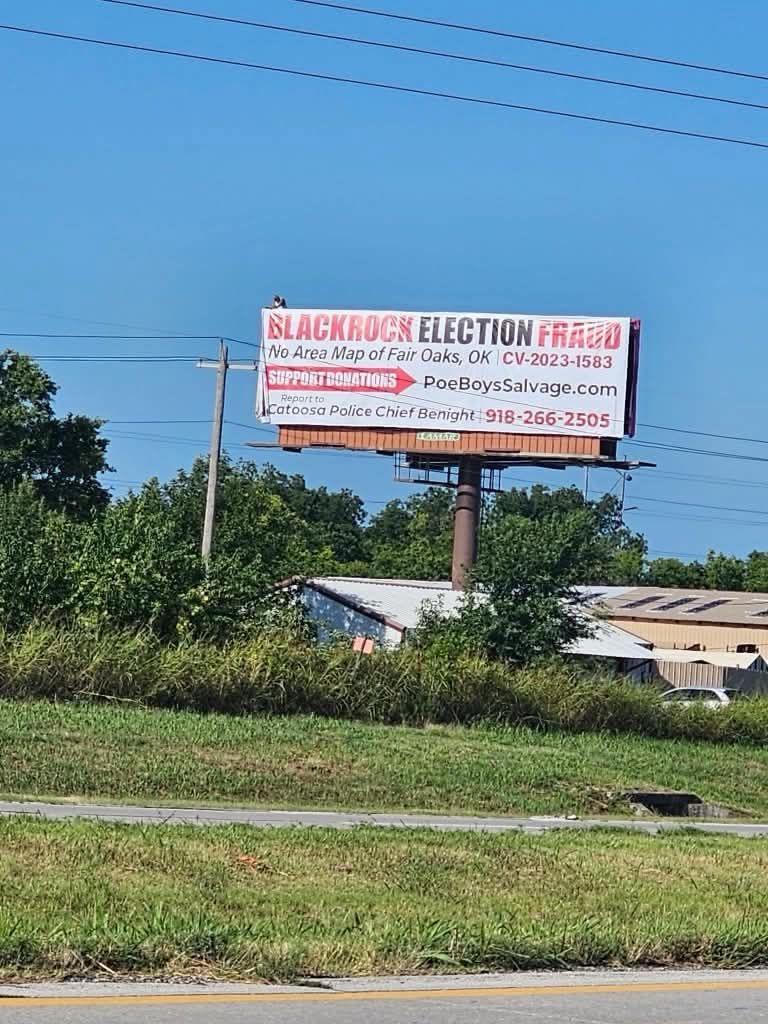
Wakat's filings are imperfect. Some of his legal theories are unconventional. Some of his framings — the "BlackRock election fraud" billboard, the color-of-law notices — reflect the legal self-education of a desperate man who could no longer afford a professional. But beneath those imperfect forms are specific, documented, verifiable claims: a defective annexation document, a county official's written confirmation, a missing $150,000, a $12 million lien, and a development project now confirmed to be exactly what he said it was.
He was not wrong about Project Anthem. It is a data center. It is at Fair Oaks. It is connected to the same corridor he identified years before it was publicly announced. It broke ground six weeks after he signed away his claims.
The Broader Pattern
Wakat's case is not unique. It is part of a pattern that Green Country communities are only beginning to recognize.
In Sand Springs, residents sued the city over the annexation of land for a data center — the same legal theory Wakat raised years earlier. In Claremore, residents packed a city council chamber to demand transparency about a project negotiated behind closed doors. In Owasso, a $1 billion data center campus — Project Clydesdale, also from Beale Infrastructure — broke ground after Tulsa County approved tax exemptions in September 2025. In Coweta — in Wagoner County, the same county where Wakat's property sits — Beale Infrastructure is pursuing a third campus, Project Atlas.
The data center rush sweeping Green Country is real, it is massive, and it is moving with a speed and secrecy that leaves communities scrambling to catch up. Wakat was not paranoid for seeing it coming. He saw it before most people were paying attention. He just had the misfortune of losing his attorney — allegedly to the attorney's own misconduct — before anyone else noticed.
What Warrants Investigation
Several specific questions in this story remain open and are answerable through public records:
The missing earnest money. $150,000 allegedly went missing while Durbin was Wakat's attorney. Was a formal bar complaint filed specifically about client funds? Did the Oklahoma Bar Association investigate? Oklahoma maintains a Client Security Fund for victims of attorney theft — has Wakat filed a claim?
The annexation documents. The Wagoner County Land Records Clerk confirmed in writing that Wakat's property is not within the City of Tulsa's annexation. A title attorney with access to the original Wagoner County land records could verify this within hours. If the annexation is defective, every zoning action taken by the City of Tulsa regarding this property was taken without jurisdiction.
The Lamar billboard permit. The billboard at 23882 East Admiral Place operates under a permit issued in Roger County, for a structure Wakat argues sits in disputed Wagoner County territory. Federal Highway Administration compliance under 23 U.S.C. § 131 is checkable. Either the permit is valid or it is not.
The $12 million lien. Document Nos. 2025-3667 and 2024-9081 are recorded instruments. A title search would reveal who holds the lien, on what terms, and what happened to it.
ARPA funding. Wakat's federal filings allege misuse of American Rescue Plan Act funds in connection with infrastructure in Creek County serving the development corridor. The Department of Justice Inspector General oversees ARPA compliance and accepts tips.
The MPD-6 / Robson Development record. TMAPC maintains public records of all zoning applications. The full record of MPD-6 — including staff reports, hearing transcripts, and correspondence — is public and could be obtained through a records request.
Oklahoma Bar Client Security Fund. If Durbin systematically misused client funds, Wakat may not be the only victim. The Fund exists to compensate exactly these losses.
Epilogue: The Gandalf Stick and the Billboard
Two images bookend this story.
In one, Ron Durbin strides into a Claremore city council meeting on New Year's Day, camera raised on his Gandalf Stick, 74,000 followers watching, exposing what powerful people did in secret to an unsuspecting community. He is celebrated. He is the hero. He is the guardian at the gate.
In the other, a billboard stands on a rusting pole above a shuttered salvage yard on U.S. Highway 412. It reads: "BLACKROCK ELECTION FRAUD. No Area Map of Fair Oaks, OK. CV-2023-1583." It was put up by a Marine veteran who went bankrupt, lost his land, lost his business, and lost $150,000 — allegedly to the man who was supposed to be guarding his gate.
Six weeks after Wakat signed away his claims, Meta broke ground at Fair Oaks Innovation Park.
The Guardian at Claremore made national news.
The Marine veteran in Trinidad, Colorado made a billboard.
The question worth asking is not why August Wakat put up a billboard. The question worth asking is who made it necessary — and whether anyone in Oklahoma's legal, regulatory, or journalistic community intends to find out.
This report is based on court documents filed in Tulsa County District Court Cases CV-2023-1583 and CV-2024-2320; United States District Court Case No. 1:25-CV-04134-LTB; United States Court of Appeals for the Tenth Circuit Case No. 26-1029; Oklahoma Supreme Court Case No. SCBD-7528; published reporting from the Oklahoma Watch, the Tulsa World, NonDoc, the Claremore Daily Progress, the Eastern Times Register, Data Center Dynamics, KJRH, the Tulsa Flyer, and The Ethics Reporter; and Beale Infrastructure and Meta public announcements. All named parties have the right to respond to these allegations. Ron Durbin, Joe Robson, Henry Winn, Linda Winn, Lamar Advertising Company, and the City of Tulsa should be contacted for comment prior to any final publication. No court has adjudicated the factual merits of Wakat's property claims.