Oklahoma Securities Regulators Have Questions About Your Cow

The state helped bust a $191 million cattle Ponzi scheme. Now it may be aiming the same weapon at families who just wanted beef.
In 1967, a federal appeals court with jurisdiction over Oklahoma was asked to decide what a beaver is.
Not biologically — legally. A company called Continental Marketing had been selling live beavers to the public, along with a strong suggestion: don't take your beaver home. Instead, place it with a professional beaver rancher, who will breed it, multiply it, and grow your rodent fortune while you do nothing at all. More than two hundred people in sixteen states bought beavers this way. The number of purchasers who ever took possession of a single animal was zero. The Tenth Circuit looked at this arrangement and ruled that these were not really beavers being sold. They were securities — investment contracts, no different in law from shares of stock — and the company was enjoined out of the beaver business.
Keep the beavers in mind. They explain almost everything about what is now happening to a cattle ranch in Mayes County, including the parts that shouldn't be happening.
Sometime in the past several months, according to people familiar with the situation, state securities regulators began pressuring Smoke River Ranch, a regenerative cattle operation outside Strang, over its "herdshare" program — an arrangement under which local families buy cows, the ranch boards and breeds them, and everyone splits the calves. Joel Hollingsworth, the ranch's founder, went public with the dispute in a fundraising appeal this year, writing that Smoke River has "come under pressure from state-level securities agencies who are trying to classify our herdshare program as a security." His response, in the same appeal: herdshares "are about real animals and represent a straightforward cattle boarding contract, not a financial instrument."
There is no press release about any of this. No public enforcement order naming Hollingsworth or Smoke River appears among the Oklahoma Department of Securities' published actions as of this writing, and no case has surfaced in state court dockets. That's not evidence nothing is happening; it's evidence of where it's happening — in the pre-order phase of securities enforcement, the part with subpoenas instead of announcements, where an investigation can grind on invisibly for months and the target pays lawyers the entire time whether or not the state ever proves a thing. Hollingsworth is now crowdfunding those lawyers. Part of the money, his appeal says, will go simply toward "keeping Smoke River Ranch running."
So before anything has been filed, before any tribunal has ruled on what a herdshare is, the operational question — can this ranch survive the process of being asked? — is already live. Which is worth sitting with, because the process is the punishment in cases like this, and it's being applied to what may be the least Ponzi-like cattle operation in the state.
Here is what got built in Strang, in less than five years, by a guy who started with no cows, no land, and no background in agriculture.
Hollingsworth came out of business economics and tech startups — a detail that will become important later, and not in his favor. He has said publicly that he launched the ranch with essentially no capital, using herdshare partnerships to grow from a handful of animals to roughly 500 head, absorbing along the way several herds whose owners had lost their land leases. Today Smoke River runs one of the larger ultra-high-density grazing operations in the country: the herd bunches into a tight mass, moves four to six times a day through paddocks drawn on a tablet — virtual fencing, no posts — eats everything, tramples the rest into the soil, and moves on. It's grazing as systems engineering, and the soil-health results have made the ranch a minor celebrity on the regenerative-agriculture podcast circuit.
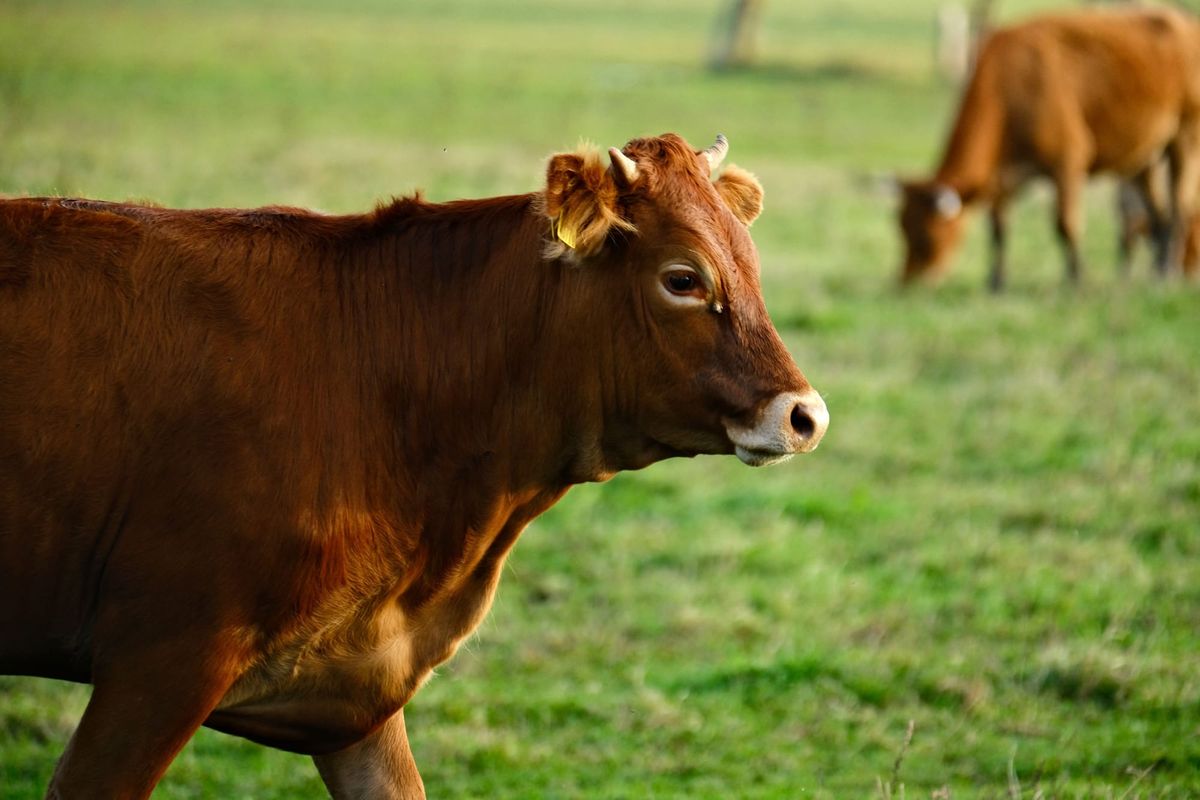
The cattle, in other words, are extremely real. You can drive to Strang and look at them. Many are owned, a few head at a time, by the families in the herdshare program — and people familiar with the membership say most of those families are Oklahomans, in it for beef and a stake in where their food comes from, not for a return on capital.
Now, if you have spent any time around securities law, you have already spotted the problem, and it isn't the cattle. It's the beavers.
The legal test at the center of this fight is older than the interstate highway system. In 1946, the Supreme Court decided SEC v. W.J. Howey Co., a case about — brace yourself — a farm. Howey sold small strips of Florida citrus grove to buyers, most of them out-of-state tourists, bundled with a service contract: the company would tend the trees, pick the fruit, sell it, and mail the buyer their share of the proceeds. The buyers owned actual dirt and actual trees. Didn't matter. The Court said they'd bought securities, because they'd invested money in a common enterprise expecting profits from somebody else's efforts. That's the Howey test, and it's why the securities laws have spent eight decades reaching things that don't look remotely like stock certificates: whiskey warehouse receipts, chinchilla breeding programs, and yes, the beavers.
Read that way, a herdshare looks like it's in trouble. Money in? Check. Common enterprise? The whole herd is managed together. Profits from the efforts of others? The families aren't out there at 5 a.m. moving polywire.
But the Supreme Court built an exit, and it's load-bearing. In 1975, in a case about a housing co-op, the Court held that when you buy a thing primarily to use or consume it, the securities laws don't apply — the "expectation of profits" collapses, and with it the whole framework. That consumption principle is the legal bedrock under every traditional herdshare in America, and there are a lot of them, because herdshares are the lawful route to raw milk in much of the country. A family that buys a share of a dairy herd to get milk is buying groceries with extra steps. Texas regulators, after years of hostility, eventually wrote rules recognizing exactly this. The arrangement Taylor Henry, the CEO of the fifty-year-old regenerative-agriculture publisher Acres U.S.A., describes in a letter supporting Hollingsworth — shared-risk agreements that "historically formed the backbone of resilient agricultural communities" — is not a loophole. It's the older tradition, the one securities law was never aimed at.
So the actual question in Mayes County is boringly, maddeningly specific: which side of that line does this herdshare sit on? Beef in the freezer is Forman. Passive profits with a cow as the mascot is Howey. And the honest answer, based on the public record, is that Smoke River has planted a foot on each side — which is how a genuinely community-oriented food operation can end up in a securities regulator's crosshairs without anyone involved being a villain.
To see why the state is even looking, you have to know what its securities cops were doing in December 2023.
That month, the SEC obtained an emergency asset freeze against a Fort Worth outfit called Agridime, which had raised about $191 million from more than 2,100 people in at least fifteen states by selling "cattle contracts." The pitch was seductively simple: buy a calf for $2,000, and Agridime would raise it, process it, and buy it back at a price guaranteeing you a return — 15 percent, sometimes advertised north of 30. Investors never saw a cow. They didn't want to; that was the product. By the time regulators moved, the SEC alleged, at least $58 million of new investors' money had gone to pay off earlier investors — the load-bearing wall of every Ponzi scheme — and the company owed contract holders well over $140 million against less than $1.5 million in the bank. A federal court has since ordered more than $100 million in restitution.
In announcing the case, the SEC publicly thanked four state regulators for their help. One was the Oklahoma Department of Securities.
This is the scar tissue. An agency that just spent months inside the wreckage of a nine-figure cattle-investment fraud is not going to wave through the next cattle-share program it encounters, and honestly, you don't want it to. Somewhere in Oklahoma right now there is probably a genuine Agridime-in-miniature, promising grandparents guaranteed returns on cows that exist mainly in a brochure. The securities laws exist for that guy.
But hold the two operations side by side and the comparison starts doing the opposite of what the state might want. Agridime's investors: fifteen states, guaranteed percentage returns, zero contact with any animal, paid in cash that turned out to be other investors' principal. Smoke River's members: mostly Oklahoma families, no guaranteed anything — the "yield" is calves, subject to every risk a calving season can deliver — and the payout, for the typical member, is beef from animals they can visit. If the theory here is "cattle program, therefore Agridime," that's not investor protection. That's pattern-matching with a badge.
And yet. The most uncomfortable evidence against Smoke River was not gathered by any investigator. It was published, voluntarily, by Smoke River.
Go to the ranch's own website and read how it describes the herdshare. You will not find the words "boarding contract." You will find herdshares described as "custodial real assets stewarded together at scale." You will learn that you don't own a particular cow — you own cows in the herd, an undivided interest in a pooled, professionally managed asset. You will be promised a calf split "in perpetuity." And you will encounter, glinting there like a subpoena magnet, the phrase "the preservation of semi-liquidity" — a selling point that only makes sense if the shares are meant to be resold, which is to say, if there's a market, which is to say, if this is an asset class.
That is not how a family describes buying beef. That is how a prospectus talks. Add the podcast tapes — Hollingsworth, in his own promotional appearances, describing the "network of investors" that helped him scale — and you can write the state's internal memo yourself. Securities analysis cares enormously about how an offering was actually marketed, and the promoter's own vocabulary is Exhibit A in practically every investment-contract case ever brought. Continental Marketing didn't get enjoined because beavers are inherently sinister. It got enjoined because of what it told people their beavers were for.
There's a charitable reading of all this, and it happens to be plausible: a founder who spent his formative years in tech and business economics reached for the dialect he knew — assets, liquidity, granular ownership — to describe something his grandparents' generation would have sealed with a handshake and called sharing the increase. The gap between Smoke River's marketing language and Smoke River's apparent reality may be nothing more than a pitch deck's vocabulary wrapped around a food system. Sloppy copy is not securities fraud.
But it's also true that if the state's theory survives first contact, it will be because of those pages. The strangest fact of this case is that the strongest witness against the cattle-boarding characterization is the ranch's own website — and the strongest evidence for it is standing around in a pasture in Strang, chewing.
Which brings us to what's actually at stake, and why three institutional voices in regenerative agriculture have put their names on letters defending a Mayes County ranch most of their readers will never visit.
The letters — from Henry at Acres U.S.A.; from Rhys Algar, a synthetic-biology PhD whose ag-tech company has spent over a year prototyping precision-grazing systems on the Strang property and who calls Hollingsworth "one of the most principled and community-minded individuals I have encountered in this industry"; and from Juan Whiting, president of the veteran-focused Hinterland Institute — converge on the same alarm. Henry's version is the most precise: community food systems "should not automatically be viewed through the lens of speculative financial activity when their actual purpose is agricultural stewardship, food production and rural revitalization." Whiting's is the bluntest: "This issue is bigger than one ranch."
He's right, and here's the mechanism. If Oklahoma's regulator concludes that a calf-split arrangement is an investment contract because the farmer does the work and the herd is pooled, there is no obvious limiting principle. Every dairy herdshare in the state pools a herd and relies on the farmer's efforts. So does every custom-grazing agreement between neighbors. So, arguably, does the crop-share lease, which has organized Oklahoma farmland since before Oklahoma was a state. The consumption exception is the only fence between all of those arrangements and the registration machinery of securities law — and a theory that tramples that fence to reach Smoke River doesn't politely rebuild it on the way out. Legal theories travel. Montana already offers a preview of the destination: there, the officially sanctioned path to a raw-milk herdshare runs through registering your herd as a security with the state. Imagine explaining that to your grandfather. Now imagine complying with it.
Then there's the part nobody puts in press releases: the members. Securities investigations subpoena investor lists as a matter of routine. Hollingsworth's appeal includes a pledge to "protect the privacy and financial involvement" of the program's participants — a line that reads very differently once you realize what it's responding to. These are families whose consequential decision was about where their groceries come from. The enforcement process, before reaching any conclusion about anything, is capable of pulling their names and finances into a state file. Whatever a herdshare turns out to be under Oklahoma law, that is a remarkable amount of machinery to aim at the act of buying beef from a neighbor.
The department, for its part, has said nothing publicly, which is standard and, in fairness, legally proper at this stage. It may yet possess facts pointing the other way — out-of-state members treating cow-shares as a hard-asset play, contracts that read worse than the website, distributions that look more like dividends than dinner. If so, those facts are not in the public record. What's in the public record is a test written for orange groves, a precedent about beavers, the smoking crater of Agridime, a ranch's ill-advised prose style, and five hundred extremely real cattle.
Eighty years of investment-contract law has always come down to one question: is this arrangement, in economic reality, a way for people to feed themselves and work land together — or a way to sell passive profits with an animal as the mascot? The beaver buyers never met their beavers. The Agridime investors never wanted to meet their cows. The families of the Smoke River herdshare, by every account available, can drive out to Strang and point to theirs.
If the state can't tell the difference, the problem isn't the herdshare.