Inside the High-Stakes Fight Over Oklahoma’s Data Center Boom

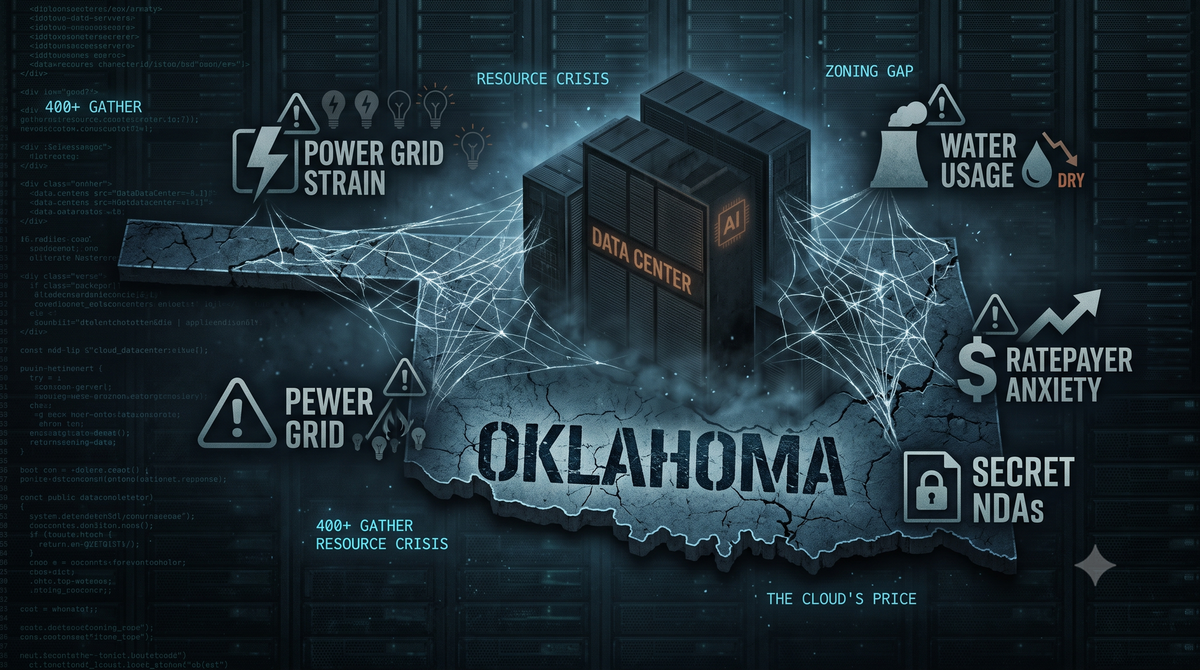
TULSA, Okla. — Inside the hall, nearly 400 residents sat shoulder-to-shoulder, spilling into the aisles as state lawmakers, environmental advocates, and community organizers took the stage. The tension was palpable. For months, news had circulated in whispers and heavily redacted municipal agendas: multi-billion-dollar tech giants and anonymous developers were quietly buying up hundreds of acres of agricultural land across Green Country.
Now, the public had gathered to confront the reality of the AI gold rush arriving at their doorsteps—and to demand answers about who would pay the price for powering the cloud.
1. The Stealth Incursion: Code Names and NDAs
Over the past year, Oklahoma has quietly transformed into ground zero for hyper-scale AI data center expansion. Drawn by cheap land, abundant water, and favorable energy rates, tech giants—including Meta and undisclosed corporate entities operating under shell names like "Project Anthem"—have targeted rural and suburban tracts surrounding Tulsa, Sand Springs, Coweta, and Stroud.
Yet, for many Tulsans, the development arrived in total secrecy.
┌────────────────────────────────────────────────────────────────────────┐
│                        THE ANONYMOUS LAND RUSH                         │
├────────────────────────────────────────────────────────────────────────┤
│  • Project Anthem: $1B+ Meta AI facility (340+ acres in East Tulsa)   │
│  • CPA-128: 375-acre agricultural rezoning request for data center     │
│  • Project Clydesdale: Hyperscale buildout in North Tulsa              │
│  • Governance Gap: City councilors signed non-disclosure agreements    │
└────────────────────────────────────────────────────────────────────────┘
When "Project Anthem"—a $1 billion, 340-acre campus planned for East Tulsa—first worked its way through municipal approvals, details were scarce. Developers utilized anonymous corporate structures, and several city officials signed non-disclosure agreements (NDAs) during preliminary negotiations. Memos later revealed that developers attempted to negotiate changes to local noise and nuisance ordinances before City Hall staff rejected the requests.
"You have volunteer city councilors and small-town mayors getting a small stipend, and they’re being asked to go up against tech giants with unlimited legal capital," stated State Representative Amanda Clinton (D-Tulsa) during the public forum. "They share a city attorney with five other towns—they’re simply not equipped on the legal side to negotiate these deals."
2. Resource Strain: Power, Water, and Ratepayer Anxiety
At the heart of the community backlash are two essential public resources: electricity and water.
Hyperscale facilities designed for artificial intelligence workloads require immense amounts of electricity—often consuming as much power as a mid-sized city—along with millions of gallons of water daily to cool high-density server racks.
| Resource Impact | Hyperscale Data Center Requirements | Community Concerns |
| Electric Grid | Continuous load of 100MW to 1,000MW+ per campus | Grid instability, rising utility rates for residential consumers |
| Water Supply | Millions of gallons/day for cooling systems | Sourcing from local reservoirs; impact on drought resilience |
| Land Use | 300 to 500+ acres of agricultural/rural land | Loss of rural character, industrial noise/vibration pollution |
| Employment | ~1,000 peak construction jobs; ~100 permanent jobs | Low long-term job density relative to land and resource consumption |
Though major tech companies and utility providers have pledged that data centers will bear the full financial burden of grid upgrades and draw on clean energy sources, public skepticism remains high. In local polling following public commitments from utility officials, over 70% of respondents expressed continued opposition to data center expansion, citing fears that utility bills will eventually spike to cover sub-station and transmission line buildouts.
Near the proposed site in East Tulsa, residents voiced specific Alarm over proximity to local water infrastructure. “They’re placing these facilities right next to vital water reservoirs,” noted one East Tulsa resident during public comments. “We were never given clear answers about water usage, noise abatement, or environmental safeguards before the first approvals were pushed through.”
3. David vs. Goliath: Municipalities Catch Up to the AI Surge
The fundamental issue facing communities across Oklahoma is a regulatory gap: current zoning codes were written for an analog era.
Under most municipal municipal frameworks, data centers have historically been classified under "Light Industrial" zoning. That designation assumes quiet operations with minimal off-site environmental impacts—a framework that fails to account for the continuous decibel hum, heat generation, and massive resource draw of modern AI server farms.
                  TRADITIONAL ZONING vs. HYPERSCALE REALITY

   [ Outdated Light Industrial Code ]       [ Modern AI Data Center Reality ]
   ──────────────────────────────────       ─────────────────────────────────
   • Assumes low environmental impact       • 24/7 continuous low-frequency hum
   • Moderate energy & water draw           • Massive grid strain (100MW+ draw)
   • Minimal off-site disruption            • Industrial-scale liquid cooling
   • Standard commercial footprint          • 300+ acre massive campus footprints
In response to mounting public outcry, the Tulsa City Council voted unanimously to enact a temporary 9-month moratorium on new data center developments. The pause allows the planning commission time to study best practices and create specific zoning regulations for hyperscale facilities.
However, the moratorium serves as a pause, not a full stop. Existing commitments—such as Phase 1 of Project Anthem and North Tulsa's Project Clydesdale—remain exempted and actively moving forward.
4. The Economic Promise vs. The Local Reality
Proponents of data centers argue that the facilities bring indispensable modern infrastructure to Oklahoma, pointing to:
- Infrastructure Capital: Hundreds of millions invested directly into transmission lines, sub-stations, and water pipes.
- Construction Surge: Over 1,000 high-paying trade and construction jobs during buildout phases.
- Community Contributions: Direct grants to local community colleges, technical schools, and public enhancement programs.
Yet, grass-roots organizations—including Stop Data Colonialism, Honor the Earth, and the Project Sand Springs Alliance—point to the severe imbalance in long-term economic returns. A $1 billion data center facility often yields only 50 to 100 permanent operations jobs, making it one of the lowest job-creators per square foot of any commercial development.
       CAPITAL INVESTMENT vs. PERMANENT JOB CREATION

       Data Center ($1B Investment):
       [▓▓▓▓▓▓▓▓▓▓▓▓▓▓▓▓▓▓▓▓▓▓▓▓▓▓▓▓▓▓▓▓▓▓▓▓▓▓▓▓] ~$1 Billion
       [▓▓] ~100 Permanent Jobs

       Manufacturing / Logistics ($1B Investment):
       [▓▓▓▓▓▓▓▓▓▓▓▓▓▓▓▓▓▓▓▓▓▓▓▓▓▓▓▓▓▓▓▓▓▓▓▓▓▓▓▓] ~$1 Billion
       [▓▓▓▓▓▓▓▓▓▓▓▓▓▓▓▓▓▓▓▓▓▓▓▓▓▓▓▓▓▓▓▓▓▓▓▓▓▓▓▓] 1,500+ Permanent Jobs
What Lies Ahead
As the 9-month moratorium ticks down in Tulsa, the fight over Oklahoma’s digital transformation is expanding to the state legislature. Lawmakers face pressure from both sides: global tech corporations seeking rapid deployment for AI computing infrastructure, and energized local coalitions demanding state-level oversight on water extraction, grid safety, and municipal transparency.
The 400 residents who packed the town hall sent a clear signal: the era of stealth site acquisition and rubber-stamped industrial permits in Oklahoma is over. Whether city halls can balance the lure of corporate investment with the preservation of local resources will set a precedent for the entire region as the national AI buildout accelerates.