Mayor of Vian, Dennis Fletcher, Was Arrested in March 2026

A Small-Town Mayor's Confrontation with Oklahoma's Controversial "Halo Law"
On a brisk March evening at Ripley High School's baseball field, just west of Stillwater, Oklahoma, a minor parking dispute escalated into a test case for one of the state's most controversial new laws. The result: Vian Mayor Dennis Fletcher, 50, found himself in handcuffs, arrested under a buffer zone statute that has drawn both praise from law enforcement and criticism from civil liberties advocates.
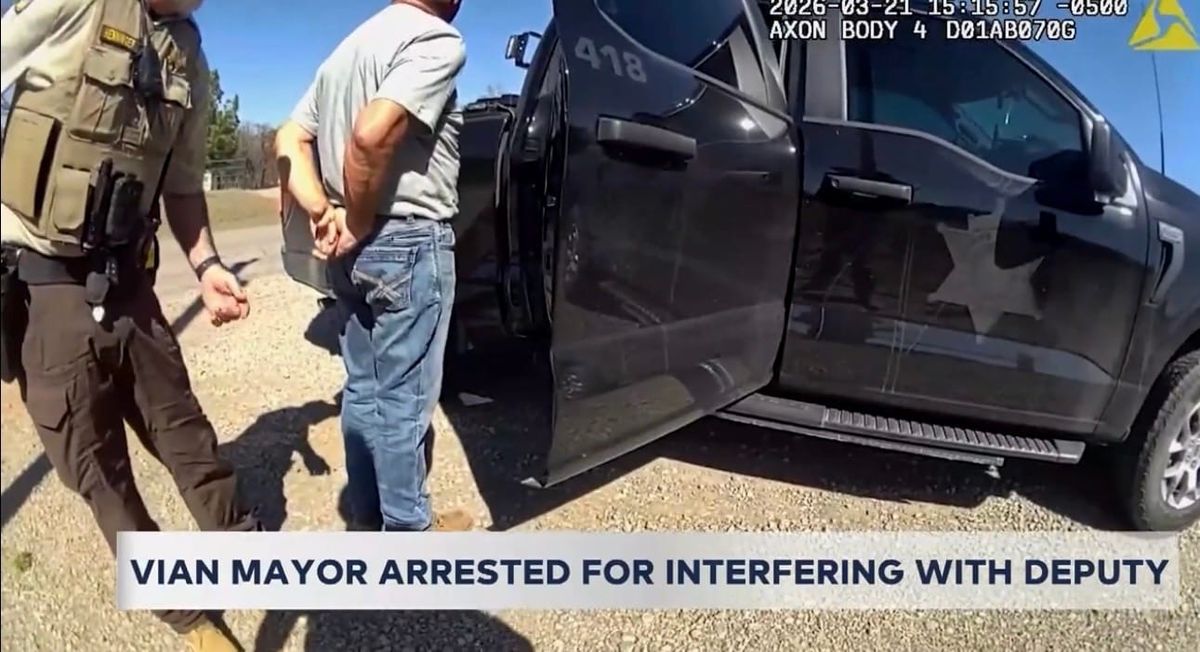
The March 21, 2026 incident — captured on body camera footage that would later circulate across local and national media — has thrust Fletcher and the tiny town of Vian into a broader debate about the balance between officer safety and citizens' rights to observe and engage with law enforcement.
But the story is more complex than a simple confrontation between authority and defiance. It's a tale that interweaves small-town politics, youth sports culture, a pattern of contentious police interactions in Vian's recent history, and the rapid proliferation of so-called "Halo Laws" across conservative states — laws that critics say create a dangerous precedent for limiting public oversight of police conduct.
The Incident: What Happened at the Baseball Field
The Payne County Sheriff's Office was not expecting trouble when Deputy [Name Withheld] responded to complaints at the Ripley High School baseball tournament on the afternoon of March 21. According to the incident report, the deputy was investigating two issues: complaints about individuals attempting to park on private property, and reports that spectators had used profanity during a game between Vian and Ripley the previous night.
Body camera footage shows the deputy speaking with an individual about the parking concerns when two men approached. One of them was Dennis Fletcher, wearing what appears to be Vian school colors, there to support his hometown team.
"There's a new state law that says if I tell you to leave, you have to leave," the deputy can be heard saying on the footage. "You have to be 25 feet away. So, go."
The men respond that they were trying to have a conversation. One questions the law. The deputy's tone becomes firmer.
"If I'm making a contact and I tell you to get back, you have to get back," the deputy states. "You refused to get back."
Moments later, Fletcher is in handcuffs, arrested and charged with misdemeanor obstruction — the first known case of a sitting Oklahoma mayor being arrested under House Bill 1597, the state's newly enacted buffer zone law.
According to the affidavit filed in Payne County District Court, Fletcher was not directly involved in the deputy's investigation and refused to comply with repeated commands to step away from the scene. He continued to engage with the deputy despite multiple warnings, the document states.
Fletcher was released the same day on personal recognizance bond and scheduled for an initial court appearance on March 27 in Stillwater. When contacted by multiple news outlets in the days following the arrest, both Fletcher and the Payne County Sheriff's Office declined to comment.
The Law: Oklahoma's Controversial "Halo" Statute
House Bill 1597, authored by State Representative John George, a Republican from Newalla and retired Oklahoma City police officer, became effective November 1, 2025. The law creates a new misdemeanor offense for bystanders who fail to move at least 25 feet away when ordered to do so by a first responder performing their official duties.
Violators face up to $500 in fines and one year in county jail.
"What this bill does — what I hope it does — is protect the officer and citizens from unnecessary confrontation," George said when introducing the legislation earlier in 2025. "If a first responder is performing their duty and they ask a citizen to stay back 25 feet, then they have to stay back. If they come forward after being warned, it's a misdemeanor and they can be arrested."
The bill passed through the Oklahoma Legislature with minimal debate and few negative votes. But its passage placed Oklahoma among a growing number of conservative states — including Florida, Georgia, Alabama, Tennessee, and Indiana — that have enacted similar "halo" or "buffer" laws in recent years.
Proponents argue these laws are necessary to protect first responders from interference, harassment, and physical danger. They point to rising confrontations at emergency scenes and increasingly hostile environments for law enforcement officers.
"When a police officer, EMT, firefighter or any emergency personnel are operating at an incident, their focus must be razor-sharp," wrote Patrick Mullaney, a former first responder and New York legislator, in defense of Nassau County's similar 15-foot buffer law. "The slightest distraction in their periphery — a bystander filming on a phone, asking a question or hovering too close — can interrupt that focus."
But critics see a different purpose: restricting citizens' ability to observe, document, and hold law enforcement accountable.
The Constitutional Questions
Several buffer zone laws enacted in other states have faced immediate legal challenges, with mixed results. The constitutional test, legal experts say, centers on the laws' specificity and their impact on First Amendment rights.
In August 2025, a federal appeals court ruled Indiana's buffer law impermissibly vague. Courts have stopped implementation in Louisiana and Arizona. A lawsuit challenging Tennessee's law remains pending. Meanwhile, laws in Florida, Georgia, and Alabama have been allowed to stand, at least for now.
The difference, judges have indicated, lies in how broadly the laws are written and how easily they can be subject to abuse.
Arizona's 2022 law, for instance, prohibited individuals from video-recording police from within eight feet — a provision that directly implicated First Amendment rights to document police activity. A federal judge blocked it, citing concerns about limiting transparency and accountability.
Oklahoma's law, by contrast, does not explicitly prohibit recording. It requires maintaining distance only after a verbal warning from a first responder. The key word is "after."
"The law is triggered by the officer's order," explained one Oklahoma criminal defense attorney who asked not to be named. "It's not a blanket prohibition. But that also means it's entirely discretionary. An officer can create a 25-foot exclusion zone anywhere, anytime, for any reason they deem their 'official duties.' That's a lot of power."
Durant Police Sergeant Nick Spencer, speaking about the law when it took effect, emphasized that warnings should be given first. "A warning should be given by that first responder—'Hey, you are harassing me, would you please stay back 25 feet so I can conduct my business,'" Spencer said.
But what constitutes harassment? The law defines it as "any willful behavior that intentionally distracts a first responder from their duties and serves no legitimate purpose."
Critics argue this language is dangerously vague. What one officer considers a distraction, another might view as lawful observation. What purpose is considered "legitimate"?
In Fletcher's case, these questions take on added significance. He wasn't filming. He wasn't shouting. According to reports, he was attempting to engage in conversation — behavior that, in any other context, would be considered ordinary civic participation.
Was he interfering with an investigation into parking complaints and profanity at a high school baseball game? Or was he exercising his right as a citizen — and, notably, as the mayor of one of the competing schools — to understand what was happening at an event involving his community's youth?
The Mayor: Dennis Fletcher's Vian
Dennis Lee Fletcher has served as mayor of Vian for multiple terms, most recently reappointed by the Vian Town Board in May 2025 to a two-year term. In that role, he oversees a small eastern Oklahoma town of about 1,374 residents, nestled along Interstate 40 about 12 miles northwest of Sallisaw and 35 miles from Fort Smith, Arkansas.
Vian is a working-class community with deep Native American roots — it lies within the jurisdiction of the Cherokee Nation. About 25% of residents live below the poverty line. The town's economy relies heavily on tourism and services, owing to its proximity to Lake Tenkiller, Sequoyah National Wildlife Refuge, and Robert S. Kerr Reservoir.
It's also a town where high school sports matter deeply. The Vian Wolverines football team made it to the Class 2A state championship game in December 2024, finishing the season with a 13-1 record — one of the best seasons in school history. For a community like Vian, these games aren't just athletics; they're social glue, civic pride, and identity rolled into one.
Fletcher's presence at the Ripley tournament was hardly unusual. Mayors in small Oklahoma towns routinely attend school sporting events, often serving as visible symbols of community support.
But this wasn't Fletcher's first brush with law enforcement controversy during his tenure.
A Pattern of Police Conflict
In May 2017, nearly nine years before the Ripley incident, Vian made headlines when both the police chief and Vian's first paid female officer resigned following a politically charged arrest.
Officer Lindsey Green, who had been with the department for less than six months, pulled over Josh Smith for driving with a suspended license — the son of a city councilman. Green, who had received officer of the month honors just weeks earlier from Chief Ted Johnson, arrested Smith and took him to jail, believing she had probable cause based on a previous citation.
According to Green's arrest report, City Attorney Larry Vickers told her she didn't have probable cause and ordered her to release Smith. The report also states that Mayor Dennis Fletcher told Green she had violated Smith's civil rights by taking him to jail, and sent the court clerk to retrieve Smith from custody.
Green contacted a local judge, who told her the arrest was justified and she had probable cause. Despite this, Green said she was told she would likely be fired. Both she and Chief Johnson resigned.
When asked about the incident at the time, Fletcher declined to comment in detail, saying, "I'll decline at this time to answer that. I'll have to talk to Larry, but I'd love to get back with you on that."
Fletcher said the city would investigate whether Green and the chief did anything wrong, and suggested an outside agency might be brought in. He insisted the city had no plans to fire Green.
Green saw it differently. "I know I'm in the right and I don't want a termination on my record," she told News on 6 in 2017. "The law's for everyone. It doesn't matter if your dad's a council member or not."
The episode raised questions about political interference in law enforcement operations in Vian — questions that, nearly a decade later, resurface in a different light with Fletcher's own arrest.
Small-Town Politics and Selective Enforcement
Critics of buffer zone laws have long warned about the potential for selective enforcement. In the wrong hands, they argue, such statutes become tools not for officer safety but for silencing inconvenient observers or critics.
Fletcher's case illustrates this concern from an unexpected angle. Here is a local official — someone with both the civic authority and arguably the civic responsibility to understand what law enforcement is doing in his community — being told he must stay away or face arrest.
The incident raises uncomfortable questions: Should elected officials receive deference in such situations? Or should they be treated exactly like any other citizen? What happens when the person being told to "back up" is someone whose job involves oversight of public affairs?
Moreover, the context matters. This wasn't an active crime scene with weapons drawn or a medical emergency with life-threatening urgency. It was a baseball field. The deputy was investigating complaints about parking and profanity — neither of which, on their face, would seem to require a sterile perimeter.
Video footage from the scene shows what appears to be other people in the vicinity, suggesting Fletcher and his companion weren't uniquely close or threatening. The question becomes: Why was the buffer invoked in this instance?
The deputy's body camera statement — "There's a new state law" — suggests the law itself may have been the motivation, a demonstration of authority under a freshly minted statute rather than a response to genuine safety concerns.
The Broader Context: Policing, Accountability, and Public Trust
Fletcher's arrest arrives at a moment of heightened scrutiny of police conduct nationwide. High-profile cases of excessive force, wrongful arrests, and deadly encounters have fueled calls for greater transparency and accountability.
Body cameras, civilian recording, and independent oversight have become standard demands from reformers. The premise is simple: sunlight is the best disinfectant. When police know they're being watched, they're more likely to follow procedures and respect rights.
Buffer zone laws, critics argue, undermine this principle by creating legal barriers — literally — between the public and law enforcement activities. Under the guise of officer safety, they insulate police from observation at the precise moments observation matters most.
"These laws are solutions in search of a problem," said one civil liberties attorney who has challenged similar statutes in other states. "Officers have existing authority to secure crime scenes, control crowds, and arrest people who actually interfere with their work. What they didn't have, until now, is the power to preemptively exclude anyone they find inconvenient."
Supporters counter that the rise in anti-police sentiment and aggressive confrontations at scenes justifies enhanced protections. They point to assaults on officers, harassment of first responders, and viral videos showing bystanders shouting, crowding, and obstructing emergency personnel.
But even some law enforcement officials express ambivalence. The International Association of Chiefs of Police has not taken an official position on buffer zone laws, and several police unions have declined to actively lobby for them, recognizing the complicated optics of appearing to restrict public oversight.
What Happens Next: Legal and Political Ramifications
Fletcher is scheduled to appear in Payne County District Court in Stillwater. The misdemeanor charge carries potential penalties of up to $500 in fines and one year in jail, though first-time offenders rarely receive maximum sentences.
The legal question at the heart of his case is straightforward: Did Fletcher's actions constitute interference with official duties after being given a lawful warning? The answer may hinge on whether the court finds the deputy's invocation of the buffer law reasonable under the circumstances.
But the political ramifications extend far beyond Fletcher's individual case.
If upheld, his conviction would establish precedent for how broadly Oklahoma's buffer law can be applied. It would signal that even minor law enforcement activities — parking disputes, noise complaints, profanity reports at youth sports events — can trigger mandatory exclusion zones, and that even elected officials are not exempt.
If dismissed or overturned, it could suggest the law's application in this case was overreach, potentially inviting legal challenges to the statute itself.
Either outcome will reverberate through Oklahoma's law enforcement community, among civil liberties advocates, and in small towns like Vian, where the boundaries between government, community, and individual rights remain fluid and contested.
The Unanswered Questions
As of this writing, several key questions remain unresolved:
Why did Fletcher approach the deputy in the first place? Was he attempting to advocate for someone from Vian? Was he responding to a constituent concern? Or was he simply curious, as any citizen might be, about what law enforcement was doing at a community event?
What specific behaviors did the deputy find obstructive? Body camera footage shows Fletcher was told to back up, but it doesn't clearly capture what he was doing that warranted the warning. Was he blocking the deputy's line of sight? Talking over him? Or simply standing nearby?
Would another citizen have been treated the same way? Or did Fletcher's position as mayor make him a target — either for special scrutiny or as an example to others?
Why has Fletcher remained silent? His refusal to comment, unusual for a public official facing charges, suggests either legal strategy or deeper complications. Is he preparing a defense? Negotiating a resolution? Or is there more to the story than has been publicly revealed?
The Payne County Sheriff's Office has also remained mum, declining all interview requests and referring questions to the court proceedings.
Vian's Future, and Oklahoma's
For Vian, the Fletcher arrest is the latest chapter in a complicated relationship with law enforcement and public accountability. The 2017 resignation of Chief Johnson and Officer Green exposed fault lines in the town's governance. The ongoing water rate dispute between the Sequoyah County Water Association and Vian Public Works Authority reflects tensions over resources and leadership. And now, Fletcher's arrest adds another layer to questions about how power is exercised — and challenged — in small-town Oklahoma.
For Oklahoma more broadly, the case will test the limits of a law that seemed uncontroversial when it passed but may prove far more contentious in application. If buffer zone statutes are used primarily to protect officers in genuinely dangerous situations, they may withstand constitutional scrutiny and gain public acceptance. But if they become tools for silencing observers, journalists, or even elected officials at routine encounters, the backlash could be swift and severe.
The stakes are high. Public trust in law enforcement is fragile, particularly in communities that have experienced overreach or misconduct. Laws that appear to prioritize officer convenience over transparency risk eroding that trust further, even if they're enacted with good intentions.
Conclusion: A Twenty-Five-Foot Question
At its core, the Dennis Fletcher case asks a twenty-five-foot question: How close is too close? At what point does a citizen's presence become interference? And who gets to decide?
The answers matter because they define the relationship between law enforcement and the communities they serve. They determine whether police are public servants operating in the public eye, or sovereign authorities entitled to work free from observation.
In Fletcher's case, the setting — a high school baseball field, not a crime scene — makes the question particularly stark. This was not a hostage situation, not a traffic accident with injuries, not an armed standoff. It was a minor investigation into complaints about parking and language.
Yet a mayor was arrested. A town's leader was handcuffed. And Oklahoma's new buffer zone law claimed its first high-profile casualty.
Whether Fletcher is convicted or acquitted, the incident has already accomplished one thing: It has forced a conversation about where the line is drawn, who draws it, and what happens when small-town politics, youth sports, and a new law collide on an otherwise ordinary March afternoon.
The answer, like the 25-foot buffer itself, is still being measured.
Editor's Note: The Vian Town Board has not issued any statement regarding his arrest or whether it affects his position as mayor. This story will be updated as court proceedings develop.
Additional Reporting:
- Court records from Payne County District Court
- Body camera footage released by Payne County Sheriff's Office
- Interviews with legal experts and civil liberties advocates
- Historical news reports from 2017 Vian police resignation
- Analysis of House Bill 1597 and buffer zone laws in other states
Contact: dustinreedterry@gmail.com for tips, corrections, or additional information.