OKCity Crisis Nursery Accused of Fraud & Part of an Ongoing Investigation

On a muggy afternoon in Oklahoma City, the narrative of a hometown heroine was dismantled in the stark, unvarnished language of a state indictment.
For nearly eight years, Jennifer Lynn Roberts was a fixture of regional feel-good local news segments. She was the founder and executive director of the OKCity Crisis Nursery, a sanctuary established in 2018 to provide emergency childcare for parents facing acute life crises—domestic violence, sudden homelessness, medical emergencies. In a state with chronically underfunded social safety nets, the Nursery presented itself as an indispensable refuge for infants and toddlers with nowhere else to turn. Roberts was portrayed as the tireless martyr keeping its doors open, pleading for diaper donations on local morning shows and collecting accolades from community organizations.
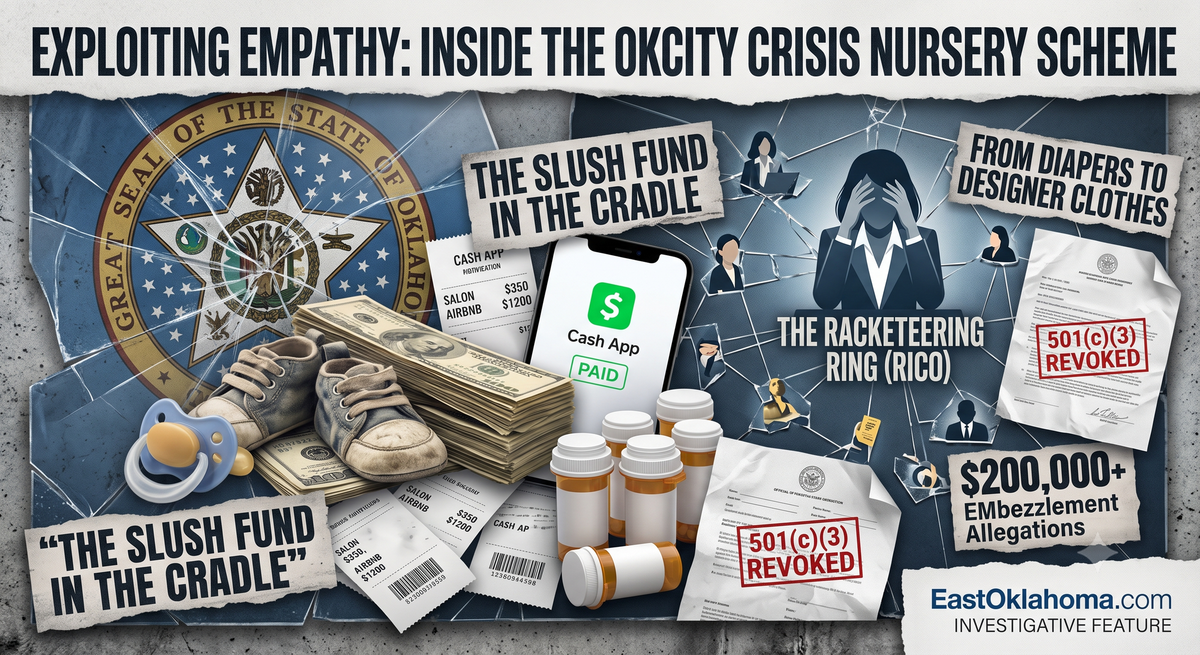
On July 28, 2026, Oklahoma Attorney General Gentner Drummond revealed what was actually happening behind those doors. In a sweeping, 15-page charging document filed in Oklahoma County District Court, state prosecutors laid out a systemic, multi-year criminal enterprise. Roberts and eight co-defendants—a network composed largely of her immediate family members and close personal associates—were charged under the Oklahoma Racketeer-Influenced Corrupt Organization (RICO) Act, alongside felony counts of embezzlement, charitable solicitation fraud, and illegal drug distribution.
What the state uncovered was not a case of sloppy bookkeeping or well-intentioned mission creep. It was a methodical, brazen siphon: a community’s empathy transformed into a personal piggy bank that funded high-end lifestyle luxuries, family payouts, and illicit prescription pill trades—all while the charity was operating without a valid tax exemption.
The Economics of Unchecked Altruism
The mechanics of the alleged scheme were as simple as they were vulnerable to abuse. As the founder and sole administrator, Roberts retained exclusive authority over the Nursery’s bank accounts, along with its merchant profiles on PayPal, Cash App, and Venmo. In the modern era of social-media-driven philanthropy, where a compelling story on Instagram or Facebook can generate thousands of dollars in peer-to-peer micro-donations overnight, the Nursery operated with zero financial friction—and zero independent oversight.
According to court filings and itemized banking records submitted by state investigators, the public’s charitable contributions were systematically converted into a personal line of credit.
Between 2020 and early 2026, prosecutors allege Roberts spent over $69,500 directly from charity accounts on personal self-care and leisure. The line items read like an inventory of mid-tier luxury: more than $10,000 at hair and nail salons, thousands in medical cosmetic procedures, gym and tanning memberships, and high-end wardrobe updates.
The everyday leakage was equally staggering. Investigators documented more than 800 separate food delivery orders totaling $33,000 billed directly to the nonprofit's debit cards. Another $15,000 was spent booking 31 separate vacation rentals through Airbnb.
SELECTED CHARGES FILED (OKLAHOMA COUNTY DISTRICT COURT)
----------------------------------------------------------------------
Case Ref: State of Oklahoma v. Jennifer Lynn Roberts et al.

• Felony Racketeering (Oklahoma RICO Act)
• Embezzlement of Charitable Funds (Multiple Counts)
• Charitable Solicitation Fraud
• Endeavoring to Distribute Controlled Substances
• Falsification of Evidence / False Preparation of Exhibits
----------------------------------------------------------------------
Yet the direct card swipes were only part of the ecosystem. The indictment details over $200,000 in peer-to-peer digital transfers routed through Cash App and Venmo from the charity's accounts directly to Roberts’ relatives and friends. The transaction memos recorded in court filings display a bizarre mix of casual impunity and family management: "hair appointment ❤️", "car insurance", and "Tahoe tag and penalty."
In one particularly damning exchange highlighted by state prosecutors, Roberts allegedly negotiated the purchase of illicit prescription narcotics—including hydrocodone and Adderall—from her brother, co-defendant Christopher Roberts. When pushed for payment, Roberts texted: "I haven't gotten any new donations today and don't have any to give you for the others, but I will as soon as I can." Donor dollars weren't just subsidizing a lifestyle; they were allegedly being leveraged as liquidity in an informal drug market.
The Co-Conspirators and the Cover-Up
When law enforcement began circling, the state alleges the enterprise pivoted from simple theft to active obstruction.
According to prosecutors, the OKCity Crisis Nursery never maintained a legitimate, functioning Board of Directors. For years, Roberts functioned without the fiduciary checks required of standard non-profit entities. When state investigators started demanding board meeting minutes, financial audits, and governance records, Roberts allegedly recruited associate Chelsea Fowler to fabricate a ghost board of directors, drafting retroactive documents and forging signatures to simulate compliance.
The family network ran deep across the nine co-defendants:
- Jennifer Lynn Roberts: Founder/Executive Director; facing RICO, embezzlement, solicitation fraud, and drug distribution charges.
- Chelsea Fowler: Charged with embezzlement and accessory after the fact for her role in constructing the fake governance records.
- Christopher Roberts: Charged with endeavoring to distribute controlled substances in connection with the text-messaged pill trades.
- Tyler Maness: Charged with false preparation of exhibits after allegedly creating fraudulent community service logs for individuals attempting to satisfy court-ordered requirements through the nursery.
- Avery Parker & Noel Crow: Charged with receiving unlawful proceeds, specifically regarding a personal vehicle purchased directly using charity capital.
- Kaleb Roberts, Myra Hargrove, & Lauren Langley: Charged with embezzlement and unlawful receipt of siphoned funds via digital payment apps.
How Did the Safety Net Fail?
The most unsettling aspect of the OKCity Crisis Nursery case is not its sheer audacity, but how long it went undetected.
The IRS officially revoked the OKCity Crisis Nursery’s tax-exempt 501(c)(3) status in May 2024 due to a persistent failure to file annual Form 990 returns—the baseline tax document that discloses executive compensation and financial allocations. Yet, for more than two years following the federal revocation, the nursery continued to solicit tax-deductible donations online, host public fundraisers, and accept community support without interruption.
Local news outlets continued to run glowing profiles. Donors continued to hit "send" on digital payment apps. No regulatory alarm sounded because the state's oversight mechanisms for small-to-midsize nonprofits rely almost entirely on self-reporting and public complaints rather than proactive audits.
"Oklahomans open their wallets to organizations like this because they believe they're helping children, not funding someone's lifestyle," Attorney General Gentner Drummond said in a statement released following the arrest warrants. "When a person exploits that trust and turns a charity into a personal slush fund, my office won't look the other way."
The Lessons for Regional Philanthropy
For readers across Eastern Oklahoma and the broader region, the collapse of the OKCity Crisis Nursery offers a sobering case study in the vulnerabilities of modern grassroots charity. In an era where digital fundraising platforms allow anyone to spun up an emergency campaign in minutes, emotional narrative frequently outpaces institutional accountability.
Investigative experts and non-profit ethics advocates point to three non-negotiable checks every donor should make before contributing to local causes:
- Verify Direct 501(c)(3) Standing: Never rely on a charity's website banner or promotional flyers. Check the IRS Tax Exempt Organization Search (TEOS) database to verify that their tax-exempt status is active and that their Form 990 disclosures are current.
- Insist on Independent Board Governance: A legitimate non-profit must be governed by an independent, uncompensated board of directors with the legal authority to review bank statements, approve salaries, and hire external auditors. If the founder, their spouse, and their siblings make up the leadership team, the organization lacks basic safeguards.
- Scrutinize Peer-to-Peer Payment Channels: While Venmo and Cash App are convenient, charities that push donors toward personal handles rather than official merchant processing systems often bypass internal accounting controls.
The physical doors of the OKCity Crisis Nursery are now closed, its operational accounts frozen, and its leadership facing decades in state custody. But the true casualty of the scheme isn't just the siphoned money—it is the erosion of public trust in the small, vital non-profits that genuinely keep Oklahoma's struggling families afloat.
All defendants are presumed innocent until proven guilty in a court of law.