Someone Set the Sheriff's House on Fire in Adair County — And Nobody's Talking

A brazen act of arson in the heart of Cherokee Country leaves federal investigators chasing ghosts in one of Oklahoma's most volatile corners
The smoke was spotted by a stranger passing by.
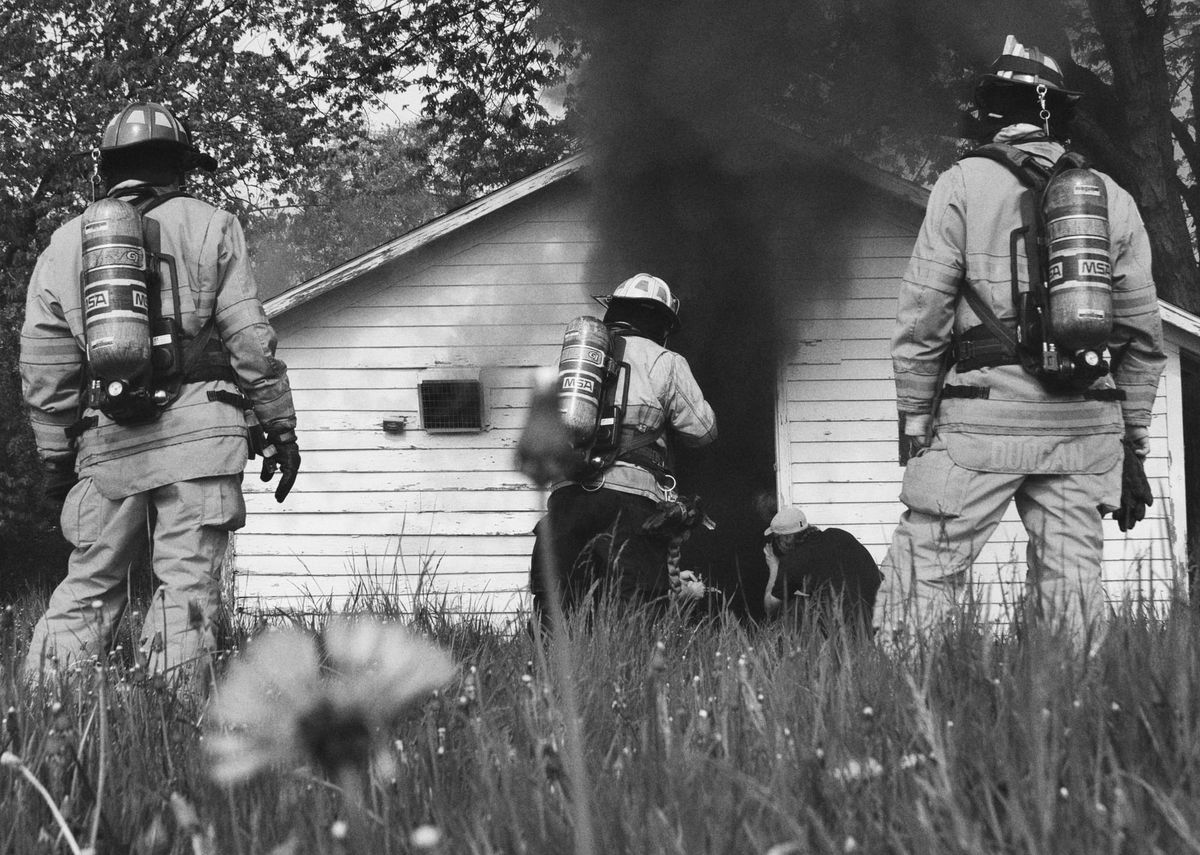
It was May 19, 2026 — a Tuesday — when a passerby noticed something wrong at a house outside Stilwell, Oklahoma, the small county seat of Adair County, tucked into the green hills of the Cherokee Nation along the Arkansas border. Smoke was pouring out. Multiple people pulled over to help. Two rural fire departments — 51 West and Stilwell Fire — raced to the scene.
What they found wasn't an accident.
The house belonged to Adair County Sheriff Jason Ritchie. Someone had broken in, doused the interior with an ignitable liquid, and set it ablaze. By the time the flames were out, most of what the Ritchie family owned was gone. A few personal items, salvaged by the quick action of neighbors and firefighters. The rest, ash.
Within 24 hours, the Bureau of Alcohol, Tobacco, Firearms and Explosives had agents on the ground from their Muskogee field office. They confirmed what the fire departments already suspected: forced entry, accelerant, deliberate ignition. This wasn't a grease fire or a faulty outlet. Someone had walked into the home of the county's top law enforcement officer, poured fuel, and lit a match.
ATF Special Agent in Charge Brian Garner put it plainly: "Fire, when used as a tool of violence, can ruin lives, property, and the American sense of security."
As of the last week of May 2026, no suspects have been arrested. The reward for information has climbed to $10,000. And in a county of fewer than 20,000 people — where everyone knows everyone, and secrets travel fast — nobody is stepping forward.
A County With a Long Memory
To understand why this matters, you have to understand where it happened.
Adair County sits in the eastern edge of Oklahoma, covering 577 square miles of hill country along the Arkansas border. As of the 2020 census, its population was 19,495. Its county seat, Stilwell, holds fewer than 4,000 people. The closest major city is Fayetteville, Arkansas — forty miles east. Tulsa is nearly two hours west.
Stilwell is located within the sovereign territory of the Cherokee Nation. It is also home to the United Keetoowah Band of Cherokee Indians in Oklahoma. The Oklahoma governor and legislature once proclaimed it the "Strawberry Capital of the World," though the role of strawberries in the local economy has long since faded.
The county was created in 1906 from the Goingsnake and Flint districts of the Cherokee Nation, and named after the influential mixed-blood Cherokee Adair family. As of the 2020 census, roughly 45 percent of the population identified as American Indian. Culturally and politically, this is Cherokee country. Federal jurisdiction runs deep here — a legacy of the 2020 Supreme Court McGirt v. Oklahoma ruling, which reaffirmed that much of eastern Oklahoma remains Indian Country for criminal prosecution purposes, shifting a vast swath of cases from state courts to federal ones.
That jurisdictional reality shapes everything about law enforcement in Adair County — including why the ATF is involved in what might otherwise be a local arson investigation. When crimes touch tribal land, the federal government steps in. The Ritchie home sits inside the Cherokee Nation Reservation. That makes this a federal matter.
The Sheriff
Jason Ritchie has been Adair County Sheriff since 2017, winning his first election and going on to a second term. He has a background in law enforcement and worked as a cop before moving up the ranks. Those who know him describe a man who understands what the area is up against and continually works to make the county safer.
That work has not been without friction.
Adair County has a stubborn methamphetamine problem — one that Ritchie has made a priority. In 2020, Ritchie oversaw a meth sting that put five people in the Adair County Jail, calling in an interagency effort involving the Stilwell Police Department, the Delaware County Sheriff's Office, and multiple drug task forces. "We do have one or two still outstanding," Ritchie said at the time, describing the group as a ring with a clear leader. "We got the main group, so it should slow down for a while."
The county's drug enforcement record is long. A previous sweep netted eleven convictions in an Adair County meth trafficking ring, drawing in agencies as varied as the DEA, the National Guard Counterdrug Task Force, the Bureau of Indian Affairs, the U.S. Marshals Service, the Cherokee Nation Marshal Service, the Oklahoma Highway Patrol, and multiple district attorney drug task forces. Stilwell, the county seat, has been at the center of many of these cases.
The work of dismantling those networks means making enemies. In small-town eastern Oklahoma, where extended families interlock across generations and everyone knows which deputy pulled over which cousin on which back road, a sheriff who takes drug enforcement seriously collects grievances. The open question investigators are now working through is whose grievance ran hot enough to turn into arson.
Ritchie himself has also navigated internal controversy. In September 2022, he placed Adair County Deputy Travis Adams on administrative leave after a video surfaced online of Adams shooting a man twice at close range during a heated argument. Ritchie said he intended to fully cooperate with the external investigation, and Adams was subsequently arrested on aggravated assault and battery charges. Holding one of your own officers accountable in a small county — publicly, on video — is the kind of decision that earns respect in some quarters and resentment in others.
None of this, on its own, points to a motive. But it sketches the terrain of a sheriff who has spent nearly a decade making difficult calls in a difficult place.
The Night of May 19
The Ritchie family was not home when the fire started. That may have been by design.
The timeline, as reconstructed from fire department and ATF reports, begins sometime during the day or evening of May 19. Someone approached the residence, forced entry — breaking in through a door or window — and introduced an ignitable liquid to the interior before setting it alight. The fire had time to spread before the passerby spotted smoke and called for help.
Ritchie posted a statement the following evening: "Good evening, friends, family, and constituents. I'm sure most of you know by now that we've had an incident involving our home. My family and I are okay and are working towards getting things back to normal. Yesterday, a passerby noticed smoke coming from our house, and multiple people stopped to help try to extinguish the fire. For that, I'm very grateful. Two fire departments, 51 West and Stilwell Fire, showed up and were amazing. I'm forever grateful for both the citizens who stopped to help and the firefighters. Because of their quick action, a few family and personal items were able to be salvaged. It appears that someone made entry into our home and set it on fire."
The sheriff's statement was measured, even gracious toward the community. He thanked people. He did not speculate about who or why. What he did not say — but what law enforcement sources confirmed through subsequent reporting — is that the evidence at the scene left little doubt: this was targeted. Someone knew whose house it was. Someone chose it deliberately.
ATF Special Agents from the Muskogee Field Office responded to the scene and found evidence of forced entry along with the presence of an ignitable liquid. Officials said investigators are pursuing multiple leads, but no suspects have been identified.
A GoFundMe was launched to support the Ritchie family's immediate needs and rebuilding efforts. The community responded.
The Federal Response
The speed and scale of the federal response tells its own story. The ATF doesn't typically deploy agents from a field office for a house fire in a rural county unless the circumstances are extraordinary. Setting a law enforcement officer's private residence on fire — with evidence of forced entry and accelerant — clears that bar decisively.
ATF Special Agent in Charge Brian Garner framed the investigation in terms that signal the agency views this as a serious threat to law enforcement: "ATF has a longstanding working relationship with the Adair County Sheriff's Office and is determined to locate the individual(s) responsible for this reckless act and hold them accountable."
The reward began at $5,000, a figure offered jointly by the ATF and the Adair County Sheriff's Office. By late May, the reward had been raised to $10,000 — a signal that tips had not yet produced a viable lead, and that investigators were hoping to shake something loose from the community.
That the reward has climbed, and that no arrest has followed, says something about the nature of the case. In Adair County, as in most of rural eastern Oklahoma, a $10,000 reward is significant money. People talk. But when they don't — when money isn't enough to make someone come forward — it usually means one of two things: either nobody knows who did it, or someone does know and is afraid to say.
In a county where law enforcement has made sustained enemies among drug networks with deep family roots, the second possibility is not abstract.
The Silence Around It
What's striking about the Adair County arson case, one week out, is how quiet the county itself has been.
Local coverage has been factual and brief. The Tahlequah Daily Press ran the ATF press release. TV stations out of Tulsa picked it up. The national wire didn't touch it. No neighbors have gone on camera to say they saw something suspicious. No social media posts from locals have gone viral with tips or theories. The community's public posture has been one of solidarity with the sheriff — and silence about who might have done it.
That silence may be evidence of nothing. In small counties, people often don't speculate publicly about serious crimes, particularly ones that could put them in the middle of a federal investigation. But it may also reflect something about the social geography of a place where the person you're pointing a finger at might be your neighbor, your relative, or someone whose friends you'd rather not antagonize.
Sheriff Ritchie, for his part, has said nothing publicly about suspects or theories. The ATF has said nothing about the direction of their leads. The investigation is officially open, officially active, and officially producing nothing for public consumption.
What This Case Means
Setting a sheriff's home on fire is not a random act of property crime. It is a statement. It says: we know where you live. It says: your badge does not protect your family. It says: whatever you are doing — the drug raids, the arrests, the meth stings, the accountability measures — there is a cost, and we are willing to impose it.
That message, if left unanswered, does real damage. Not just to one sheriff and one family, but to the entire premise of rural law enforcement in a region that already operates under profound resource constraints. Ritchie himself once described the challenge plainly: "We're a small department. We have a very limited budget, so we really rely on the task force and smaller police departments to serve the warrant." A sheriff who is outgunned and outfunded, facing a community where criminal networks have had decades to build loyalty and fear — and who now has to wonder whether doing his job will cost him his home — is a sheriff working at a disadvantage the public rarely sees.
There is also a jurisdictional dimension worth noting. Because the crime occurred on Cherokee Nation land, federal prosecutors will likely handle any eventual case. That means the stakes for whoever lit that fire are federal, not state. Arson targeting a law enforcement officer, with evidence of forced entry, carries serious exposure in federal court. The ATF is not a local department that can be waited out.
Whether that eventually produces an arrest is the question hanging over Adair County right now.
Where It Stands
As of June 2, 2026, the investigation is ongoing. The ATF's Muskogee field office is leading the effort, assisted by the Adair County Sheriff's Office. The reward stands at $10,000. No suspects have been publicly identified. No arrests have been made.
Anyone with information is asked to contact:
- ATF Muskogee Field Office: 918-594-1800
- Adair County Sheriff's Office: 918-696-2106
- ATF Tip Line: 1-888-ATF-TIPS (1-888-283-8477)
- Email: ATFTips@atf.gov
The Ritchie family is working, in Ritchie's own words, "towards getting things back to normal." Whether normal is still possible — in a small county where a sheriff's home was torched in daylight, where federal agents are working leads that haven't broken yet, and where nobody is talking — remains to be seen.
Somewhere in Adair County, or just outside it, someone knows what happened on the night of May 19. Whether they're willing to say so is a different question entirely.
This story will be updated as new information becomes available. Tips related to this case should be directed to ATF at 1-888-ATF-TIPS.