The Embarrassing $5,000 Tax Dispute That Was The Start of a Stitt Administration Mired in Scandals

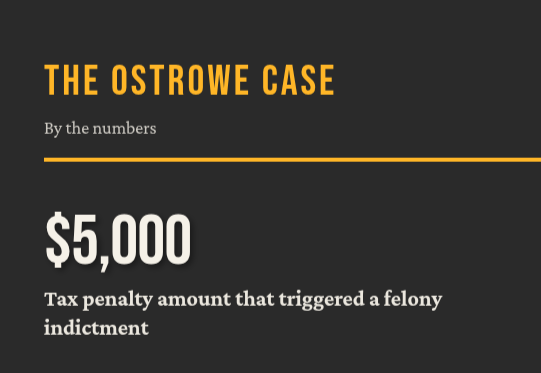
How a $5,000 tax dispute became a political scandal that exposed Oklahoma's broken accountability system
By Staff Reporter
Oklahoma City, Oklahoma — May 18, 2026
In September 2020, David Ostrowe picked up his phone and made three calls that would derail his career, embarrass Governor Kevin Stitt's administration, and ultimately reveal how easily Oklahoma's criminal justice system could be weaponized for political purposes.
Or did they?
The story of what happened when Ostrowe—then Oklahoma's Secretary of Digital Transformation and Administration—contacted three members of the Oklahoma Tax Commission about a former state senator's $5,000 penalty dispute depends entirely on who's telling it. To Attorney General Mike Hunter's office, those phone calls were attempted bribery, a felony punishable by up to five years in prison. To Ostrowe, they were routine constituent service calls that became a politically motivated prosecution. To current Attorney General Gentner Drummond, they were evidence of Hunter's "weaponization" of the state's top law enforcement office.
What's indisputable is this: a multi-county grand jury indicted Ostrowe in December 2020 after hearing testimony from only one witness who had no firsthand knowledge of the alleged crime. Five months later, as scandal engulfed his own office, Mike Hunter dismissed the charges on his way out the door. And two years after that, Drummond—Hunter's longtime political rival—formally exonerated Ostrowe, declaring he had committed "no wrongdoing."
Between those three moments lies a case study in how Oklahoma's public corruption prosecutions can unravel under political pressure, how grand juries can be manipulated, and how the system designed to hold powerful people accountable can instead be turned against them.
The Phone Calls That Started Everything
The sequence of events that led to David Ostrowe's indictment began, improbably, with a numerical error at a restaurant that had been closed for three years.
In mid-2020, the Oklahoma Tax Commission contacted former State Senator Jason Smalley about JCG Futures LLC, a restaurant and event center he had operated in Stroud until 2017. A reporting error, Smalley later explained, meant the business had underpaid its sales taxes by about $5,600 over a three-month period. By the time the Tax Commission caught the mistake, penalties and interest had ballooned the debt to approximately $10,600.
Smalley, a Republican who had served in the Oklahoma House and Senate before resigning in January 2020 to take a telecommunications job, paid the full amount. But he thought the penalties were excessive—a sentiment he shared with many Oklahoma small business owners who have tangled with the state's tax bureaucracy.
So in late summer 2020, Smalley did what constituents often do: he called his legislators. Specifically, he called Representative Kevin Wallace and Senator Roger Thompson, both Republicans he knew from his time in the legislature. Thompson represented the neighboring district to where Smalley lived—a district that had no senator at the time because of Smalley's own resignation.
"Like all the other constituents whenever they call and say, 'Is there anything you can do?' I said, 'Well let me ask them to take another look at it,'" Thompson later told investigators and reporters.
Thompson, who at the time served as chairman of the Senate Appropriations Committee, reached out to David Ostrowe for help navigating the Tax Commission's procedures. As Secretary of Digital Transformation and Administration, Ostrowe oversaw approximately 50 state agencies—including the Oklahoma Tax Commission, the largest agency under his portfolio.
On September 10, 2020, Ostrowe made his move.
First, he texted Tax Commissioner Steve Burrage, a Democrat: "JCG Futures LLC applied for waivers of penalties. I'll call you later with the details."
Burrage responded: "Okay."
Later that evening, Ostrowe called Burrage. According to Burrage's subsequent testimony to investigators, Ostrowe told him that if the Tax Commission didn't waive the penalties and interest for JCG Futures, Senator Roger Thompson would "punish" the Oklahoma Tax Commission—presumably by cutting the agency's appropriations.
That same day, Ostrowe contacted Commissioner Charles Prater, a Republican, by both text and phone. According to the indictment, Ostrowe explained the JCG Futures situation and said "a former senator would be coming before the Tax Commission and that he needed his penalties and interest abated."
Prater's response, according to court documents, was unequivocal: they shouldn't be talking about the matter.
Ostrowe also attempted to contact a third commissioner, Clark Jolley, though the details of that contact remain less clear in the public record.
Two things did not happen: the Tax Commission did not waive Smalley's penalties, and Senator Thompson did not punish the Tax Commission's budget.
But Commissioner Prater did something else. He went to Governor Stitt and told him about Ostrowe's calls. According to Prater's account, Stitt agreed the matter should be investigated. Prater and at least one other commissioner then formally contacted Attorney General Mike Hunter's office.
By December, a grand jury had returned an indictment.
A Grand Jury Hears From One Witness
The indictment of David Ostrowe on December 17, 2020, came from Oklahoma's 18th multi-county grand jury, a special investigative body empowered to examine public corruption across county lines.
Multi-county grand juries occupy a unique and somewhat controversial place in Oklahoma's justice system. Created to investigate complex crimes that span multiple jurisdictions, they operate largely in secret, with proceedings closed to the public and defendants. Grand jurors hear only the evidence prosecutors choose to present, and defense attorneys have no opportunity to cross-examine witnesses or present contrary evidence.
The standard for indictment is low: grand jurors need only find "probable cause" to believe a crime occurred—a far lower bar than the "beyond a reasonable doubt" standard required for conviction at trial.
In Ostrowe's case, the grand jury heard testimony from exactly one witness: Tom Helm, an investigator from Attorney General Mike Hunter's office. Helm had no firsthand knowledge of Ostrowe's phone calls with the tax commissioners. He could only relay what others had told him.
The grand jury heard nothing from David Ostrowe himself, who was never given an opportunity to explain his version of events. They heard nothing from Senator Roger Thompson, who might have testified about what he asked Ostrowe to do. They heard nothing from Jason Smalley, who later said he'd never even met Ostrowe and had no idea why the secretary would involve himself in Smalley's tax dispute.
Most critically, they heard no evidence about whether Ostrowe actually made a threat—or whether his contacts with the tax commissioners were simply routine communications between a cabinet secretary and the agency under his supervision.
The indictment charged Ostrowe with one count of attempted bribery of an official, alleging that he "did commit the crime of attempted bribery of an officer by knowingly and unlawfully attempting to commit the crime of bribery of an official by directing Oklahoma Tax Commissioners Steve Burrage and Charles Prater to waive the interest and penalties of JCG Futures, LLC which were owed to the State of Oklahoma and if not compliant with this directive, appropriations to the Oklahoma Tax Commission would be withheld."
The charge carried up to five years in prison.
Ostrowe told The Oklahoman he made no threats and stood by his actions. Governor Stitt's office issued a careful statement: "Governor Stitt is aware of the allegations involving Secretary Ostrowe and takes them seriously. We are still working to obtain more information regarding the details of the situation. The governor has faith in the fairness of Oklahoma's justice system which includes the presumption of innocence."
Notably absent was any call for Ostrowe to resign or even to be suspended pending the outcome of the case.
The Hidden Motive
But the indictment contained allegations that went beyond the JCG Futures matter—allegations that suggested Ostrowe might have had reasons beyond constituent service for involving himself in a former senator's tax dispute.
According to the probable cause affidavit filed by Tom Helm, Commissioner Charles Prater told investigators that Ostrowe had approached him in September or October 2020 with an unusual request: Would Prater be willing to change his political party affiliation from Republican to Democrat?
Prater believed he understood why. State law requires the three-member Oklahoma Tax Commission to have bipartisan representation—no more than two members from the same political party. At the time, the commission had two Republicans (Prater and Jolley) and one Democrat (Burrage). Burrage's term was set to expire in January 2021.
If Prater switched parties, it would open a Republican slot on the commission. And Ostrowe, who was registered as a Republican at the time, would be eligible for appointment.
"Prater further stated that he believed Ostrowe's motive for attempting to influence the JCG Futures matter was that Ostrowe was attempting to curry favor with Burrage in an effort to obtain Burrage's support for Ostrowe's appointment to the Tax Commission," Helm wrote in his affidavit.
In other words, prosecutors theorized that Ostrowe was trying to help a former senator with his tax problem in order to win support for his own appointment to a lucrative government position. Tax commissioners in Oklahoma earned six-figure salaries—a significant financial incentive for what would amount to a part-time job.
Ostrowe denied having any interest in joining the Tax Commission. He told reporters he had changed his own voter registration from Republican to independent, but insisted that was merely a reflection of his political thinking, not a strategic move to qualify for appointment.
The theory, while plausible, was never proven. No one presented evidence that Ostrowe had formally sought the Tax Commission position or lobbied the governor for it. The connection between the September phone calls about Smalley's taxes and any hypothetical January appointment to the commission remained speculative.
But it gave prosecutors—and the media—a narrative that made the case seem more sinister than a simple dispute over whether a phone call constituted a threat.
The Fast-Food Magnate Turned Digital Reformer
To understand why Ostrowe became a target—and why his case became so politically charged—requires understanding who David Ostrowe was and what he represented in Kevin Stitt's administration.
Ostrowe was a businessman, not a career politico. In the private sector, he served as president of O&M Restaurant Group, which owned Burger King, Blaze Pizza, and Taco Bell franchises across Oklahoma, Arkansas, and Louisiana. He had made his fortune in fast food, not in government contracts or political influence-peddling.
When Kevin Stitt became Oklahoma's governor in 2019, he tapped Ostrowe to lead an ambitious initiative: the digital transformation of state government. Oklahoma's government systems were notoriously antiquated. Agencies still relied on paper forms, outdated databases, and bureaucratic processes that could have been streamlined decades earlier. During the COVID-19 pandemic, when unemployment claims surged, the state's overwhelmed unemployment system became a national embarrassment.
Ostrowe's job was to drag Oklahoma into the 21st century. As Secretary of Digital Transformation and Administration, he oversaw roughly 50 state agencies with a mandate to modernize their operations, digitize their services, and make it easier for Oklahomans to interact with their government.
It was an enormous portfolio with enormous budgets—and enormous potential for conflict.
In April 2020, just months before the Tax Commission incident, Ostrowe had clashed publicly with House Speaker Charles McCall and other legislative leaders over rural broadband expansion and proposed cuts to his Digital Transformation Fund. The tensions between Ostrowe's reform agenda and legislative resistance had already made him a controversial figure in state government.
Some legislators saw him as an outsider businessman who didn't understand how government worked. Others saw him as a threat to entrenched interests who profited from government inefficiency. Still others simply resented that a governor's appointee controlled such large portions of the state budget without having to answer to voters.
When Ostrowe was indicted, it's unclear how many people believed the charges were really about bribery—and how many saw an opportunity to bring down a reformer who had made too many enemies.
The One-Sided Investigation
As details of the Ostrowe case emerged, questions mounted about how the investigation had been conducted.
Jason Smalley told multiple reporters the same story: he'd never met David Ostrowe, didn't have Ostrowe's phone number, and had never spoken with him. "I don't even think he could tell you who I was if I walked through the door," Smalley told NonDoc.
Smalley said he told Attorney General investigators exactly that. Yet somehow, the investigation proceeded as if Ostrowe had been deeply involved in advocating for Smalley's case—despite Smalley's insistence that he'd only contacted Senator Thompson and had no idea why Ostrowe got involved.
Senator Roger Thompson told investigators—and later confirmed publicly—that he never made any threat to cut the Tax Commission's appropriations. "I have always and will always advocate for the citizens of Oklahoma in trying to navigate government bureaucracy," Thompson said. "I have done this no matter their position and most importantly in accordance with the law."
Thompson's account was consistent and never wavered: a constituent called asking for help with what seemed like an excessive penalty, and Thompson asked someone to take another look—exactly what legislators do for constituents every day.
David Ostrowe, for his part, maintained that he routinely discussed tax-related issues with members of the commission as part of his oversight responsibilities. The idea that such a conversation constituted bribery seemed, to Ostrowe and his supporters, like a criminalization of normal government business.
But the grand jury never heard any of these perspectives. They heard only from Tom Helm, relaying secondhand what the tax commissioners had told him.
Most troubling was Commissioner Prater's allegation about Ostrowe asking him to switch parties. If true, it would be ethically questionable—but was it criminal? And more importantly, was it relevant to whether Ostrowe's September 10 phone calls constituted attempted bribery?
The indictment conflated the two issues, creating an impression of ongoing corrupt scheming when the evidence suggested, at most, some inappropriate political horse-trading that never went anywhere.
Legal experts who reviewed the case noted that "attempted bribery" requires proof that the defendant tried to influence an official action through an offer or threat. Ostrowe never offered money or anything of value. The allegation was that he threatened budget cuts—but he had no authority to cut the Tax Commission's budget. Only the legislature could do that.
And Senator Thompson—who did have influence over appropriations—said he made no such threat.
Where, exactly, was the crime?
A Grand Jury Under Scrutiny
Oklahoma's 18th multi-county grand jury—the body that indicted Ostrowe—had been busy in 2020.
The same grand jury had also indicted State Representative Terry O'Donnell, a Republican from Catoosa, on corruption charges related to a tag agency bill. It had investigated former University of Oklahoma President David Boren over allegations of sexual misconduct. It had examined the Epic Youth Services case, a sprawling investigation into a troubled youth facility.
The grand jury was presided over by Judge Tim Henderson. But in early 2021, Henderson resigned amid his own scandal—allegations of an extramarital affair.
The grand jury's hearings dwindled. By May 2021, the momentum behind Oklahoma's aggressive use of multi-county grand juries for high-profile public corruption cases had largely collapsed.
Critics of the multi-county grand jury system argue it gives prosecutors too much power with too little oversight. Unlike a trial, where defense attorneys can cross-examine witnesses and juries hear both sides, grand jury proceedings are completely one-sided. Prosecutors decide what evidence to present, which witnesses to call, and how to frame the case.
Grand jurors—typically ordinary citizens with no legal training—hear only the prosecution's version of events and are asked to decide whether "probable cause" exists to indict. They almost always say yes. Nationwide, grand juries return indictments in more than 99% of cases.
The saying goes: a prosecutor could indict a ham sandwich if they wanted to.
In Ostrowe's case, the prosecution presented testimony from one investigator with no firsthand knowledge, obtained an indictment, and put Ostrowe's reputation and freedom at risk.
Five months later, it would all fall apart.
The Attorney General Who Walked Away
On Wednesday, May 26, 2021, Oklahoma Attorney General Mike Hunter announced his resignation.
The stated reason was "personal matters"—a euphemism that fooled no one. Media outlets had been preparing stories about Hunter's alleged extramarital affair with a state employee from another agency. Under pressure, Hunter chose to step down rather than face the political and personal fallout.
His resignation would be effective the following Tuesday, June 1.
But before he left, Hunter had one more piece of business to handle: the David Ostrowe case.
On Friday, May 28—two days after announcing his resignation and four days before it would take effect—Hunter filed a motion in Oklahoma County District Court to dismiss the attempted bribery charge against Ostrowe.
The dismissal was "without prejudice," meaning the charges could theoretically be refiled at a later date by a future attorney general. But in practice, a dismissal without prejudice in these circumstances is usually permanent. Once a case has been dismissed and an attorney general has left office, the odds of a successor reviving it are vanishingly small.
Hunter's dismissal documents said the case had been submitted to his office "after a complaint from the then-chairman of the Tax Commission" and that his office had followed standard procedures. But he offered no explanation for why the case was being dropped, no acknowledgment that the evidence was insufficient, and no apology to Ostrowe for the months of legal jeopardy and public embarrassment.
Governor Kevin Stitt issued a statement praising the dismissal: "I am relieved to hear that the charges have been dropped against David Ostrowe and look forward to seeing the name and reputation of a good man and loyal public servant restored. From the beginning, I have maintained my faith in the fairness of Oklahoma's justice system and its presumption of innocence, and I am thankful the truth has been revealed."
But the timing raised obvious questions: Why dismiss the case now? Why not two months ago, or two months from now? Was the dismissal driven by new evidence, or by Hunter's desire to tie up loose ends before leaving office under a cloud?
And most pointedly: Did Hunter know the case was weak all along?
The Lawsuit and The Apology
David Ostrowe didn't accept vindication quietly.
On June 2, 2021—just days after Hunter dismissed the charges—Ostrowe held a press conference with his attorney, Matt Felty, to announce he was preparing a lawsuit against the former attorney general.
"This week I am formally moving forward with seeking legal action and vindication against those who unlawfully, recklessly, and intentionally created harm against me with a frivolous and abusive indictment that caused significant damage to me and my family," Ostrowe said.
Ostrowe's legal team argued that Hunter had "weaponized" the state's top law enforcement office, conducting "outcome-oriented" investigations designed to indict political enemies rather than pursue justice. In Ostrowe's view, his efforts to reform the Oklahoma Tax Commission—including questioning the commissioners' six-figure salaries and pushing for operational changes—had made him a target.
"There is a difference between a public servant and a politician," Felty said. "My client has and always will be a public servant."
In September 2022, Ostrowe formally filed a lawsuit against the Oklahoma Tax Commission, its three commissioners as of 2020, and Mike Hunter. The lawsuit alleged malicious prosecution and claimed that Ostrowe had been indicted in retaliation for his reform efforts.
But Ostrowe never formally served the defendants with the lawsuit, and by early 2023, his legal strategy shifted dramatically.
On February 1, 2023, Oklahoma's new Attorney General, Gentner Drummond, sent Ostrowe a letter that amounted to an official exoneration and a scathing rebuke of his predecessor.
"Upon review and examination of the facts surrounding your case, I have concluded that the prior administration of Attorney General Michael J. Hunter failed to adhere to necessary protocols to avoid any appearance of impropriety," Drummond wrote. "Specifically, former Attorney General Hunter should have disqualified himself from any involvement in the investigation of potential or alleged wrongdoing by you."
Drummond went further: "I have instructed my office to convert the dismissal of your felony charge to a dismissal with prejudice. This should be interpreted as my belief that you committed no wrongdoing and as such should not be subject to any further legal action pertaining to the charges."
A dismissal "with prejudice" means the charges can never be refiled. It's the legal equivalent of declaring the case dead and buried.
Drummond's letter didn't explicitly detail why Hunter should have recused himself, but the implication was clear: Hunter had a conflict of interest—political, personal, or both—that compromised his ability to handle the case fairly.
Drummond's criticism of Hunter wasn't new. The two men had been political rivals since 2018, when Drummond narrowly lost to Hunter in the Republican primary for attorney general. After Hunter resigned in 2021, Governor Stitt appointed John O'Connor to serve as interim attorney general rather than Drummond. But in 2022, Drummond ran again and defeated O'Connor in the primary, winning the job Hunter had once held.
Some observers dismissed Drummond's exoneration of Ostrowe as political payback—one of Hunter's enemies helping another. But Drummond's letter cited "facts surrounding your case," suggesting his office had conducted its own review and found the original prosecution wanting.
In December 2021, Ostrowe's attorney had written in a tort notice letter that Mike Hunter's AG office "became a place where political favorites went to get revenge or get a favor, and not where victims felt safe to get justice."
Drummond's 2023 letter seemed to validate that assessment.
With the exoneration in hand, Ostrowe dismissed his lawsuit. The Tax Commission, the commissioners, and Mike Hunter would never have to answer for their roles in the case.
The Return
In September 2025, David Ostrowe made headlines again—but this time, the story was about redemption, not scandal.
Governor Kevin Stitt announced that Ostrowe would return to his administration as Chief Operating Officer, rejoining the team for Stitt's final 18 months in office.
Ostrowe had resigned from his position as Secretary of Digital Transformation in September 2021, four months after the charges against him were dismissed. The indictment had taken its toll on Ostrowe and his family, even though he had been exonerated.
"I never envisioned coming back," Ostrowe told NonDoc in September 2025. "I can tell you my family never envisioned me coming back. But when the governor asks for assistance, it's hard to say no."
Stitt called Ostrowe "one of the hardest-working public servants I've ever known" and said his return would help "stabilize the administration" during its final stretch.
The appointment raised eyebrows. Critics pointed out that Ostrowe had no experience in the private sector since leaving government in 2021—he'd returned to his restaurant franchise business. Bringing him back as COO suggested either that Stitt truly valued Ostrowe's skills, or that the governor wanted to make a point about standing by an ally who had been wrongly accused.
Either way, Ostrowe's return symbolized something larger: in Oklahoma politics, even a felony indictment isn't necessarily the end of a career—especially if that indictment later falls apart.
What Was It All About?
Four years after David Ostrowe was indicted, the fundamental questions remain unanswered:
Did Ostrowe threaten to cut the Tax Commission's budget if they didn't waive Jason Smalley's penalties?
The tax commissioners said he did, or at least implied it. Ostrowe said he didn't. Senator Thompson—who supposedly would have carried out the threat—said he never made any such threat. There's no recording of the phone calls, no email trail, no witnesses beyond the commissioners themselves.
Was it appropriate for Ostrowe to contact the commissioners about a constituent's tax case?
This is where the case gets murky. Cabinet secretaries often serve as intermediaries between citizens and the agencies they oversee. Helping constituents navigate bureaucracy is considered normal government business. But if Ostrowe went beyond asking the commissioners to "take another look" and instead pressured them with threats, that crosses a line.
The problem is that we'll never know exactly what Ostrowe said. We only have the commissioners' characterization of it.
Was Ostrowe really trying to get himself appointed to the Tax Commission?
This allegation added intrigue to the case but was never proven. Ostrowe denied it. No evidence emerged that he had formally sought the position or lobbied for it. The theory was that he was helping Smalley to curry favor with Commissioner Burrage—but Burrage's term was ending, so winning his favor wouldn't matter for a future appointment.
The whole Tax Commission appointment angle felt like prosecutors trying to find a motive that would make the case seem more corrupt than it was.
Did Mike Hunter weaponize his office for political purposes?
This is perhaps the most important question, because it goes beyond Ostrowe's case and speaks to the integrity of Oklahoma's justice system.
Hunter's handling of the case was certainly suspicious. He authorized an investigation based on a complaint from tax commissioners who were under Ostrowe's supervision and whom Ostrowe had reportedly been pressuring to modernize their operations. He allowed a grand jury to hear testimony from only one witness with no firsthand knowledge. He obtained an indictment that was, at best, legally questionable. And then he dismissed the charges on his way out the door after his own ethical misconduct became public.
Gentner Drummond's assessment that Hunter "failed to adhere to necessary protocols to avoid any appearance of impropriety" seems, if anything, understated.
And what about Jason Smalley?
The most forgotten figure in this entire drama is the man whose $5,000 tax penalty started it all.
Smalley was never accused of any wrongdoing. He paid his taxes and penalties in full. He called his legislator for help—something Oklahomans do every day. He told investigators he'd never met Ostrowe and had no idea why the secretary got involved.
And yet his business became the centerpiece of a political scandal that destroyed careers and reputations.
One imagines Smalley must have regretted ever making that phone call to Senator Thompson.
The System's Failure
The David Ostrowe case is ultimately a story about institutional failure—not just Mike Hunter's failure, but the failure of Oklahoma's systems for investigating and prosecuting public corruption.
Multi-county grand juries, designed to combat sophisticated corruption schemes, can too easily become tools for politically motivated prosecutions when wielded by partisan actors. The secrecy of grand jury proceedings and the low bar for indictment mean that defendants can be charged before they ever have a chance to defend themselves.
The case also exposed tensions inherent in Oklahoma government: reformers brought in from the private sector clash with entrenched bureaucrats who resist change; legislators resent executive branch officials who control large budgets without electoral accountability; and attorney generals face pressure to prosecute public corruption even when the evidence is thin.
Most fundamentally, the Ostrowe case demonstrated that in Oklahoma, the line between constituent service and bribery, between political hardball and criminal conduct, between holding power accountable and weaponizing the justice system, is far less clear than anyone would like to admit.
David Ostrowe's indictment should have been a cautionary tale about the abuse of power in government. Instead, it became a cautionary tale about the abuse of power by prosecutors.
Mike Hunter is gone, his career ended by scandal.
David Ostrowe is back, his reputation eventually restored.
And somewhere in Stroud, Oklahoma, Jason Smalley probably still thinks those tax penalties were excessive.
Epilogue: The Pattern
The Ostrowe case wasn't an isolated incident in Oklahoma's recent political history.
The same multi-county grand jury that indicted Ostrowe also indicted State Representative Terry O'Donnell on corruption charges related to a tag agency bill that would have benefited O'Donnell's family. O'Donnell stepped down from his House leadership position but maintained his innocence. In February 2023—the same month Gentner Drummond exonerated Ostrowe—Drummond's office dropped the charges against O'Donnell as well, citing insufficient evidence.
The grand jury had investigated former University of Oklahoma President David Boren on sexual misconduct allegations. Those charges were never filed.
Judge Tim Henderson, who presided over the grand jury, resigned in early 2021 after his own sex scandal.
And Mike Hunter resigned in May 2021 after allegations of an affair with a state employee.
The pattern is clear: Oklahoma's 18th multi-county grand jury, operating in 2020-2021, was presided over by a judge who would resign in disgrace, under the direction of an attorney general who would resign in disgrace, investigating high-profile figures in cases that would later be dismissed or dropped.
It's hard to look at this record and have confidence that justice was being pursued fairly.
The multi-county grand jury system remains in place. The legal standards for indictment remain the same. The opportunity for abuse remains as real as ever.
David Ostrowe's case is closed. But the questions it raises about how Oklahoma investigates and prosecutes public corruption remain painfully open.
Editor's Note: Mike Hunter did not respond to requests for comment for this article. David Ostrowe, through his office, declined an interview. Former Senator Jason Smalley could not be reached for comment. The Oklahoma Tax Commission declined to provide comment beyond confirming the basic facts of the JCG Futures case.
This article is based on court documents, Attorney General press releases and correspondence, contemporaneous news reporting, grand jury indictments, and public statements from the parties involved.