The Secret Annexation Playbook: How Oklahoma's Data Center Boom Is Built on Land Nobody Asked You About

From a Marine veteran's stolen salvage yard to Bixby's confidential meetings — a pattern of secret annexations, silenced communities, and one disbarred attorney at the center of it all
An investigative report by EastOklahoma.com
The Template
Somewhere in Green Country, a city manager receives a call from a developer's representative. The developer is building AI data centers. They need land — a lot of it. They need water. They need power. They need the land to be inside city limits so the city can provide utilities and zoning protection.
The developer has one non-negotiable requirement: secrecy.
The city manager schedules a meeting. The subject line reads: "Annexation/Re-Zone — Confidential." City staff are told to join by phone. The community is not informed. The community is not consulted. The community will not know until the deal is done — or until someone leaks the email.
This is not a hypothetical. It is a documented template, repeated across at least three Green Country communities in the span of three years: Catoosa, Claremore, and now Bixby.
And running like a thread through all three — sometimes as a supposed victim's attorney, sometimes as the self-appointed community watchdog — is a disbarred Oklahoma lawyer named Ron Durbin.
Bixby — The Newest Secret
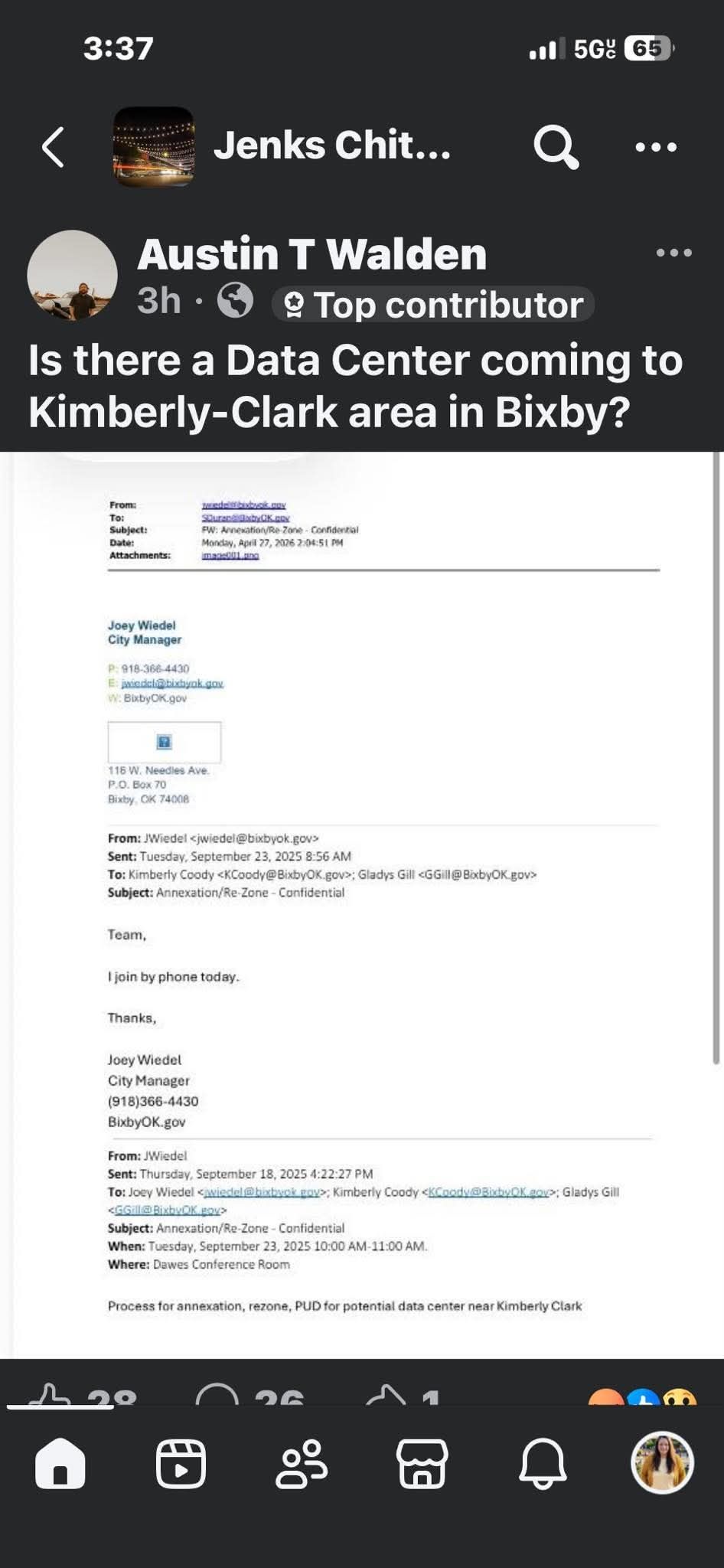
On September 18, 2025, at 4:22 in the afternoon, an email went out from Joey Wiedel's account.
Wiedel was Bixby's city manager — a man who had worked his way up from firefighter to fire chief to interim city manager to permanent appointment in March 2025. The email went to Wiedel himself, to Kimberly Coody, and to Gladys Gill, all of the City of Bixby.
The subject line: "Annexation/Re-Zone — Confidential."
The meeting details: Tuesday, September 23, 2025, 10:00-11:00 AM, Dawes Conference Room.
The agenda item, stated plainly in the calendar entry: "Process for annexation, rezone, PUD for potential data center near Kimberly Clark."
Five days later, on September 23, Wiedel sent a follow-up to Coody and Gill: "Team, I join by phone today." He would not be physically present for the meeting about secretly annexing land near one of Bixby's largest employers for a potential data center. He would dial in.
The residents of Bixby knew nothing about any of this.
They still might not know — if not for what happened on Highway 51 in Wagoner County at 10 o'clock on the night of May 25, 2026.
The City Manager, the Highway, and the 0.21
An EMS driver called 911. There was a reckless driver on Highway 51, east of Tulsa, running off the road multiple times. Officers responded and located a blue 2025 Ford F-150, its driver failing to maintain his lane.
Wagoner officers initiated a traffic stop at a gas station and identified the driver as Joey Wiedel. Officers noticed a strong odor of alcohol coming from the vehicle. Wiedel admitted to consuming several alcoholic beverages.
Wiedel's blood alcohol content measured more than two-and-a-half times the legal limit. The breath test came back at 0.21. He was unsteady on his feet. His eyes were bloodshot and watery. His speech was slurred.
Court records show Wiedel was previously arrested in Okmulgee in August 2025 for aggravated DUI and transporting an open container. Records show Wiedel entered a guilty plea and received a one-year deferred sentence.
He had just begun serving that deferred sentence when he was arrested again.
The City of Bixby suspended Wiedel from his duties as City Manager, and Police Chief Todd Blish was appointed to serve as Acting City Manager.
The city's statement was brief: "The City of Bixby is aware of the current situation regarding the arrest of City Manager Joey Wiedel. The City will continue to monitor the situation and provide updates as appropriate. No further information is available for release at this time."
No further information. That has been Bixby's posture on a lot of things lately.
The Email That Changed Everything
When Wiedel's arrest became public, something else became public too.
Ron Durbin — the disbarred Tulsa attorney turned Guerrilla Publishing social media personality — posted the confidential annexation emails on his Facebook page, which has 74,000 followers. The post went up eight hours after the DUI news broke.
"So about that 'SECRET' Bixby Data Center," Durbin wrote. "Well well well. While everyone was focused on Joey Wiedel's DUI arrest, we stumbled across emails referencing meetings about a potential DATA CENTER project involving annexation, rezoning, utilities, and planning discussions near Kimberly Clark."
He added: "Apparently 'Annexation/Re-Zone — Confidential' is not exactly subtle naming strategy, guys."
And then, in a line that would have been darkly funny if the stakes weren't so serious: Durbin asked whether "the stress of hiding a data center" had led to Wiedel's DUI.
There are several things worth noting about Ron Durbin's Bixby post.
First: the emails he published are dated September 2025 — eight months ago. He published them the same day as the DUI arrest. This raises a question nobody in Durbin's 74,000 followers appears to have asked: How long has Durbin had these emails, and why did he wait until Wiedel's most vulnerable moment to publish them?
Second: Durbin is presenting himself as the community's watchdog against secret data center deals being negotiated behind closed doors. He is celebrated for this role. His followers share his posts. They call him a hero.
Third — and this is the part his followers don't know — Ron Durbin was disbarred by the Oklahoma Supreme Court on October 21, 2025, on 115 counts of professional rule violations including dishonesty, fraud, and deceit. All nine justices. Unanimous. The court called his case "almost in a class by itself."
And before his disbarment, Ron Durbin represented a man named August Wakat — a Marine veteran whose land sat directly in the path of a data center corridor that became, six weeks after Wakat lost his case, the site of a $1 billion Meta facility.
Wakat alleges that $150,000 in earnest money went missing while Durbin was his attorney.
Wakat went bankrupt.
Ron Durbin went on to build a brand exposing secret data center deals.
The Playbook — How Secret Annexations Work in Oklahoma
To understand what happened to August Wakat, what is allegedly happening in Bixby, and what has already happened in Claremore, Sand Springs, Catoosa, Coweta, Owasso and communities across Green Country, you need to understand the annexation playbook.
It works like this:
A developer identifies land they want for a data center. The land is typically in an unincorporated area — outside any city's limits — which means it falls under county jurisdiction with different zoning rules, different tax structures, and no city utility infrastructure.
The developer needs the land inside a city. They approach the city manager — not the city council, not the public — in confidential preliminary discussions. Many city councils and counties sign non-disclosure agreements with data center developers long before the public learns anything at all, and before the backroom deals begin to take shape.
The city annexes the land. Sometimes this requires the property owner's consent. Sometimes cities use "string connector" annexations — narrow strips of land connecting the target parcel to existing city limits — to claim contiguity and annex without broader community input.
The rezoning follows. The public learns about it at a planning commission hearing, weeks or months after the deal is structurally complete.
By the time residents show up to object, the city's position is already set. The developer's lawyers are already filing. The community's options — lawsuits, recalls, protests — face an uphill battle against a deal that city officials insist was done legally and properly.
This pattern has played out identically across Green Country:
In Sand Springs: The Sand Springs City Council hid the Project Spring Google data center project and their eventual plans for well over six months, failing in their role as representatives. The Protect Sand Springs Alliance filed a lawsuit contending the City improperly annexed the site, alleging the city bypassed necessary legal procedures and statutory requirements during the annexation process. Plaintiffs argued that the official basis for expanding the city limits relied on the property touching a previous strip of land annexed in 1966, and alleged an ordinance from the 1970s did away with that annexation decades ago. Two weeks after the project was announced publicly, residents marched into City Hall with recall paperwork. The entire city council now faces recall.
In Claremore: On New Year's Day 2026, Ron Durbin published internal emails showing Claremore city officials had negotiated a confidential data center deal with Beale Infrastructure — Project Mustang — over the holidays. The community was furious. Residents packed city council chambers. Standing-room crowds. Durbin was celebrated as the man who exposed what power tried to bury.
In Coweta: The city annexed the land and has a contract of sale with Beale Infrastructure. But the deal hasn't closed, and the area would need to be rezoned. The community learned about it after the annexation was already complete.
In Catoosa/Fair Oaks — the case that started years before any of the others: A 2001 annexation document with alleged defects — no notary seal, no filing numbers, no proper statutory notice — brought August Wakat's land into the City of Tulsa's jurisdiction. The Wagoner County Land Records Clerk later confirmed in writing that the property was not within the City of Tulsa's legitimate annexation. No court has ruled on the merits of that claim. Every dismissal has been procedural.
The annexation playbook is not unique to Oklahoma. In Augusta Township, Maine, residents are attempting to oust their city council over the rezoning of land for a data center by Thor Equities Group. But Oklahoma has become a particular flashpoint, and Green Country — with its combination of available land, access to power infrastructure, and proximity to Tulsa's fiber networks — has become the epicenter.
What They're Building — and Why They Want Your Land
To understand why communities are fighting so hard, and why developers are paying so much, you need to understand what a modern AI data center actually is.
These are not the server farms of the early internet. The facilities being proposed across Green Country are hyperscale AI computing campuses — massive, power-hungry, water-intensive infrastructure built to run the large language models and AI systems that major tech companies are racing to deploy.
Project Anthem — the Meta facility that broke ground at Fair Oaks Innovation Park on April 21, 2026 — will span more than 2 million square feet. It is Meta's 28th data center in the United States. Governor Kevin Stitt celebrated it as a $1 billion investment generating $3.3 billion in economic activity during construction.
Project Spring — the Google data center proposed for Sand Springs — would cover 827 acres of farmland. Residents voiced concerns about a doubling of their utility bills, concerns that fell on deaf ears when the Sand Springs city council approved rezoning in a 6-1 vote despite overwhelming public opposition.
Project Clydesdale — Beale Infrastructure's Owasso campus — received Tulsa County tax exemptions in September 2025. Project Atlas — Beale's Coweta proposal — is pending. Project Mustang — Beale's Claremore deal — was negotiated in secret over Christmas.
And now: an unnamed potential data center near Kimberly Clark in Bixby, discussed in confidential meetings by a city manager now suspended for his second aggravated DUI in nine months.
The big lie surrounding this issue is that data centers are inevitable, and we should just accept it. That is the message communities keep receiving from city officials who signed NDAs before the public knew anything was happening. Oklahoma City leaders placed a moratorium on data centers, with officials saying the pause ensures the city moves forward strategically so future projects align with the community's needs and support sustainable, long-term growth. Tulsa city councilors also approved a data center moratorium at the end of March 2026, saying they wanted more time to study data center impacts before any more centers were approved.
Moratoriums. Recalls. Lawsuits. A city manager arrested drunk on the highway while his confidential annexation emails circulate on social media.
This is what Oklahoma's data center boom looks like from the ground.
Ron Durbin — The Man in Every Story
Ron Durbin is everywhere in this story, and the nature of his presence shifts depending on which community you are looking at.
In Catoosa, he was an attorney — or allegedly was. August Wakat hired him. $150,000 went missing. Wakat went bankrupt.
In Claremore, he was a hero — on New Year's Day, 74,000 followers, exposed the secret deal, packed the council chambers.
In Bixby, he is the revealer — publishing confidential emails on the same day the city manager was arrested, positioning himself once again as the man who told you what they tried to hide.
Who is Ron Durbin, really?
He is, by his own account, a man transformed by a heart attack in 2020. He traded his law practice for a camera on a stick he calls the Gandalf Stick, launched Guerrilla Publishing — "Oklahoma's independent investigative newsroom exposing corruption, government secrecy, and abuse of power" — and built a following of 74,000 people who believe he is fighting for them.
He ran for Congress in Oklahoma's First District on a platform of auditing government spending and holding power accountable. His campaign website declared he was "the only candidate in this race who has actually held power accountable, at personal cost."
At personal cost.
On October 21, 2025, the Oklahoma Supreme Court disbarred Ronald Edward Durbin II. All nine justices. Unanimous. 115 counts of professional rule violations. Justice James Edmondson, writing for the court, found violations in 18 of 20 counts of misconduct. The disbarment was made retroactive to April 8, 2024.
The court found that Durbin brought retaliatory lawsuits against his ex-wife and neighbors "for the sole purpose of causing certain defendants to incur legal expenses." He threatened opposing counsel in a courthouse elevator. He screamed at a district court judge in a courthouse hallway, calling her "drunk," and provided no evidence to support the claim.
The key rule violations included Rule 8.4(c): dishonesty, fraud, deceit, and misrepresentation.
The disbarment was consolidated with a Rule 7 summary disciplinary action arising from Durbin's nolo contendere plea under 21 O.S. §136 — a criminal statute.
The Ethics Reporter, an independent legal ethics publication that had no prior connection to this investigation, noted the following in its March 2026 analysis of the Durbin disbarment:
"And then there were the community reports — never formally adjudicated in this proceeding but circulating through local accounts — of $150,000 in stolen earnest money. Whether or not those allegations ultimately find their way into a separate legal proceeding, they form part of the broader picture of an attorney who treated every relationship — with clients, with colleagues, with courts — as terrain to be exploited."
The Ethics Reporter identified the $150,000 independently. They were not writing about August Wakat. They were writing about Ron Durbin.
August Wakat — The Man Who Saw It First
Before Claremore. Before Bixby. Before the Tulsa moratorium. Before Sand Springs. Before any Green Country community knew what Project Anthem or Project Mustang or Project Spring were —
August Wakat was already fighting.
The Marine veteran and owner of Poe Boy Fleming Auto Salvage, Inc., filed his first court documents in Tulsa County in August 2023. He identified the development corridor. He named the project. He alleged defective annexation documents. He subpoenaed developers, city officials, and planning commissioners. He filed a formal zoning protest petition with TMAPC. He put up a billboard on Highway 412.
He did all of this while bankrupt, without legal representation, from a rental house in Trinidad, Colorado.
No court has told August Wakat he was wrong about the facts. Every dismissal he received was procedural. The annexation document at the center of his case — a 2001 "Consent to Annexation" signed by the Ann Landrith Trust — allegedly lacks a notary seal, filing numbers, and abstract references required by Oklahoma law. The Wagoner County Land Records Clerk confirmed in writing that the property is not within the City of Tulsa's legitimate annexation area.
The same legal argument — improper annexation, failure to follow Oklahoma statutory requirements, string-connector contiguity violations — is now being made by Sand Springs residents in a lawsuit that has received national press coverage in NBC News, the Tulsa World, and the Tulsa Flyer.
When Sand Springs residents made that argument, they were called concerned citizens. Their lawsuit was taken seriously. Their lawyers were competent. Their recall effort made national news.
When August Wakat made the same argument, he was dismissed. On procedure. Every time.
The difference between August Wakat and the Sand Springs Alliance is not the argument. The argument is identical. The difference is that Wakat had no lawyer — because the lawyer he hired allegedly took his money and left him bankrupt.
Six weeks after Wakat signed away his claims, Meta broke ground.
The Accountability Gap
There is a specific, documented accountability gap at the center of this story that no institution has yet moved to close.
The Oklahoma Bar Association disbarred Ron Durbin on 115 counts of professional rule violations. The disbarment proceeding, however, did not formally adjudicate the $150,000 missing earnest money claim. The Oklahoma Bar Association maintains a Client Security Fund specifically for victims of attorney theft. Whether Wakat has filed a claim — and whether the Bar has investigated the specific allegation of client fund theft — is unknown.
The courts have dismissed Wakat repeatedly on procedural grounds without reaching the merits of his annexation claims. The identical annexation claims raised by Sand Springs residents have been taken seriously by the same court system. No court has explained why one community's annexation challenge deserves a hearing on the merits while another's is dismissed on procedure.
The City of Bixby held confidential meetings about annexing land for a data center in September 2025. Its city manager — the man who arranged those meetings — was arrested for his second aggravated DUI eight months later. The city's response to both the data center emails and the DUI arrest has been: "No further information is available for release at this time."
The federal government — specifically the Department of Justice Inspector General — has oversight of ARPA funding compliance. Wakat's federal filings allege ARPA funds were misused in connection with infrastructure serving the data center corridor in Creek County. That allegation has not been investigated or dismissed.
Ron Durbin himself continues to operate. His Guerrilla Publishing page has 74,000 followers. He publishes confidential government emails. He exposes secret data center deals. He asks whether city managers' stress about hiding data centers caused their DUIs. He positions himself as Oklahoma's last honest watchdog.
And August Wakat is in Trinidad, Colorado.
What Bixby Deserves to Know
The residents of Bixby deserve answers to questions their city government has not been asked publicly.
What is the status of the potential data center near Kimberly Clark? The confidential meetings happened in September 2025. Eight months have passed. Has a deal been signed? Has land been annexed? Has rezoning been applied for? Has the city council been informed? Has the public been informed?
Who is the developer? The emails reference a "potential data center" but do not name the company. Is it Beale Infrastructure — the company behind Project Mustang in Claremore, Project Clydesdale in Owasso, and Project Atlas in Coweta? Is it Meta, whose Fair Oaks campus just broke ground? Is it Google, whose Project Spring is under litigation in Sand Springs? The public has a right to know.
Why was the process labeled "Confidential"? Oklahoma's Open Meeting Act and Open Records Act exist precisely to prevent city government from conducting public business in secret. Was a non-disclosure agreement signed? If so, with whom, and what does it prohibit the city from disclosing to its own residents?
What is Joey Wiedel's future as city manager? Wiedel had just begun serving a one-year deferred sentence tied to his previous DUI case when he was arrested again. He was the person organizing and attending confidential annexation meetings for a potentially transformative development project. His continued employment — or termination — will signal what Bixby's city council believes about accountability.
The Highway and the Billboard
Two images define this story.
On Highway 51 in Wagoner County, a city manager's truck runs off the road multiple times at 10 o'clock on a Monday night. His blood alcohol is 0.21. He has done this before. He is the man who scheduled confidential meetings about annexing land for a data center his community knew nothing about.
On Highway 412 in Catoosa, a billboard stands above a shuttered salvage yard. It reads: "BLACKROCK ELECTION FRAUD. No Area Map of Fair Oaks, Oklahoma. CV-2023-1583." It was put up by a Marine veteran who went bankrupt — allegedly because his attorney took $150,000 of his money — while his land was consumed by a development corridor that became, six weeks after he surrendered his claims, the site of a $1 billion Meta data center.
These two images are connected. They are connected by a pattern of secret annexations, confidential meetings, NDA-gagged city officials, and communities that find out what happened to their land only after the deal is done.
They are connected by the question that Green Country communities from Bixby to Sand Springs to Catoosa are now all asking simultaneously:
Why didn't anyone ask us?
And they may be connected — at least in Catoosa — by Ron Durbin, the disbarred attorney who built 74,000 followers exposing data center deals done in secret, and who allegedly left the man who trusted him unable to stop one.
A Note on What Warrants Independent Investigation
The following specific questions in this report are answerable through public records and warrant investigation by journalists, attorneys, and public officials:
- Bixby data center identity — Which developer is behind the Kimberly Clark area data center? A records request to the City of Bixby under Oklahoma's Open Records Act should produce all communications related to "Annexation/Re-Zone — Confidential" meetings held in September 2025.
- Oklahoma Bar Client Security Fund — Has August Wakat filed a claim for the missing $150,000? Has the Bar investigated the specific allegation of client fund theft against Durbin? The Bar's public records should reflect any such claim.
- The 2001 Catoosa annexation — The Wagoner County Land Records Clerk's letter confirming Wakat's property is not within the City of Tulsa's legitimate annexation is a public record. A title search of the properties at 23610, 23780, and 23882 East Admiral Place, Catoosa, Oklahoma 74015 would resolve this question definitively.
- The $12 million Lamar Advertising lien — Document Nos. 2025-3667 and 2024-9081 are recorded instruments. Their contents are public. What does a $12 million lien on a property in a disputed annexation zone mean for the development of that corridor?
- ARPA funding in Creek County — Wakat's federal filings allege misuse of American Rescue Plan Act funds for infrastructure serving the development corridor in Creek County. The DOJ Inspector General's office accepts tips and has jurisdiction over ARPA compliance.
- Ron Durbin's other clients — If Durbin systematically used client relationships to gain inside knowledge of development corridors — and then built a public brand exposing those corridors after his clients lost — there may be other victims. The Oklahoma Bar Association has records of all complaints filed against Durbin.
This report is based on court documents filed in Tulsa County District Court Cases CV-2023-1583 and CV-2024-2320; United States District Court Case No. 1:25-CV-04134-LTB; United States Court of Appeals for the Tenth Circuit Case No. 26-1029; Oklahoma Supreme Court Case No. SCBD-7528; probable cause affidavit, Muscogee Creek Nation v. Wiedel, Joel Edward Junior, dated May 25, 2026; internal City of Bixby email correspondence obtained through public disclosure; published reporting from KJRH, NewsOn6, the Tulsa World, the Tulsa Flyer, NonDoc, KRMG, KTUL, FOX23, NBC News, KOSU, the Broken Arrow Sentinel, OKC Fox, Oklahoma Energy Today, the Claremore Daily Progress, and The Ethics Reporter; and published statements from the City of Bixby, City of Sand Springs, City of Tulsa, and Protect Sand Springs Alliance.
All named parties have the right to respond to allegations in this report. Ron Durbin, Joey Wiedel, Joe Robson, the City of Bixby, the City of Tulsa, and Lamar Advertising Company should be contacted for comment prior to final publication. No court has adjudicated the factual merits of August Wakat's property claims.